
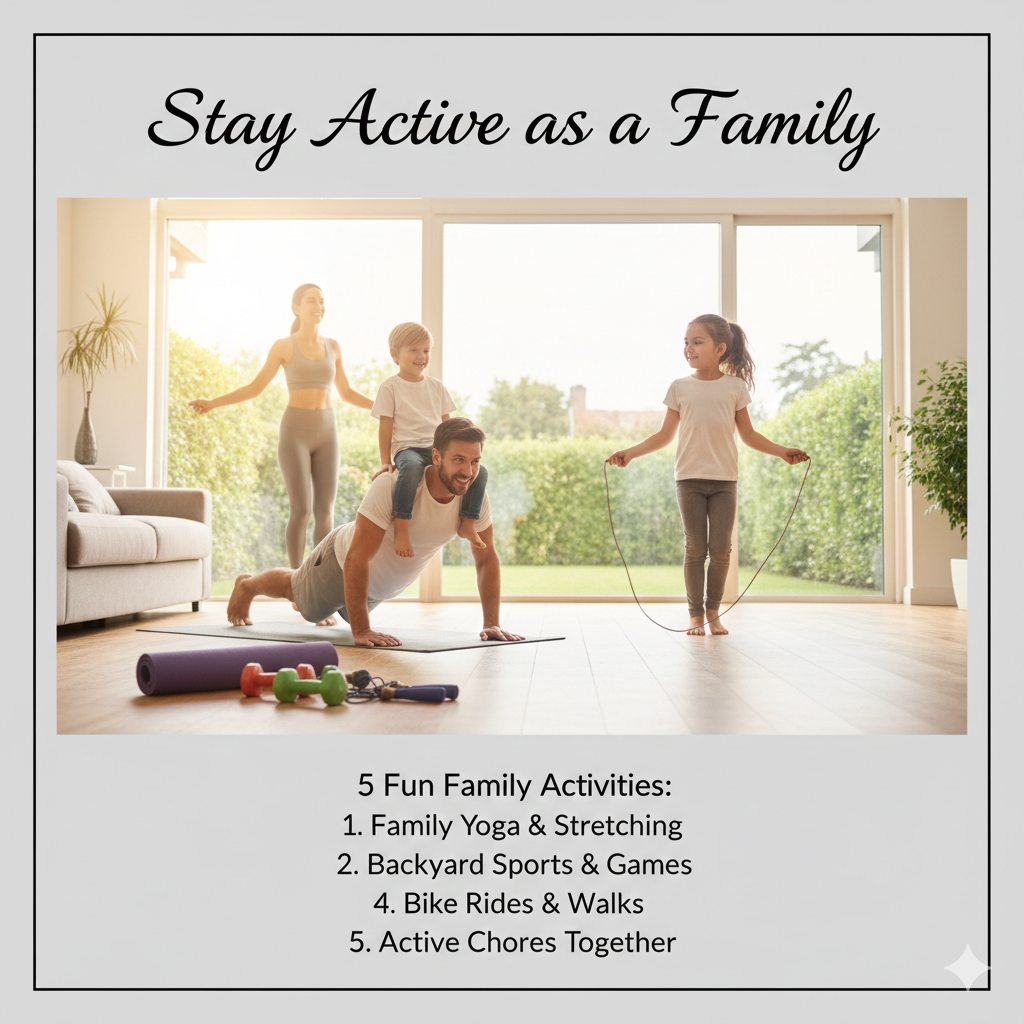
Busy schedules, school commitments, and long workdays can make movement feel optional rather than essential. Yet the most sustainable approach to health is rarely built on individual willpower alone. When activity becomes a shared family practice, it is easier to maintain, more enjoyable, and far more likely to shape lifelong habits. Learning how to stay active as a family does not require a home gym or elaborate plans—only intentional choices that invite everyone to move, consistently and together.
Why Staying Active as a Family Matters
Physical, Mental, and Emotional Benefits of Family Activity
Regular movement supports cardiovascular health, bone density, coordination, and healthy weight management for children and adults alike. For kids, physical activity strengthens developing muscles and motor skills while improving posture, balance, and confidence in their bodies. For parents, it helps counteract sedentary work patterns, reduces stiffness, and improves energy levels throughout the day.
The benefits extend well beyond the physical. Activity is a proven stress regulator, supporting mood through improved sleep quality and healthier hormonal balance. Children often manage anxiety better when they have consistent outlets for movement, and adults may find that a brisk walk or short circuit resets their focus more effectively than additional screen time. Emotionally, shared activity creates moments of success, laughter, and mutual encouragement—small experiences that accumulate into a more resilient household.
How Active Families Build Stronger Bonds and Better Habits
Family routines are powerful because they shape identity. When your household regularly chooses movement—whether that means evening walks, weekend hikes, or short easy family exercises at home—children internalize that physical activity is a normal part of life rather than a special event. This creates an active family lifestyle that feels natural, not forced.
Shared movement also strengthens relationships. Activities that require cooperation—such as a scavenger hunt, a relay, or a bike ride with shared route decisions—encourage communication without the intensity of a formal “talk.” They provide a neutral space for connection. Over time, these repeated interactions make it easier to support one another in other areas of life, from school challenges to work stress.
Getting Started: Setting Your Family Up for Active Success
Assessing Your Family’s Current Activity Level and Goals
Before adding new family fitness activities, take stock of what is already happening. Consider your typical week: how much time is spent sitting, how much time is spent walking, and which moments are consistently available. Many families discover that the best opportunities are not weekends but the transitional parts of the day—after school, before dinner, or immediately after work.
Next, define goals that are realistic and measurable. Instead of aiming for “more exercise,” aim for “a 20-minute walk four nights per week” or “two active outings each weekend.” If you have young children, goals should emphasize participation and enjoyment rather than performance. For older kids, light structure—such as learning a new skill or improving endurance—can be motivating when framed as personal progress.
Overcoming Common Barriers to Staying Active as a Family
Time is the most cited obstacle, but it is often a scheduling problem rather than an absolute limitation. Short sessions are highly effective; a 10-minute burst of movement after school, another 10 minutes before dinner, and a longer activity on the weekend can add up quickly. Treat movement as a recurring appointment, not a filler activity.
Different ages and abilities can complicate planning. The solution is to rotate formats: one day may focus on toddler-friendly play, another on a parent-led workout with modifications, and another on a group walk where everyone can participate. Choose activities with adjustable intensity, such as hiking, swimming, dancing, or circuit stations where each person selects their level.
Motivation tends to drop when movement feels like punishment. Prioritize options that are intrinsically enjoyable: games, challenges, music-based routines, or exploring new parks. When you need structure, make it brief and upbeat. If you are searching for fun ways to exercise with kids, the best indicator is simple—would they ask to do it again?
Weather and space are also common constraints. Keep an “indoor activity menu” for rainy or cold days, and an “outdoor default” for pleasant weather. That small level of planning eliminates decision fatigue, which is often what derails good intentions.
Fun Ways to Stay Active Together Every Day
Indoor and Outdoor Activities the Whole Family Will Enjoy
Variety prevents boredom and supports different aspects of fitness—strength, mobility, endurance, and coordination. The following family workout ideas are adaptable for most ages and require minimal equipment.
Indoor options
- Family circuit stations: Set up 5–8 stations (squats to a chair, wall push-ups, jumping jacks or marching, plank holds, stair climbs). Rotate for 30–45 seconds each, resting briefly between rounds.
- Dance sessions: Choose a playlist and alternate who leads. Add simple rules—such as a “freeze” cue—to keep kids engaged while increasing heart rate.
- Hallway movement challenges: Bear crawls, crab walks, or lunges from one end to the other. This works well for small spaces and builds coordination.
- Yoga or mobility flow: Keep it short (8–15 minutes). Use simple poses and let kids “teach” one pose each, which increases ownership.
- Active chores: Turn tidying into a timed relay. Carrying laundry baskets, sweeping briskly, or organizing a room can be surprisingly effective when approached with purpose.
Outdoor options
- Neighborhood walks with a purpose: Add a photo scavenger hunt, counting challenges, or “walk-and-talk” prompts to make the time feel meaningful.
- Bike rides and scooter loops: Choose routes with safe turnaround points. Parents can increase intensity by adding brief intervals or hills.
- Park circuits: Use benches for step-ups, rails for incline push-ups, and open areas for short sprints, skipping, or ball games.
- Nature hikes: Keep younger children engaged by assigning roles—navigator, “wildlife spotter,” or map reader.
- Backyard games: Tag variations, relay races, or obstacle courses with chalk and cones. These are some of the most effective outdoor activities for families because they combine play and fitness naturally.
If your family is wondering how to get kids moving consistently, lean into autonomy. Provide two or three activity choices and let them decide. The goal is to reduce resistance by giving children a sense of control while still keeping the household active.
Screen‑Time Swaps: Simple Daily Routines to Keep Everyone Moving
Screen time is not inherently negative, but it often crowds out movement. Instead of attempting sudden restrictions, use practical substitutions that preserve convenience. Think in terms of “movement anchors”—short routines tied to predictable moments in the day.
- Before-school reset (5–8 minutes): A brisk walk to the bus stop, a quick mobility routine, or a short dance song to start the morning with energy.
- After-school transition (10 minutes): Outdoor play, a driveway basketball shoot-around, or a mini circuit before homework.
- Pre-dinner movement (10–15 minutes): A family walk, stair intervals, or an indoor obstacle course while dinner is finishing.
- Evening wind-down (8–12 minutes): Gentle stretching or yoga to support sleep and reduce restlessness.
These swaps are especially effective because they do not demand large blocks of time. Over a week, they create meaningful volume of activity while keeping expectations reasonable. They also function as reliable family physical activity tips because they build habits through repetition rather than enthusiasm alone.
Making Family Fitness a Long-Term Lifestyle
Creating a Weekly Family Activity Plan That Sticks
A plan succeeds when it is simple, visible, and adaptable. Start with three categories: daily movement, two structured sessions, and one outdoor outing. Then adjust based on school schedules and energy levels.
- Daily baseline: 15–30 minutes of light-to-moderate activity (walk, bike, dance, active play).
- Two “family fitness” blocks: 20–30 minutes each of circuits, sports practice, swimming, or longer rides.
- One weekend adventure: A hike, park day, family sports game, or exploring a new trail—an easy way to accumulate time outdoors.
Place the plan where everyone can see it—on the refrigerator or a shared digital calendar. Keep the language inviting: “park loop” sounds more appealing than “cardio,” and “family challenge” feels more collaborative than “workout.” Rotate leadership so children sometimes choose the activity; it increases engagement and reduces the burden on parents.
Also build in contingency options. If weather changes, switch the hike to an indoor circuit. If a late work meeting disrupts the evening, do a 10-minute routine instead of skipping entirely. Consistency matters more than perfection when you are trying to stay active as a family over months and years.
Motivating Kids (and Parents) to Stay Active All Year Round
Motivation is easiest to maintain when progress is visible and rewards are meaningful. For children, celebrate participation: completing a weekly streak, trying a new activity, or improving a personal best. For parents, focus on outcomes that matter in daily life—more energy, better sleep, fewer aches, and improved mood.
Use simple frameworks that encourage follow-through without turning movement into a negotiation:
- Make it social: Invite another family for a weekend walk or park game. Shared accountability reduces drop-off.
- Track gently: A family calendar with check marks, a step goal on weekends, or a “try one new activity per month” list supports momentum without pressure.
- Emphasize skill-building: Learning to ride a bike confidently, improving a swimming stroke, or mastering a new yoga pose makes activity feel purposeful.
- Keep equipment minimal but ready: A jump rope, a light ball, resistance bands, and comfortable shoes remove friction and support easy family exercises at home.
Finally, model the behavior you want to see. Children notice whether adults treat movement as a chore or as a valued form of self-care. When parents participate with consistency—and a calm, practical attitude—kids are far more likely to view activity as a normal and rewarding part of life.
Conclusion
Building an active family lifestyle is not about transforming your household overnight; it is about creating repeatable moments of movement that fit your real schedule. Start by identifying small windows in the day, choose activities that work across ages, and keep the focus on connection as much as fitness. With a simple plan, a few dependable screen-time swaps, and a rotating menu of indoor and outdoor activities for families, you can make movement a shared routine—one that strengthens health, relationships, and long-term habits for everyone at home.