
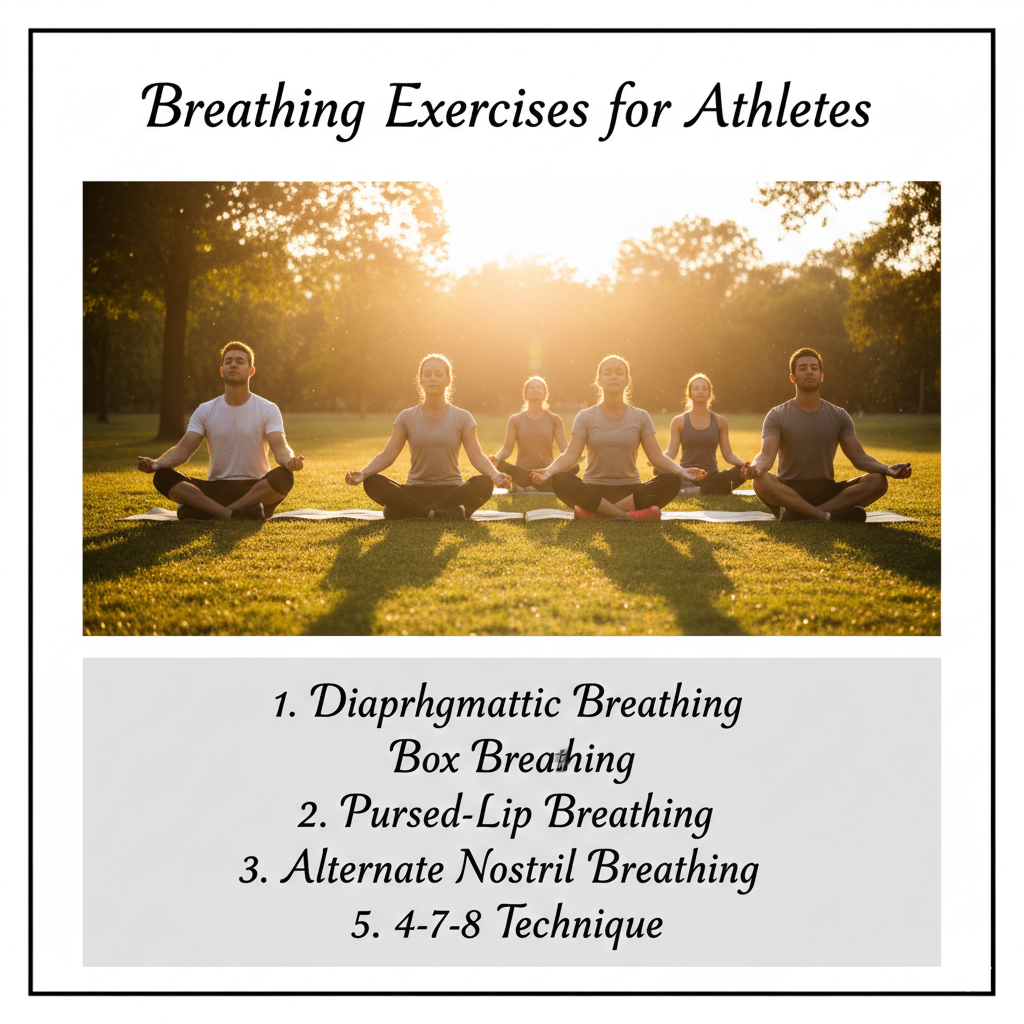
Breathing is the only performance system you can adjust in real time—mid-rep, mid-stride, or under pressure—without equipment. Yet many athletes treat it as automatic background noise rather than a trainable skill. The result is avoidable fatigue, inconsistent pacing, and recovery that lags behind the demands of training.
This guide breaks down five high-impact breathing exercises for athletes, each chosen for a specific performance outcome: endurance, focus, efficient oxygen use, controlled exertion, and heart-rate regulation. You will learn practical, step-by-step athletic breathing techniques and exactly when to apply them in warm-ups, workouts, and recovery.
Understanding the Power of Breathing for Athletic Performance
Why Breathing Mechanics Matter for Athletes
Breathing mechanics shape how efficiently you move air, how well you stabilize your trunk, and how quickly you can downshift from stress to recovery. Efficient breathing reduces the work done by accessory muscles in the neck and shoulders, conserving energy for sport-specific output. It also supports better ribcage expansion, improved posture under fatigue, and more consistent pacing.
In performance terms, better mechanics can help you improve endurance with breathing by lowering perceived exertion, delaying the onset of “air hunger,” and improving tolerance to rising carbon dioxide levels. In recovery terms, controlled breathing influences the autonomic nervous system, helping you restore a calmer baseline and making sleep more accessible after intense sessions.
Common Breathing Mistakes That Limit Performance
- Shallow chest breathing: Over-recruiting the upper chest and neck increases tension, reduces efficiency, and can disrupt rhythm during sustained efforts.
- Unstable breathing cadence: Irregular inhale/exhale timing often leads to erratic pacing and premature fatigue in endurance and mixed-modal sports.
- Constant mouth breathing at low intensities: Over time, it can reinforce inefficient patterns and make nasal breathing feel “impossible,” even when effort is easy.
- Holding the breath unintentionally: Common during lifting, change-of-direction drills, or under stress; it spikes pressure and can cause early burnout or dizziness.
- Skipping recovery breathing: Training ends, but the nervous system remains elevated. Without intentional downregulation, recovery quality suffers.
Breathing Exercise #1: Diaphragmatic Breathing for Better Endurance
Diaphragmatic breathing trains you to use the diaphragm effectively, reducing the reliance on accessory breathing muscles and supporting smoother ventilation during sustained work. For many athletes, this is the foundational diaphragmatic breathing workout that improves comfort under load and helps establish a stable breathing rhythm.
Step-by-Step Guide to Diaphragmatic Breathing
- Set your position: Start lying on your back with knees bent, feet flat. Place one hand on your upper chest and the other on your lower ribs or abdomen.
- Inhale through the nose: Breathe in slowly for 3–4 seconds. Aim for expansion in the lower ribs and abdomen while keeping the upper chest relatively quiet.
- Pause gently: Hold for 1 second without bracing or tensing.
- Exhale steadily: Exhale through the mouth for 4–6 seconds. Let the ribs soften down and in; avoid forceful pushing.
- Progress to sport posture: Repeat the same pattern seated, then standing, then in an athletic stance. The goal is portability—usable under movement and fatigue.
When and How Often Athletes Should Practice Diaphragmatic Breathing
Practice 5–10 minutes, 4–6 days per week. Use it in two primary windows:
- Skill-building: After training or on recovery days, when you can focus on mechanics.
- Warm-up primer: 2–3 minutes before sessions to establish rhythm and reduce unnecessary tension in the shoulders and neck.
Consistency matters more than intensity. The aim is to make diaphragmatic breathing your default under moderate effort, not a technique you only access when lying on the floor.
Breathing Exercise #2: Box Breathing for Focus and Recovery
Box breathing is a structured pattern—equal counts for inhale, hold, exhale, hold—used to sharpen attention and regulate arousal. It is particularly valuable as box breathing for sports performance when nerves, distraction, or adrenaline interfere with execution.
How to Perform Box Breathing Correctly
- Choose a count: Start with a 4–4–4–4 pattern (seconds). If 4 seconds feels too long, use 3–3–3–3.
- Inhale: Breathe in through the nose for 4 seconds.
- Hold: Hold for 4 seconds with relaxed face and shoulders.
- Exhale: Exhale through the nose or lightly through the mouth for 4 seconds, slow and controlled.
- Hold: Hold for 4 seconds before the next inhale.
- Repeat: Complete 4–8 cycles (approximately 2–5 minutes).
Benefits of Box Breathing for Pre-Competition Nerves
Pre-competition arousal is not the enemy; mismanaged arousal is. Box breathing creates a repeatable pre-event routine that anchors attention and smooths physiological spikes. Athletes often report clearer decision-making, steadier hands, and improved timing—particularly in sports requiring precision, tactical awareness, or composure under pressure.
Use this technique as a practical answer to how to control breathing in sports when the environment feels unpredictable. The structure itself becomes the stabilizer.
Breathing Exercise #3: Nasal Breathing for Efficient Oxygen Use
Nasal breathing encourages a slower respiratory rate, improves humidification and filtration of air, and supports better control over ventilation at lower intensities. For endurance athletes, especially, nasal breathing for runners can become a powerful tool for pacing discipline and aerobic development.
Technique: Transitioning from Mouth to Nasal Breathing
- Start below threshold: Choose an intensity where you can maintain nasal breathing comfortably—often Zone 1–2 or an easy conversational pace.
- Inhale through the nose, exhale through the nose: Maintain relaxed jaw and tongue posture. Keep shoulders down.
- Shorten the stride or reduce load: If you feel air hunger, lower intensity immediately rather than switching to mouth breathing.
- Use a “bridge” if needed: Inhale nasally, exhale through the mouth for a few minutes, then return to nasal-only.
- Build duration: Add 2–5 minutes of nasal-only breathing per session until it becomes sustainable.
Nasal Breathing Drills for Training and Low-Intensity Sessions
- 10-minute nasal-only warm-up: Easy pace, nasal breathing throughout. If you cannot maintain it, the pace is too high.
- Nasal cadence intervals: Alternate 3 minutes nasal-only with 2 minutes normal breathing for 20–30 minutes.
- Cool-down constraint: Last 5–8 minutes of training nasal-only to reinforce downshifting and recovery control.
These drills are not about forcing discomfort. They are about building efficiency and restraint—often the missing ingredient in endurance development.
Breathing Exercise #4: Pursed-Lip Breathing for Controlled Exertion
Pursed-lip breathing extends exhalation and helps maintain airway pressure, making it useful during rising effort. Many athletes find it immediately practical in intervals, hill work, and high-rep strength circuits where breathing can become frantic.
How to Practice Pursed-Lip Breathing During Workouts
- Inhale: Breathe in through the nose for about 2 seconds.
- Purse the lips: As if you were gently blowing through a straw.
- Exhale longer than you inhale: Exhale for about 4 seconds—smooth, not forced.
- Match to movement: Pair the longer exhale with the hardest phase (e.g., standing on a climb, finishing a rep, accelerating out of a turn).
Using Pursed-Lip Breathing to Manage Fatigue and Pace
Under fatigue, athletes often over-inhale and under-exhale, which can intensify breathlessness and destabilize pacing. Pursed-lip breathing counters this tendency by emphasizing a controlled, longer exhale. In practice, it becomes one of the most accessible best breathing drills for athletes during hard efforts—especially when you need to stay composed without reducing intensity.
Use it tactically: during the last third of an interval, in the final minutes of a tempo effort, or late in a match when execution must remain crisp.
Breathing Exercise #5: Resonant (Coherent) Breathing for Heart Rate Control
Resonant breathing—often called coherent breathing—typically targets 5–6 breaths per minute. The goal is a calm, steady rhythm that supports heart rate variability and nervous system regulation. It is one of the most effective recovery breathing exercises for athletes who struggle to “turn off” after training.
Steps to Practice Resonant Breathing at 5–6 Breaths per Minute
- Get comfortable: Sit upright or lie down. Relax the jaw, shoulders, and hands.
- Inhale for 5 seconds: Through the nose, smooth and quiet.
- Exhale for 5 seconds: Through the nose or gently through the mouth, maintaining an unbroken stream of air.
- Continue for 5–10 minutes: Keep the breath light. If you feel strained, shorten to a 4-second inhale and 4-second exhale, then build back up.
How Resonant Breathing Supports Recovery and Sleep for Athletes
High training loads elevate sympathetic drive. Resonant breathing provides a reliable method to downshift, which can translate into improved post-session recovery quality and smoother transition into sleep. Used consistently, it can help athletes regain composure after competitions, reduce lingering restlessness, and improve next-day readiness—without adding mechanical stress to the body.
Integrating Breathing Exercises into Your Training Plan
When to Use Each Breathing Exercise (Warm-Up, Training, Recovery)
- Warm-up: Diaphragmatic breathing (2–3 minutes) to establish mechanics; nasal breathing (5–10 minutes) to set aerobic control.
- Training: Nasal breathing for low-intensity sessions; pursed-lip breathing during hard intervals or sustained efforts to regulate exertion.
- Pre-competition: Box breathing (2–5 minutes) to manage arousal and sharpen focus.
- Post-training and evenings: Resonant breathing (5–10 minutes) to accelerate downregulation and support recovery.
Athletes often make faster progress by selecting one primary technique for performance (nasal or pursed-lip, depending on sport demands) and one for recovery (resonant or box breathing), rather than attempting all five every day.
Tracking Progress and Performance Gains from Better Breathing
Breathing adaptations can be subtle, so track them with simple metrics:
- Perceived exertion at a fixed pace/load: If breathing is more efficient, the same work should feel easier.
- Ability to maintain nasal breathing: Longer duration at the same easy pace is a clear sign of improved control.
- Recovery speed between intervals: Note how quickly your breathing settles and how soon you feel ready for the next effort.
- Pre-competition composure: Assess mental clarity and early-game execution after box breathing routines.
Over time, these changes compound into measurable improvements in pacing, consistency, and readiness—key outcomes of refined athletic breathing techniques.
Safety Tips and Best Practices for Athletic Breathing Training
Who Should Modify or Avoid Certain Breathing Techniques
Breathing work should feel controlled and restorative, not dizzying or aggressive. Modify or seek clinical guidance if you have asthma that is not well-managed, cardiovascular conditions, panic disorder, or a history of fainting with breath holds. Reduce or avoid extended holds in box breathing if you experience lightheadedness, and never force nasal breathing at intensities that provoke distress.
Stop immediately if you feel chest pain, severe dizziness, tingling that escalates quickly, or unusual shortness of breath unrelated to effort. In those cases, consult a qualified healthcare professional.
How to Combine Breathing Work with Strength and Conditioning
In strength training, breathing should support bracing without rigidly locking the system. Use diaphragmatic practice to improve ribcage mobility and trunk control, then apply it under load with intention: inhale to prepare, exhale through effort when appropriate, and avoid accidental breath holding in high-rep fatigue.
For heavy lifts where bracing strategies are critical, follow coaching guidance specific to your sport and lifting style. Breathing training should complement—not compromise—technical stability and safe execution.
Conclusion
Elite performance is not only built in the legs, lungs, and heart; it is refined through control—especially when fatigue and pressure rise. These five methods—diaphragmatic breathing, box breathing, nasal breathing, pursed-lip breathing, and resonant breathing—offer a practical toolkit you can apply immediately, from endurance development to competition composure and recovery.
Start with one technique that matches your biggest constraint, practice it consistently, and integrate it into your routine with purpose. When breathing becomes a trained skill rather than an afterthought, the return is tangible: steadier pacing, sharper focus, and recovery that keeps up with ambition.