
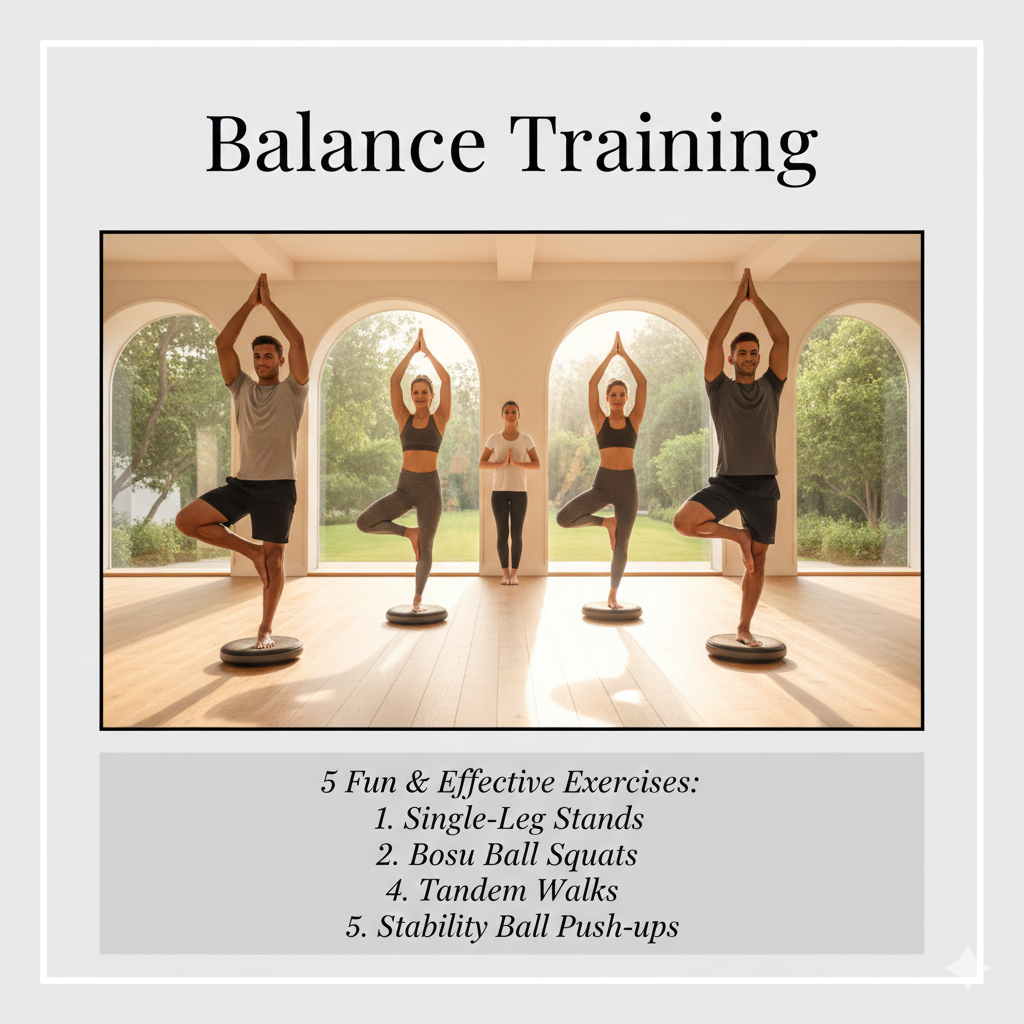
Balance is often treated as an athletic extra—useful for sports, optional for everyone else. In reality, it is a foundational capacity that shapes how you walk, climb stairs, carry groceries, and react to an unexpected misstep. A well-designed balance training routine refines coordination between the nervous system and the musculoskeletal system, improving control in both stillness and motion. Whether your goal is better performance, safer daily movement, or healthy aging, balance and stability workouts deserve a permanent place in your program.
The Importance of Balance Training
Understanding Balance Training and Why It Matters
What Is Balance Training? Definition and Key Components
Balance training is a structured method of improving your ability to maintain body control over your base of support—standing, stepping, reaching, turning, and transitioning between positions. It is not limited to “standing on one leg.” Effective functional balance training develops multiple systems simultaneously:
- Proprioception: your body’s awareness of joint position and movement, essential for precise foot placement and posture adjustments.
- Vestibular control: inner-ear input that helps stabilize vision and orientation during movement.
- Visual integration: the ability to use sight to regulate body sway and navigate changing environments.
- Neuromuscular coordination: timing and sequencing of muscle activation, especially in the feet, ankles, hips, and trunk.
- Core and hip stability: the platform that supports efficient limb movement and resists unwanted rotation or collapse.
Because balance relies on several interacting systems, the most productive balance exercises vary stance, surface, speed, and attention demands. The objective is not simply to “hold still,” but to cultivate adaptable control under realistic conditions.
How Balance Affects Everyday Movement and Functional Fitness
Balance is the silent partner of nearly every movement pattern. When you step off a curb, pivot to reach into a cabinet, or brace while lifting a suitcase, you are constantly managing shifting forces. Strong balance reduces “energy leaks” caused by poor alignment and delayed muscle response. It also enhances functional fitness by making movement more economical, confident, and resilient under fatigue.
Importantly, balance is rarely a single-task event in real life. You may be walking while looking at traffic, carrying a bag, or talking. Training balance under varied and occasionally distracting conditions prepares you for the complexity of everyday movement, where stability must be automatic rather than deliberative.
Health Benefits of Balance Training for All Ages
Physical Benefits: Strength, Stability, and Fall Prevention
The benefits of balance training extend beyond “not falling.” It strengthens the small stabilizers of the feet and ankles, enhances hip control, and improves trunk stiffness where needed—creating a body that can accept and redirect force efficiently. Over time, balance training can support:
- Improved joint stability: particularly at the ankle, knee, and hip, where uncontrolled motion can contribute to strain.
- Better movement mechanics: cleaner squats, smoother lunges, more consistent gait, and safer deceleration.
- Injury risk reduction: by improving reactive control when you slip, land awkwardly, or change direction quickly.
- Enhanced strength expression: because stability is a prerequisite for producing force efficiently.
For older adults, the value becomes even more direct. Balance training for seniors is one of the most practical strategies for maintaining independence. Targeted fall prevention exercises improve postural control, stepping reactions, and confidence during daily tasks such as bathing, getting up from a chair, or walking on uneven ground.
Cognitive and Long-Term Health Benefits of Better Balance
Balance is not purely muscular; it is deeply neurological. Many balance drills demand attention, error correction, and rapid decision-making—functions governed by the brain. Training these elements can sharpen motor planning and improve the speed at which you respond to unexpected perturbations.
There is also a long-term compounding effect: better balance encourages greater physical activity because movement feels safer and more manageable. More activity supports cardiovascular health, bone density, and metabolic resilience. In this sense, improved stability can be a gateway to sustained exercise adherence, especially for individuals who have become cautious after a fall or near-fall.
Effective Balance Training Exercises and Techniques
Beginner to Advanced Balance Exercises You Can Start Today
A thoughtful progression begins with simple positions and advances toward dynamic, multi-directional control. Choose options that match your current capability and gradually increase the challenge by narrowing your stance, reducing hand support, adding movement, or introducing light external load.
Beginner
- Feet-together stand (20–60 seconds): Stand tall, ribs stacked over pelvis, eyes forward. Use a wall lightly if needed.
- Tandem stance (heel-to-toe) (15–45 seconds each side): Keep hips level and avoid gripping the floor with your toes.
- Single-leg stand with support (10–30 seconds each side): One fingertip on a counter is enough to reduce fear while still training control.
- Weight shifts (front/back and side/side) (8–12 reps each direction): Move your center of mass deliberately without bending excessively at the waist.
Intermediate
- Single-leg stand without support (15–45 seconds each side): Maintain a quiet trunk; minor ankle movement is normal.
- Clock taps (6–10 taps each leg): Stand on one leg and tap the free foot forward, side, and back, like points on a clock.
- Heel-to-toe walk (10–20 steps): Slow tempo, steady breathing, eyes fixed ahead to refine control.
- Step-downs (6–10 reps each side): From a low step, lower one heel toward the floor with controlled knee tracking.
Advanced
- Single-leg Romanian deadlift (6–10 reps each side): A cornerstone of functional balance training; keep hips square and spine long.
- Lateral bounds with stick (6–10 reps each side): Hop side-to-side and “freeze” the landing for 1–2 seconds to train deceleration.
- Farmer carry with turns (20–40 meters): Carry moderate weight, turn smoothly, and resist torso sway.
- Reactive stepping (5–10 cues): Step quickly in the direction of a cue (self-directed or with a partner), then regain posture.
For many people, the most effective balance exercises are those that resemble life: stepping, turning, reaching, and stabilizing under load. When appropriate, integrate balance and stability workouts into strength movements—for example, split squats, step-ups, and carries—so the skill transfers to real-world tasks.
How Often Should You Do Balance Training? Frequency, Duration, and Progression
Consistency matters more than long sessions. Most individuals improve rapidly with brief, frequent exposures that challenge control without inducing excessive fatigue.
- Frequency: 2–5 days per week. Daily micro-sessions are especially effective for skill acquisition.
- Duration: 8–20 minutes per session, depending on intensity and complexity.
- Progression: Increase difficulty by reducing hand support, narrowing stance, adding head turns, adding movement (steps, hinges, reaches), or incorporating light loads. Progress one variable at a time.
If your goal is fall prevention, prioritize stepping drills and controlled transitions (sit-to-stand, step-ups, direction changes). If your goal is athletic performance, emphasize dynamic balance, deceleration control, and single-leg strength under speed and fatigue.
How to Safely Add Balance Training to Your Workout Routine
Safety Tips, Common Mistakes, and Who Should Be Cautious
Balance training should be demanding, not risky. Use these guidelines to protect your progress:
- Set up support: Train near a wall, sturdy chair, or countertop so you can stabilize instantly if needed.
- Choose stable surfaces first: Master control on firm ground before experimenting with foam pads or unstable tools.
- Focus on posture, not strain: Excessive toe gripping, breath holding, and rigid shoulders usually signal over-challenge.
- Avoid rushing complexity: Unstable surfaces are not automatically superior; quality control on the ground often transfers better to daily life.
- Stop with warning signs: Dizziness, sharp pain, new numbness, or pronounced vertigo warrants stopping and seeking medical guidance.
Individuals who should be cautious include those with recent falls, severe osteoporosis, unresolved concussion symptoms, significant vestibular disorders, neuropathy affecting the feet, or uncontrolled blood pressure. In these situations, a clinician-guided plan can improve outcomes and confidence.
Creating a Balanced Weekly Workout Plan with Strength, Cardio, and Balance
The easiest way to make balance training sustainable is to attach it to an existing habit. You can place balance drills in your warm-up, between strength sets, or as a short finisher. Below is a practical template that integrates strength, cardio, and a dedicated balance training routine without overwhelming your schedule:
- Day 1 (Strength + Balance): Squat or split squat, hinge, push, pull. Add 10 minutes of single-leg stands, clock taps, and step-downs.
- Day 2 (Cardio + Mobility): 25–45 minutes brisk walking, cycling, or swimming. Include heel-to-toe walk and weight shifts for 8 minutes.
- Day 3 (Strength + Balance): Step-ups, deadlift pattern, overhead press, row. Add carries and controlled turns for 10 minutes.
- Day 4 (Active Recovery): Light cardio or a long walk. Practice tandem stance and sit-to-stand transitions for 6–12 minutes.
- Day 5 (Optional Dynamic Balance): Lateral bounds with stick, reactive stepping, single-leg RDL technique work (short, high-quality session).
This structure reinforces balance across contexts: steady postural control, stepping coordination, and strength-driven stability. Over time, you will not only learn how to improve balance, but also retain it under fatigue and distraction—where it matters most.
Conclusion
Balance is a trainable skill with immediate returns: steadier movement, stronger joints, and greater confidence in daily life. The benefits of balance training become even more consequential with age, making it a critical pillar alongside strength and cardiovascular fitness. By practicing progressive balance exercises, emphasizing safe setup, and integrating short sessions into your week, you build stability that translates beyond the gym—into better function, reduced fall risk, and more capable, independent movement.