
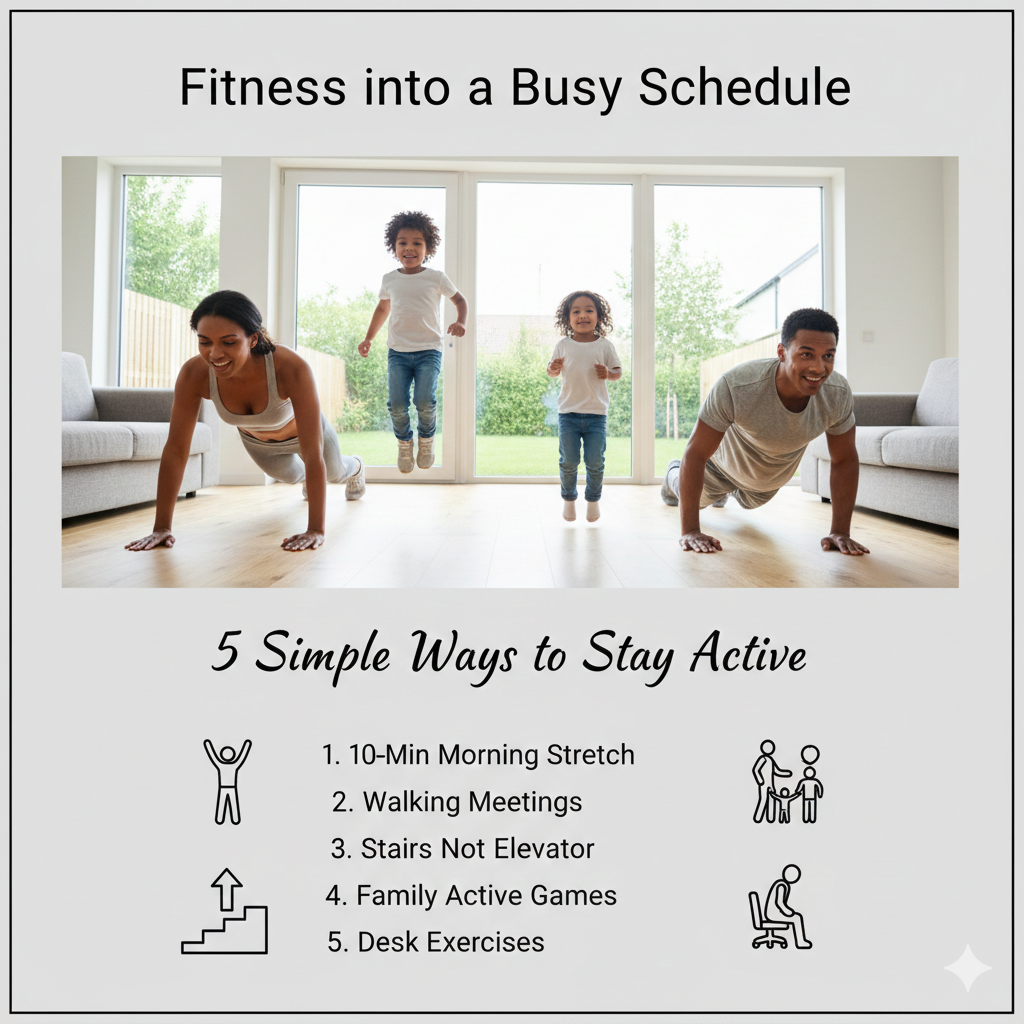
Maintaining consistent exercise habits can feel unrealistic when your calendar is full and your energy is limited. Yet fitness for busy schedules is not about finding a mythical “free hour.” It is about using deliberate, time-smart choices that fit the reality of demanding workdays, family responsibilities, travel, and unpredictable obligations. With the right strategies, you can build momentum through short sessions, purposeful movement, and a realistic fitness plan that supports your health without requiring a complete lifestyle overhaul.
Understanding the Challenges of Fitting Fitness into a Busy Schedule
Common Time Constraints and Lifestyle Barriers
Most people do not struggle with motivation alone; they struggle with logistics. Long commutes, back-to-back meetings, caregiving duties, irregular shifts, and decision fatigue can make workouts feel like one more task competing for attention. Add the friction of changing clothes, driving to a gym, waiting for equipment, and showering afterward, and even a “30-minute workout” becomes a 90-minute block.
Another barrier is the all-or-nothing mindset: if there is not enough time for a “proper” session, people skip exercise altogether. This thinking is one of the biggest obstacles to learning how to fit workouts into a busy day. In practice, consistency matters more than perfection, and smaller efforts compound.
Why Regular Exercise Matters for Busy Professionals
Exercise for busy professionals is not merely a wellness trend; it is a performance advantage. Well-structured physical activity improves cardiovascular health, supports metabolic function, and helps regulate blood sugar and cholesterol. It also enhances mood through neurochemical changes, reduces stress reactivity, and can sharpen attention—benefits that directly affect work output and decision-making.
Regular movement further protects against the long-term costs of sedentary routines: back pain, reduced mobility, poor posture, and sleep disruption. In other words, exercise is not time taken away from productivity; for many people, it is what makes sustained productivity possible.
Time-Efficient Workout Strategies for a Hectic Lifestyle
Best Short Workouts: HIIT, Circuit Training, and Micro-Workouts
When time is scarce, the goal is to maximize the return on each minute. The best time efficient workouts share three features: minimal setup, multi-joint movements, and manageable intensity that you can repeat consistently.
- HIIT (High-Intensity Interval Training): Alternating short bursts of hard effort with brief recovery. Done correctly, HIIT builds cardiovascular fitness quickly, but it should be used judiciously to avoid burnout.
- Circuit training: Moving through strength and cardio exercises with limited rest. It is efficient, scalable, and excellent for maintaining muscle while improving conditioning.
- Micro-workouts: Short bouts (2–8 minutes) distributed throughout the day. These micro-workouts for busy people lower the activation barrier and help counter prolonged sitting.
Short workouts are most effective when they focus on foundational patterns: squats, hinges, pushes, pulls, carries, and brisk locomotion (walking, cycling, stair climbing). These movements deliver broad benefits without requiring complicated programming.
Sample 10–20 Minute Routines You Can Do Anywhere
The routines below require little to no equipment and work well as quick home workouts, hotel-room sessions, or “between meetings” training. Adjust the pace to your current fitness level, prioritize good form, and stop a set one or two repetitions before failure.
10-Minute Micro-Circuit (No Equipment)
Format: 40 seconds work / 20 seconds rest, 2 rounds
- Bodyweight squats
- Push-ups (incline on a desk or wall if needed)
- Reverse lunges (alternating legs)
- Plank (on forearms or hands)
- Mountain climbers (moderate pace for control)
15-Minute Strength-Conditioning Circuit (One Dumbbell or Kettlebell)
Format: 3 rounds, 45 seconds per exercise, 15 seconds transition
- Goblet squats
- One-arm rows (switch arms each round or halfway)
- Romanian deadlifts
- Overhead press
- Fast march in place or stair climbing
20-Minute Interval Walk (Low-Impact, High Payoff)
Format: 5-minute warm-up, then 10 rounds of 30 seconds brisk / 60 seconds easy, finish with 3–5 minutes easy
This session is deceptively effective. It is joint-friendly, suitable for most fitness levels, and easy to repeat, making it a dependable tool to stay active with a busy lifestyle.
Practical Ways to Incorporate Fitness into Your Daily Routine
Sneaky Ways to Add More Movement to Your Workday
Not every day allows a discrete workout window. That is where daily routine fitness tips become essential. The objective is to increase total movement without disrupting responsibilities.
- Schedule “movement appointments”: Put two 10-minute breaks on your calendar and treat them as non-negotiable. A brisk walk and a short mobility sequence are enough to reset energy.
- Use transition time: Before opening your inbox, do 1–2 minutes of squats, wall push-ups, or a plank. Small, consistent triggers create durable habits.
- Walk during calls: For audio-only meetings, pace or step outside. Even modest walking reduces stiffness and elevates alertness.
- Take the long route: Park farther away, use stairs when feasible, and choose restrooms or printers on another floor.
- Adopt a “stand-and-move rule”: Stand up every 30–45 minutes and do a brief sequence: 10 calf raises, 10 hip hinges, 10 shoulder rolls.
These choices may not feel like a workout in the moment, but they meaningfully increase daily energy expenditure and reduce the physical strain of prolonged sitting.
Turning Everyday Tasks into Opportunities for Exercise
Fitness does not have to live exclusively in a gym. When approached strategically, ordinary tasks become opportunities for conditioning and strength.
- Commute creatively: If possible, walk part of the route, cycle once or twice per week, or get off public transit one stop early.
- Make chores count: Carry groceries in multiple trips to add loaded carries, use deliberate squats while unloading items, and increase pace during cleaning.
- Family-inclusive movement: A short after-dinner walk, a park circuit, or a weekend hike builds activity without separating it from personal time.
- Stairs as training: Two to five minutes of stair intervals can replace a cardio session on days when your schedule is tight.
The most sustainable strategy is not heroic effort; it is repeated exposure to manageable movement. Over time, your baseline activity rises, and structured exercise becomes easier to maintain.
Building a Sustainable, Realistic Fitness Plan for Busy People
Setting Achievable Goals and Tracking Your Progress
A realistic fitness plan is built around constraints rather than fantasies. Start with the smallest routine you can execute even during a demanding week, then scale gradually. For example: three 15-minute sessions, or five 8-minute micro-workouts. This approach protects consistency, which is the true engine of results.
Set goals that are specific and measurable:
- Frequency goal: “Exercise 3 days per week” or “Accumulate 90 minutes of movement per week.”
- Performance goal: “Hold a plank for 60 seconds” or “Complete 10 push-ups with good form.”
- Behavior goal: “Walk 20 minutes after lunch on weekdays.”
Track progress with simple metrics: a calendar checkmark system, step counts, or notes on sets and repetitions. Avoid overcomplicating the process. When time is limited, the best tracking method is the one you will actually use.
Staying Motivated and Overcoming Common Setbacks
Busy schedules are unpredictable, so resilience matters more than enthusiasm. Expect disruptions—deadlines, travel, illness, family needs—and design a plan that adapts rather than collapses.
- Use a two-tier system: Maintain a “full session” option (15–30 minutes) and a “minimum viable workout” (3–8 minutes). On hard days, you still keep the habit alive.
- Reduce friction: Keep a resistance band in your bag, store shoes near the door, and prepare a short routine you can start immediately.
- Protect recovery: Sleep, hydration, and protein intake influence energy and adherence. If you feel consistently depleted, reduce intensity and prioritize steady, repeatable training.
- Reframe missed sessions: One missed workout is a scheduling issue; repeated misses signal that the plan is too demanding. Adjust the plan, not your self-judgment.
Motivation becomes more reliable when it is supported by structure. By choosing exercises that require minimal setup and aligning them with your day, you make the healthy choice the easy choice.
Conclusion
Learning how to incorporate fitness into a busy schedule is less about finding extra time and more about using existing time with intention. Short, focused training sessions, strategic movement throughout the day, and a flexible plan that anticipates setbacks can transform fitness from a recurring frustration into a stable part of your routine. Whether you rely on HIIT, circuits, or micro-workouts for busy people, consistency will outperform occasional intensity. Start small, track what matters, and allow your plan to evolve—so you can stay healthy, capable, and energized even when life remains full.