
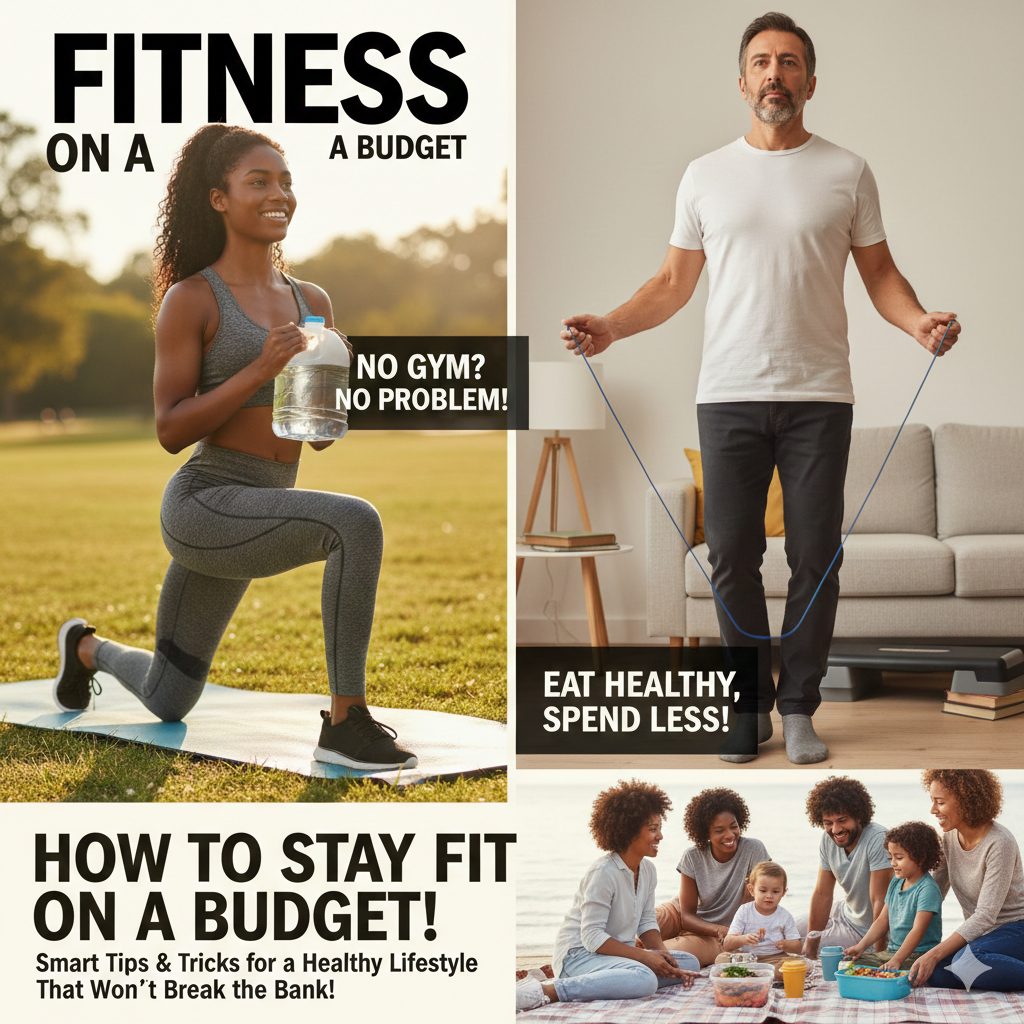
Staying healthy often gets framed as a luxury—one that requires boutique studios, premium supplements, and the newest fitness tracker. In reality, the fundamentals of progress are remarkably inexpensive: consistent movement, a sensible plan, and nourishing food. If you are looking for practical ways to stay fit without a gym membership or costly programs, the strategies below will help you build a sustainable routine. This guide explains how to stay fit on a budget through smart training choices, disciplined meal planning, and long-term habits that protect both your health and your finances.
Understanding Fitness on a Budget
Why Staying Fit Doesn’t Have to Be Expensive
Effective fitness is not purchased; it is practiced. Strength, endurance, mobility, and body composition improvements come from progressive effort over time—something that can be achieved with bodyweight training, walking, running, and basic equipment. Many high-priced offerings mainly provide convenience or atmosphere, not superior results.
When you approach fitness on a budget strategically, you prioritize the essentials: a routine you will follow, enough resistance to challenge your muscles, and a diet that supports recovery. With that mindset, the “cost” of fitness becomes largely optional. You can save money on fitness by investing in a small set of versatile tools or by relying entirely on free resources and public spaces.
Common Myths About Budget-Friendly Fitness
Myth 1: You need a gym membership to make real progress. Gyms can be useful, but they are not required. Structured free home workouts and outdoor training can build impressive strength and cardiovascular capacity, especially when you apply progression (more repetitions, harder variations, shorter rest, or added load).
Myth 2: Affordable routines are too basic to be effective. The “basics” are precisely what work. Squats, hinges, pushes, pulls, carries, and steady cardio form the backbone of most successful programs—whether you train in a luxury facility or your living room.
Myth 3: Healthy eating is inherently expensive. Some convenience items are costly, but affordable healthy eating is highly achievable with staples such as beans, eggs, oats, frozen vegetables, canned fish, seasonal produce, and whole grains. Cost is often driven by waste and impulse purchases, not nutrition.
Creating a Low-Cost Workout Plan
Free and Cheap Ways to Exercise at Home
Home training succeeds when it is simple, repeatable, and measurable. Start with sessions you can complete consistently, then increase the challenge gradually. The following cheap workout ideas require little to no equipment:
- Bodyweight strength circuits: Push-ups, squats, lunges, glute bridges, planks, and mountain climbers. Adjust difficulty by changing leverage, tempo, or range of motion.
- Stair intervals: If you have access to stairs, brisk climbing intervals provide excellent conditioning with minimal joint impact when performed with control.
- Jump rope: One of the most cost-effective cardio tools. Short sessions improve coordination and heart health quickly.
- Resistance bands: Inexpensive, portable, and versatile for rows, presses, hinge patterns, and mobility work.
- A single adjustable dumbbell or kettlebell: If you choose to buy equipment, one well-chosen weight supports presses, rows, goblet squats, swings, and carries.
To make home workouts feel purposeful rather than improvised, use a weekly structure. For example:
- Day 1: Full-body strength (push, pull, squat, core)
- Day 2: Cardio (walk, jog, jump rope, or intervals)
- Day 3: Full-body strength (hinge, lunge, push, pull)
- Day 4: Low-intensity movement (long walk, mobility)
This approach delivers the core benefits of a paid program while remaining flexible. It is also one of the most reliable low cost fitness tips: reduce complexity so consistency becomes inevitable.
How to Use Public Spaces for Effective Workouts
Public infrastructure can function like an open-air gym if you know what to look for. Parks, tracks, playgrounds, and community courts provide free opportunities for strength and conditioning training. Consider these options:
- Walking and running routes: Sidewalks, trails, and tracks support steady-state cardio and interval training. A simple plan—such as alternating one minute faster with two minutes easy—builds fitness without equipment.
- Park benches: Use them for step-ups, incline push-ups, triceps dips, split squats, and elevated planks.
- Playground bars: Excellent for pull-up progressions, hangs (for grip strength), rows, and knee raises.
- Open fields: Great for sprints, shuttle runs, and bodyweight circuits with ample space.
If safety or weather is a concern, plan alternatives: an indoor hallway walk, a short bodyweight session, or mobility work. The goal is to remove friction so training remains consistent. When you treat the environment as adaptable, it becomes far easier to maintain fitness on a budget throughout the year.
Saving Money on Healthy Eating
Budget-Friendly Meal Planning and Prep Tips
Food spending increases when meals are decided at the last minute. A modest amount of planning reduces waste, lowers impulse purchases, and supports more consistent nutrition. The most effective budget friendly meal prep habits are also the simplest:
- Build meals around a few core staples: Choose two proteins, two carbohydrate sources, and several vegetables for the week. Repetition is a financial advantage.
- Cook once, eat multiple times: Prepare a large batch of chili, lentil stew, roasted vegetables, or chicken and rice. Portion and refrigerate or freeze.
- Use frozen and canned foods strategically: Frozen vegetables, canned beans, and canned fish are nutritious, stable, and often cheaper than fresh alternatives out of season.
- Prioritize high-satiety foods: Oats, potatoes, beans, eggs, Greek yogurt, and soups help control snacking and make it easier to stay within your budget.
When meal prep feels monotonous, vary seasonings rather than the core ingredients. Different spice blends, sauces, and cooking methods can transform the same affordable staples into distinct meals without raising costs.
Smart Grocery Shopping Strategies for Nutritious, Low-Cost Foods
To master affordable healthy eating, focus less on trends and more on purchasing discipline. These strategies protect your nutrition and your finances:
- Shop with a list—and a purpose: Align the list with your planned meals and avoid “just in case” items that often go unused.
- Buy seasonal produce: It is typically cheaper and better tasting. When prices rise, switch to frozen options.
- Choose economical protein sources: Eggs, beans, lentils, canned tuna or sardines, chicken thighs, and tofu often deliver excellent nutrition per dollar.
- Look at unit pricing: The lowest sticker price is not always the best value. Compare cost per ounce or per pound.
- Limit ultra-processed convenience foods: These items can be expensive and less satiating, leading to higher overall intake and spending.
- Use store brands: Many generic products match the quality of name brands at a lower cost.
Healthy eating does not require specialty “fitness foods.” It requires enough protein, fiber, and micronutrients from straightforward ingredients. When you keep your pantry stocked with reliable staples, it becomes far easier to stay consistent—and consistency is the true engine of change.
Long-Term Strategies to Stay Fit on a Budget
Tracking Progress Without Costly Apps or Devices
Progress tracking is valuable because it reinforces momentum and highlights what works. However, it does not require subscriptions or wearable devices. A simple notebook, spreadsheet, or calendar can capture the metrics that matter:
- Workouts completed: Record exercises, sets, repetitions, and rest time to ensure gradual progression.
- Performance markers: Time for a fixed walk/run route, maximum push-ups in one set, or how long you can hold a plank with good form.
- Body measurements: Waist or hip circumference can provide clearer insight than scale weight alone.
- Energy and recovery: Brief notes on sleep quality and stress help you interpret performance changes.
Tracking should be minimal yet consistent. Overly complex logging often becomes a reason to stop. The objective is clarity, not perfection—one of the most practical ways to save money on fitness while still training with intent.
Building a Support System and Staying Motivated for Free
Motivation is rarely stable; systems are. A supportive environment makes routine maintenance far easier, especially when your plan does not rely on paid accountability. Consider these no-cost methods:
- Train with a friend: A weekly walking appointment or home workout session adds commitment without expense.
- Use community resources: Local running groups, recreation centers, and public events often provide free or low-cost opportunities for movement and connection.
- Set process-based goals: Commit to “three workouts per week” rather than vague outcomes. Process goals are measurable and within your control.
- Reduce decision fatigue: Keep a default workout plan. When time is limited, follow a shorter version rather than skipping entirely.
If motivation drops, return to the smallest workable step: a ten-minute walk, a brief mobility sequence, or one strength circuit. These “minimum viable workouts” protect your habit, and habit is what sustains fitness on a budget over months and years.
Conclusion
Learning how to stay fit on a budget is less about deprivation and more about precision. Train with intention using free home workouts, public spaces, and simple progression. Eat well by planning meals, shopping strategically, and relying on nutritious staples. Track your progress with basic tools, and build accountability through relationships and community rather than recurring fees.
When you focus on the fundamentals—consistent movement, sensible nutrition, and repeatable routines—you can achieve meaningful, lasting results while keeping costs firmly under control.
https://narmerstore.org/fun-zone/
Blog
Slither Arcade
Features
- Classic Gameplay: Grow your snake by eating apples while avoiding self-collision.
- Dynamic Difficulty: The game speed increases as you eat more food.
- Juicy Polish: Screen shakes on eating, pulsing food animations, and high-score tracking.
- Responsive Controls: Use Arrow keys, WASD, or swipe on touch devices/mouse.
- Visuals: Custom-generated stylized assets and a minimalist neon background.
How to play:
- Controls: Use Arrow Keys or WASD to change direction. On mobile, Swipe in the direction you want to turn.
- Objective: Eat the glowing red apples to grow and increase your score. The game ends if you collide with your own tail.
The snake wraps around the screen edges, allowing for strategic maneuvers! Enjoy your game.Controls Reminder: The golden apple slows time for 5 seconds