

A balanced diet plan is often discussed as if it were a rigid template—an inflexible list of “good” and “bad” foods. In reality, balanced nutrition is both simpler and more nuanced. It is a practical method for meeting your body’s needs consistently, while still allowing room for preferences, culture, budget, and real-life schedules. This balanced nutrition guide will walk you through how to create a balanced diet that supports energy, health markers, and weight management without relying on extremes or short-lived rules.
Understanding What a Balanced Diet Plan Really Means
A balanced diet plan is a sustainable pattern of eating that provides adequate energy and a full spectrum of nutrients: macronutrients for fuel and structure, micronutrients for regulation and protection, and fiber for digestive and metabolic health. “Balanced” does not mean perfect. It means consistent alignment with your needs over time, with enough flexibility to accommodate social events, travel, busy workdays, and changing goals.
At its core, healthy meal planning is about closing nutrient gaps while maintaining a calorie intake that supports your objective—whether that is weight maintenance, gradual fat loss, muscle gain, or improved metabolic health. The most effective personalized diet plan is the one you can repeat comfortably for months, not days.
Key Components of a Balanced Diet (Macros, Micros, and Fiber)
Macronutrients are the foundation of any weight management diet because they supply energy and influence satiety.
- Protein supports muscle repair, immunity, and fullness. It is particularly important during fat loss to preserve lean mass.
- Carbohydrates provide readily available energy and support training performance, mood, and thyroid function. Quality and portion size matter more than demonizing the category.
- Fats are essential for hormone production, brain function, and absorption of fat-soluble vitamins (A, D, E, K). The goal is not low fat, but appropriate fat from high-quality sources.
Micronutrients—vitamins and minerals—regulate everything from energy metabolism to red blood cell production. A balanced diet plan prioritizes variety because no single food covers all needs.
Fiber is a non-negotiable for sustainable eating habits. It improves satiety, supports gut health, moderates blood sugar response, and contributes to cardiovascular health. Fiber is best obtained from vegetables, fruit, legumes, whole grains, nuts, and seeds.
Common Myths and Misconceptions About “Healthy Eating”
Myth 1: Healthy eating means cutting entire food groups. Elimination is sometimes medically necessary (allergies, intolerances), but most people benefit more from improving food quality and portions than from rigid restriction.
Myth 2: A balanced diet is expensive. While some specialty foods are costly, balanced nutrition can be built around budget-friendly staples: eggs, oats, rice, beans, frozen vegetables, canned fish, seasonal produce, and yogurt.
Myth 3: “Clean eating” is required for results. Progress is driven by overall dietary pattern and consistency. An 80/20 approach—mostly nutrient-dense foods with planned flexibility—often outperforms perfectionism.
Myth 4: Carbs are inherently fattening. Excess calories drive weight gain, not carbohydrates alone. Carbohydrates can be part of an effective personalized diet plan when portions and food choices are appropriate.
Step-by-Step Guide to Creating Your Personalized Balanced Diet Plan
The best way to design a balanced diet plan is to begin with measurable targets, then translate them into a simple daily structure. This keeps your plan specific enough to guide decisions, yet flexible enough to live with.
How to Calculate Your Calorie and Macronutrient Needs
Step 1: Estimate your calorie needs. A practical starting point is to estimate maintenance calories, then adjust based on your goal.
- For weight maintenance: aim near estimated maintenance calories.
- For fat loss: start with a modest deficit (often 10–20% below maintenance) to preserve performance and reduce hunger.
- For muscle gain: begin with a small surplus (often 5–10% above maintenance), prioritizing protein and training quality.
If you prefer a simpler approach, track your intake for 7–14 days without changing anything. If weight is stable, your average intake is likely near maintenance. From there, adjust in small increments.
Step 2: Set protein first. Protein anchors satiety and helps protect lean mass. A common evidence-based range is 1.6–2.2 g of protein per kilogram of body weight per day, adjusted for activity level, age, and preference.
Step 3: Choose a fat range. Dietary fat supports hormones and micronutrient absorption. Many people do well around 0.6–1.0 g per kilogram of body weight per day, with emphasis on unsaturated fats.
Step 4: Fill the remaining calories with carbohydrates. Carbohydrates become the flexible lever. Increase them for higher training volume and performance; reduce them slightly if appetite control is difficult or if your calorie target is lower.
Step 5: Add fiber and micronutrient “guardrails.” As a general target, aim for 25–38 g of fiber per day (depending on body size and sex), and include multiple colors of produce daily. These guardrails improve diet quality without micromanaging.
Note: If you have medical conditions, take medications affecting appetite or metabolism, are pregnant, or have a history of disordered eating, consult a qualified clinician or registered dietitian before implementing calorie targets.
How to Build a Daily Meal Structure (Breakfast, Lunch, Dinner, and Snacks)
Once calories and macros are roughly set, translate them into a repeatable routine. Structure reduces decision fatigue—one of the main reasons healthy meal planning fails.
- Breakfast: prioritize protein and fiber to stabilize appetite (e.g., eggs and vegetables, Greek yogurt with berries, oats with protein).
- Lunch: build around a lean protein, high-volume vegetables, and a measured carb source (e.g., chicken, salad, quinoa; beans, vegetables, rice).
- Dinner: mirror lunch, adjusting carbs and fats based on training time and preference.
- Snacks: use strategically—either to meet protein targets, add fruit/vegetables, or prevent overeating later (e.g., cottage cheese, fruit and nuts, hummus and carrots).
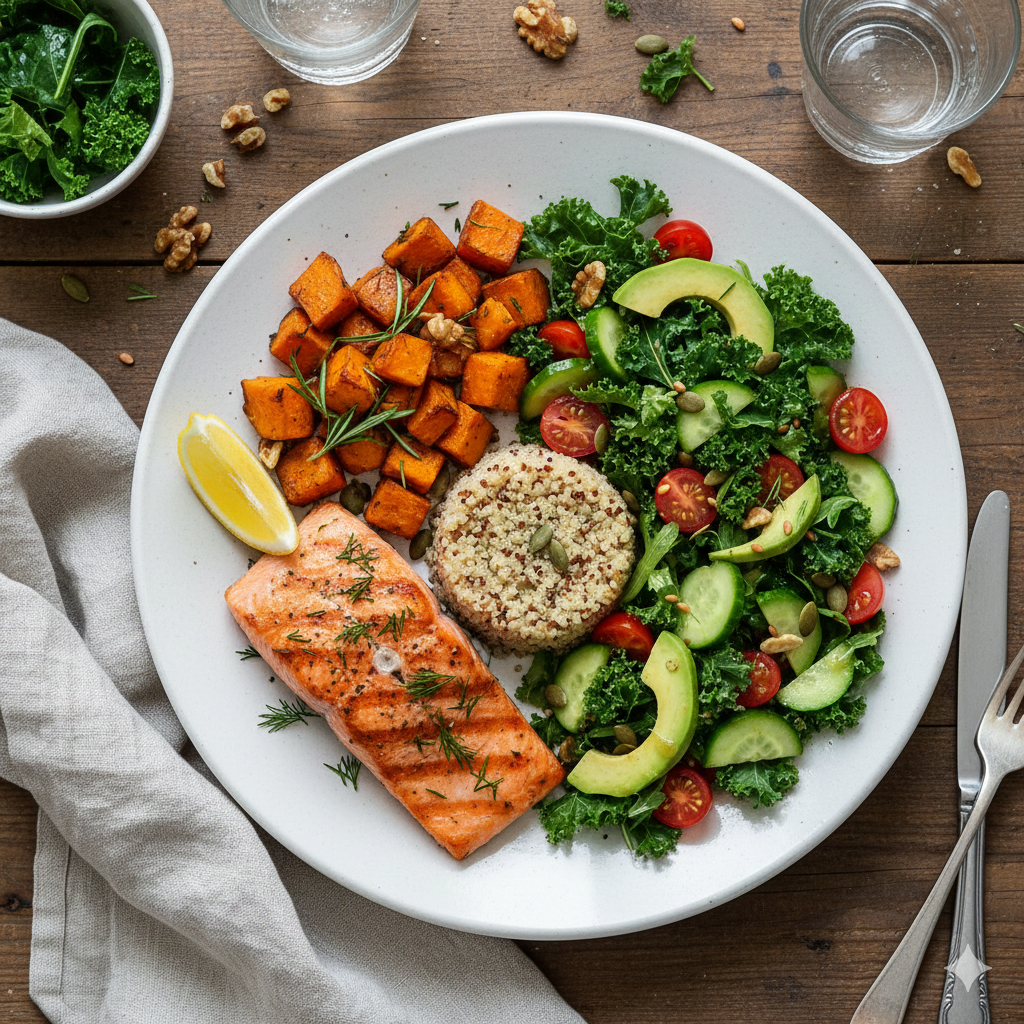
A simple “balanced plate” method works well for many people:
- 1/2 plate non-starchy vegetables
- 1/4 plate protein
- 1/4 plate carbohydrates (whole grains, potatoes, legumes, fruit)
- + 1–2 teaspoons healthy fats (olive oil, avocado, seeds), adjusted to your needs
This approach functions as an intuitive portion control tips framework while still supporting a personalized diet plan.
Choosing the Right Foods for a Sustainable Balanced Diet
Sustainable eating habits are built on foods that are accessible, enjoyable, and nutritionally dense. You do not need a perfect shopping cart; you need reliable staples you can use repeatedly in different combinations.
Best Food Sources for Protein, Carbs, Fats, and Micronutrients
Protein options (mix and match for variety):
- Chicken, turkey, lean beef, pork loin
- Fish and seafood (salmon, sardines, tuna, shrimp)
- Eggs and egg whites
- Greek yogurt, cottage cheese, milk or fortified alternatives
- Tofu, tempeh, edamame, lentils, beans
Carbohydrate options (favor minimally processed sources most of the time):
- Oats, brown rice, quinoa, whole-grain pasta or bread
- Potatoes and sweet potatoes
- Beans and lentils (carbs plus fiber and protein)
- Fruit (berries, apples, citrus, bananas)
Fat sources (prioritize unsaturated fats):
- Extra-virgin olive oil, avocado oil
- Avocados, olives
- Nuts and nut butters
- Seeds (chia, flax, pumpkin)
- Fatty fish for omega-3 intake
Micronutrient-dense foods to strengthen your balanced diet plan:
- Leafy greens (spinach, kale), cruciferous vegetables (broccoli, cauliflower)
- Colorful vegetables (peppers, carrots, tomatoes)
- Legumes and whole grains for magnesium, potassium, and B vitamins
- Dairy or fortified alternatives for calcium and vitamin D
- Iodized salt and seafood for iodine (important for thyroid health)
Supplements can be useful in specific cases, but they should not replace a robust food foundation. When in doubt, treat supplements as insurance—not the main strategy.
How to Plan Balanced Meals and Snacks for Busy Lifestyles
Time constraints are not a character flaw; they are a planning problem. The most reliable approach is to design meals that are modular and repeatable.
- Use a “protein + produce + carb” formula. Example: rotisserie chicken + bagged salad + microwavable rice.
- Keep convenience foods that still fit balanced nutrition. Frozen vegetables, canned beans, pre-cut fruit, and ready-to-eat yogurt reduce friction.
- Build emergency options. Stock shelf-stable staples (tuna packets, whole-grain crackers, nut butter) so busy days do not become skipped meals and rebound overeating.
- Plan snacks with intention. Pair protein with fiber or healthy fat for staying power (e.g., yogurt + fruit; apple + peanut butter; hummus + vegetables).
Healthy meal planning becomes sustainable when it is engineered to succeed under less-than-ideal conditions. Your plan should work on your hardest days, not only on your easiest ones.
Practical Tips to Stick to Your Balanced Diet Plan Long-Term
Consistency is not the product of motivation; it is the outcome of systems. A balanced diet plan succeeds when it is supported by routines that reduce daily effort and create predictable results.
Meal Prep, Grocery Lists, and Portion Control Strategies
Meal prep for beginners: start with partial prep rather than full meal containers. Cook two proteins, one carbohydrate base, and prep vegetables. Then assemble meals in minutes.
- Example prep list: bake chicken thighs, cook a pot of rice or quinoa, roast mixed vegetables, wash salad greens.
Use a structured grocery list. This helps you maintain a balanced diet plan without overthinking:
- Proteins: 2–3 options (fresh or frozen)
- Produce: 3–5 vegetables + 2–3 fruits
- Carbs: 2 options (grains, potatoes, legumes)
- Fats: olive oil + 1–2 nuts/seeds/avocado
- Convenience items: frozen vegetables, canned beans, yogurt
Portion control tips that do not require obsession:
- Use consistent dishware. A smaller plate naturally limits portions without feeling restrictive.
- Measure briefly, then estimate. Weigh or measure key foods for 1–2 weeks to calibrate your eye, then transition to visual portions.
- Prioritize protein and vegetables first. This typically reduces overeating of calorie-dense foods later in the meal.
- Limit “liquid calories.” Sugary drinks and specialty coffees can quietly undermine a weight management diet.
Tracking Progress and Adjusting Your Balanced Diet Plan Over Time
Tracking is not about judgment; it is about feedback. Choose metrics that match your goal and personality.
- Body weight: use weekly averages (daily weigh-ins can fluctuate). Look for trends over 3–4 weeks.
- Measurements and photos: valuable when weight is stable but body composition is changing.
- Performance markers: gym progression, step count, endurance, recovery, and energy.
- Hunger and adherence: if hunger is consistently high or adherence is poor, the plan is too aggressive.
When to adjust:
- If your goal is fat loss and there is no change for 3–4 weeks, reduce intake slightly (e.g., 100–200 calories/day) or increase activity modestly.
- If performance, mood, or sleep deteriorate, consider increasing calories—often through carbohydrates—or improving meal timing.
- If you feel deprived, build planned flexibility: allocate a small portion of calories to foods you enjoy, without turning it into an unstructured “cheat” cycle.
The hallmark of a strong personalized diet plan is adaptability. Your needs shift with stress, seasons, training volume, and age. Your nutrition should evolve accordingly.
Conclusion
Learning how to create a balanced diet is less about discovering a secret formula and more about building a repeatable framework: calculate reasonable targets, choose nutrient-dense staples, structure your meals, and support everything with simple systems. When healthy meal planning is realistic, it becomes sustainable—and sustainable eating habits are what ultimately drive better health, stable energy, and effective weight management.
Start small: improve one meal, stock a more deliberate grocery list, or prep a few core ingredients. A balanced diet plan is not a one-time project. It is a practical skill set that grows stronger through iteration.
Slither Arcade
Features
- Classic Gameplay: Grow your snake by eating apples while avoiding self-collision.
- Dynamic Difficulty: The game speed increases as you eat more food.
- Juicy Polish: Screen shakes on eating, pulsing food animations, and high-score tracking.
- Responsive Controls: Use Arrow keys, WASD, or swipe on touch devices/mouse.
- Visuals: Custom-generated stylized assets and a minimalist neon background.
How to play:
- Controls: Use Arrow Keys or WASD to change direction. On mobile, Swipe in the direction you want to turn.
- Objective: Eat the glowing red apples to grow and increase your score. The game ends if you collide with your own tail.
The snake wraps around the screen edges, allowing for strategic maneuvers! Enjoy your game.Controls Reminder: The golden apple slows time for 5 seconds