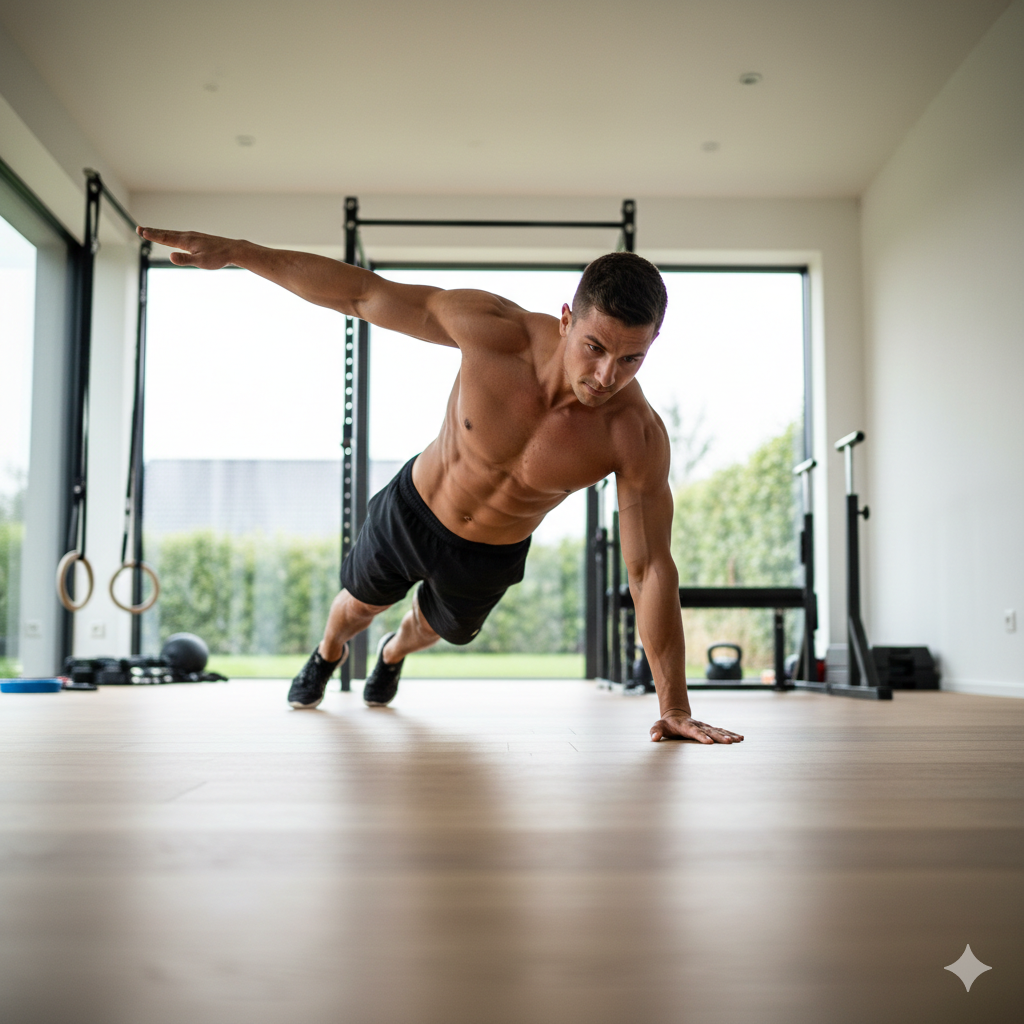
Bodybuilding without weights is not a compromise; it is a disciplined method of developing muscular size, shape, and control using nothing but your own body. When training is organized with the same rigor as a gym-based plan—clear progression, targeted exercise selection, and thoughtful recovery—bodyweight bodybuilding can produce visible hypertrophy, sharper definition, and athletic strength. Whether you want a home workout for muscle gain, you travel frequently, or you simply prefer minimalist training, this guide explains how to build muscle without a gym through precise, repeatable strategies.
How to Practice Bodybuilding Without Weights: Complete Guide
Understanding Bodybuilding Without Weights
What Is Bodyweight Bodybuilding?
Bodyweight bodybuilding is the pursuit of muscle development and physique improvement using calisthenics-style movements—push-ups, rows, squats, lunges, and core work—performed with intentional technique and progressive difficulty. Unlike general fitness calisthenics, the bodybuilding approach prioritizes:
- Hypertrophy-focused execution: controlled tempo, full ranges of motion, and consistent tension.
- Balanced aesthetics: comprehensive work for chest, back, shoulders, arms, legs, and core.
- Progressive overload without external load: harder leverage, unilateral variations, longer time under tension, and higher mechanical tension.
- https://www.teepublic.com/t-shirt/53135655-yoga?store_id=2851997
Done properly, calisthenics for bodybuilding can deliver the “pump,” density, and muscular detail typically associated with resistance training—especially for beginners and intermediates, and even for advanced athletes who master leverage-based progressions.
Benefits of Building Muscle Without Equipment
No equipment muscle building offers advantages beyond convenience. It encourages better movement quality and often improves joint resilience due to the emphasis on control and positional strength.
- Accessibility: train anywhere—living room, hotel, park—making consistency easier.
- Lower barrier to entry: no gym fees, no setup time, fewer excuses.
- Movement integrity: bodyweight training rewards clean mechanics and stable positions.
- Scalable intensity: from knee push-ups to archer push-ups to handstand push-ups, progressions can be steep.
- Full-body coordination: many bodyweight patterns demand total-body tension, improving athleticism while building muscle.
For many trainees, the largest benefit is adherence: a reliable build muscle without gym system that remains effective even when life becomes unpredictable.
Key Principles for Muscle Growth Without Weights
Progressive Overload Using Only Bodyweight
Muscle growth requires a gradually increasing stimulus. In progressive overload bodyweight training, you are not adding plates—you are increasing challenge through smarter variables. The most reliable overload methods include:
- Leverage progressions: shift more bodyweight onto the working muscles (e.g., incline push-up → standard → decline → archer → one-arm progression).
- Unilateral training: single-leg squats, split squats, and one-arm variations dramatically raise intensity.
- Range of motion expansion: deeper squats, deficit push-ups (hands elevated on books), or extended core ranges increase tension.
- Tempo manipulation: slower eccentrics (3–6 seconds down), pauses in stretched positions, and controlled concentrics enhance time under tension.
- Volume increases: more hard sets per muscle group across the week, when recovery supports it.
- Density training: same work in less time by reducing rest, used strategically (not always).
- Mechanical drop sets: progress from a difficult variation to an easier one without rest (e.g., decline push-ups → standard → knee push-ups).
- https://orenga.myspreadshop.com/adorable+animal-A6529a7c79d712c3a5a08a040?productType=815&sellable=zrZNkbVljAF07GbnJRAk-815-9&appearance=2
For hypertrophy, prioritize sets that end close to muscular failure with clean form—often 0–3 reps in reserve. If your sets end with perfect ease, the stimulus is likely insufficient. If every set is sloppy and maximal, fatigue may outpace adaptation.
Structuring Your Bodyweight Bodybuilding Routine (Sets, Reps, Rest)
To make bodybuilding without weights work like bodybuilding, structure matters. Use the same logic you would in a gym program: a mix of moderate reps, adequate sets, and stable weekly progression.
- Reps: Many bodyweight moves drift into very high reps. For muscle gain, aim for variations that land you mostly in the 6–20 rep range with strong control. If you exceed ~25–30 reps easily, progress the exercise rather than endlessly adding repetitions.
- Sets: Start with 10–16 hard sets per muscle group per week as a general target, adjusting based on recovery and experience.
- Rest: For hypertrophy with demanding variations, rest 60–120 seconds. For strength-oriented progressions (e.g., handstand push-up variations), rest 2–3 minutes.
- Frequency: Training each muscle 2–3 times per week often improves practice quality and weekly volume without excessive soreness.
- Technique standard: full range where possible, stable trunk, consistent depth, and controlled eccentric phases.
Lastly, treat progression as a planned system. Keep a log. Track reps, tempo, rest, and variation difficulty. The difference between random calisthenics and a true home workout for muscle gain is recorded progression.
Best Bodyweight Exercises for Full-Body Muscle Building
Upper Body Muscle-Building Exercises (Chest, Back, Shoulders, Arms)
Upper-body hypertrophy is entirely feasible with well-chosen pushing and pulling patterns. Pushing is straightforward; pulling requires creativity if you truly have no equipment. If you can access a sturdy table edge, doorframe (with caution), or playground bar, your back training becomes far more complete. However, even with minimal setup, you can create significant stimulus.
Chest
- Push-up (strict): the foundation—brace, full depth, elbows tracked comfortably.
- Decline push-up: more load on the upper chest and shoulders.
- Archer push-up: a powerful progression toward unilateral pressing.
- Deficit push-up (hands elevated): deeper stretch and greater tension.
Back
- Inverted row under a sturdy table: one of the best no-gym back builders if available.
- Towel door rows (careful setup): loop a towel around a stable handle/hinge side and row with control. Safety is paramount—avoid unstable doors.
- Prone “W” and “Y” raises: high-quality rear-deltoid and upper-back work, excellent as accessory volume.
- Isometric lat contractions: squeeze elbows toward hips while prone or standing; useful but best as a supplement, not a replacement for rows/pulls.
Shoulders
- Pike push-up: a direct bridge to overhead pressing strength.
- Feet-elevated pike push-up: more vertical pressing and higher mechanical demand.
- Wall-assisted handstand push-up progression: advanced shoulder hypertrophy and strength when performed with control.
Arms
- Close-grip push-up: triceps-biased pressing without joint strain when executed properly.
- Diamond push-up: strong triceps stimulus; keep shoulders controlled and range honest.
- Bodyweight triceps extensions (hands on a stable surface): highly effective if you can use a counter, sofa edge, or sturdy table.
- Towel curls/isometric biceps work: stand on a towel and curl against resistance, or perform isometrics. This is not perfect, but it can maintain and build arms when equipment is truly absent.
For an aesthetically balanced upper body, prioritize: one primary press variation, one primary pull variation (if available), one overhead emphasis, and arm-focused accessories.
Lower Body and Core Exercises for Mass and Definition
Leg training without weights can be brutally effective when it becomes unilateral, deep, and controlled. The goal is to avoid “endurance-only” sets by selecting variations that challenge you within hypertrophy ranges.
Quads and Glutes
- Split squat: excellent for quads and glutes; add pauses at the bottom for intensity.
- Bulgarian split squat (rear foot elevated): one of the most potent bodyweight exercises for mass in the lower body.
- Step-ups (stable chair/bench): drive through the whole foot; control the descent.
- Pistol squat progression (assisted → full): advanced unilateral strength and hypertrophy when trained patiently.
Hamstrings and Posterior Chain
- Hip hinge good-morning pattern (bodyweight): best paired with tempo and pauses.
- Single-leg hip hinge: improves load per limb and demands stability.
- Hamstring walkouts / sliding leg curls (if socks on smooth floor): excellent if your environment allows it; otherwise focus on hinge and bridge progressions.
- Glute bridge → single-leg glute bridge: strong glute stimulus with controlled tempo.
Calves
- Single-leg calf raise: pause at the top, slow eccentric; use a step for deeper stretch if available.
Core (for strength and visual definition)
- Hollow body hold: a cornerstone for trunk rigidity.
- Leg raises (floor) / reverse crunch: lower-ab emphasis with pelvic control.
- Plank and side plank variations: anti-extension and anti-rotation strength.
- Slow mountain climbers: controlled core work with conditioning carryover.
Remember that “definition” is partly muscular development and partly leanness. Training builds the structure; nutrition and energy balance reveal it.
Sample No-Equipment Bodybuilding Workout Plans
Beginner Bodyweight Bodybuilding Routine (At Home, No Equipment)
This beginner plan uses straightforward movements and emphasizes consistent weekly progression. Train 3 days per week on nonconsecutive days (e.g., Monday/Wednesday/Friday). Keep 1–3 reps in reserve on most sets while learning form.
Workout A (Full Body)
- Push-up — 3 sets × 6–12 reps
- Split squat — 3 sets × 8–12 reps per leg
- Glute bridge — 3 sets × 10–15 reps
- Pike push-up — 2 sets × 6–10 reps
- Plank — 3 sets × 30–60 seconds
Workout B (Full Body)
- Close-grip push-up — 3 sets × 6–12 reps
- Step-up (stable surface) — 3 sets × 8–12 reps per leg
- Single-leg calf raise — 4 sets × 10–20 reps per leg
- Reverse crunch — 3 sets × 10–15 reps
- Side plank — 2 sets × 20–45 seconds per side
Weekly progression: add 1 rep per set until you reach the top of the range, then move to a harder variation (e.g., from incline push-up to standard). If legs become too easy, add pauses (2 seconds at the bottom) or slow eccentrics (4–6 seconds down).
Intermediate and Advanced Bodyweight Programs for Muscle Gain
Once basic variations are no longer challenging, progress with leverage, unilateral work, and stricter intensity management. Below are two options: a 4-day upper/lower split and a 3-day full-body approach. Choose based on schedule and recovery.
Option 1: Upper/Lower Split (4 Days/Week)
Day 1 — Upper (Push Emphasis)
- Decline push-up — 4 sets × 6–12 reps
- Pike push-up (or feet-elevated) — 4 sets × 6–10 reps
- Diamond push-up — 3 sets × 8–15 reps
- Prone “Y” raise — 3 sets × 12–20 reps (slow, strict)
Day 2 — Lower (Hypertrophy)
- Bulgarian split squat — 4 sets × 8–12 reps per leg
- Single-leg glute bridge — 4 sets × 10–15 reps per leg
- Hamstring walkouts / sliding leg curls — 3 sets × 6–12 reps
- Single-leg calf raise (on step if possible) — 5 sets × 10–20 reps
- Hollow body hold — 3 sets × 20–45 seconds
Day 3 — Upper (Pull + Shoulder Balance)
- Inverted row (table) or towel rows — 5 sets × 6–12 reps
- Archer push-up — 4 sets × 5–10 reps per side (or alternating)
- Bodyweight triceps extension (stable surface) — 3 sets × 8–15 reps
- Prone “W” raise — 3 sets × 12–20 reps
Day 4 — Lower (Strength Skill + Core)
- Pistol squat progression (assisted if needed) — 5 sets × 3–6 reps per leg
- Tempo split squat (5 seconds down) — 3 sets × 6–10 reps per leg
- Hip hinge good-morning (slow) — 4 sets × 10–20 reps
- Leg raise variation — 4 sets × 8–15 reps
Progression strategy: keep the main movement variations challenging enough that most sets fall within 6–12 reps. When you can exceed the range with clean form, increase difficulty: elevate feet, shift to archer versions, add pauses in the stretched position, or transition to unilateral progressions.
Option 2: Full Body Bodyweight Workout (3 Days/Week)
If you prefer fewer training days while still targeting hypertrophy, use this full body bodyweight workout plan. Rotate exercises to manage fatigue while training each muscle group frequently.
Day 1
- Archer push-up (or decline push-up) — 4 sets × 6–12
- Bulgarian split squat — 4 sets × 8–12 per leg
- Inverted row / towel row — 4 sets × 6–12
- Hollow body hold — 3 sets × 20–45 seconds
Day 2
- Feet-elevated pike push-up — 4 sets × 6–10
- Single-leg glute bridge — 4 sets × 10–15 per leg
- Close-grip push-up — 3 sets × 8–15
- Leg raise / reverse crunch — 4 sets × 8–15
Day 3
- Mechanical drop set push-ups (decline → standard → knee) — 3 rounds to near-failure
- Pistol squat progression — 5 sets × 3–6 per leg
- Row variation (different grip/angle) — 4 sets × 6–12
- Side plank — 3 sets × 20–45 seconds per side
Advanced refinement: When you are strong enough to make many variations look easy, hypertrophy often comes from precision—slower eccentrics, longer pauses, and uncompromising depth—combined with carefully increased weekly set volume.
Conclusion
Effective bodybuilding without weights is built on the same pillars as any successful physique program: progressive overload, intelligent exercise selection, sufficient hard sets, and consistent recovery. By using leverage progressions, unilateral work, tempo control, and structured programming, no equipment muscle building becomes a legitimate pathway to muscular growth—not merely maintenance. Choose a plan, track your progress, and treat each repetition as deliberate practice. With time, bodyweight bodybuilding can deliver a stronger, more developed physique from the simplest training environment: your own home.
Slither Arcade
Features
- Classic Gameplay: Grow your snake by eating apples while avoiding self-collision.
- Dynamic Difficulty: The game speed increases as you eat more food.
- Juicy Polish: Screen shakes on eating, pulsing food animations, and high-score tracking.
- Responsive Controls: Use Arrow keys, WASD, or swipe on touch devices/mouse.
- Visuals: Custom-generated stylized assets and a minimalist neon background.
How to play:
- Controls: Use Arrow Keys or WASD to change direction. On mobile, Swipe in the direction you want to turn.
- Objective: Eat the glowing red apples to grow and increase your score. The game ends if you collide with your own tail.
The snake wraps around the screen edges, allowing for strategic maneuvers! Enjoy your game.Controls Reminder: The golden apple slows time for 5 seconds