
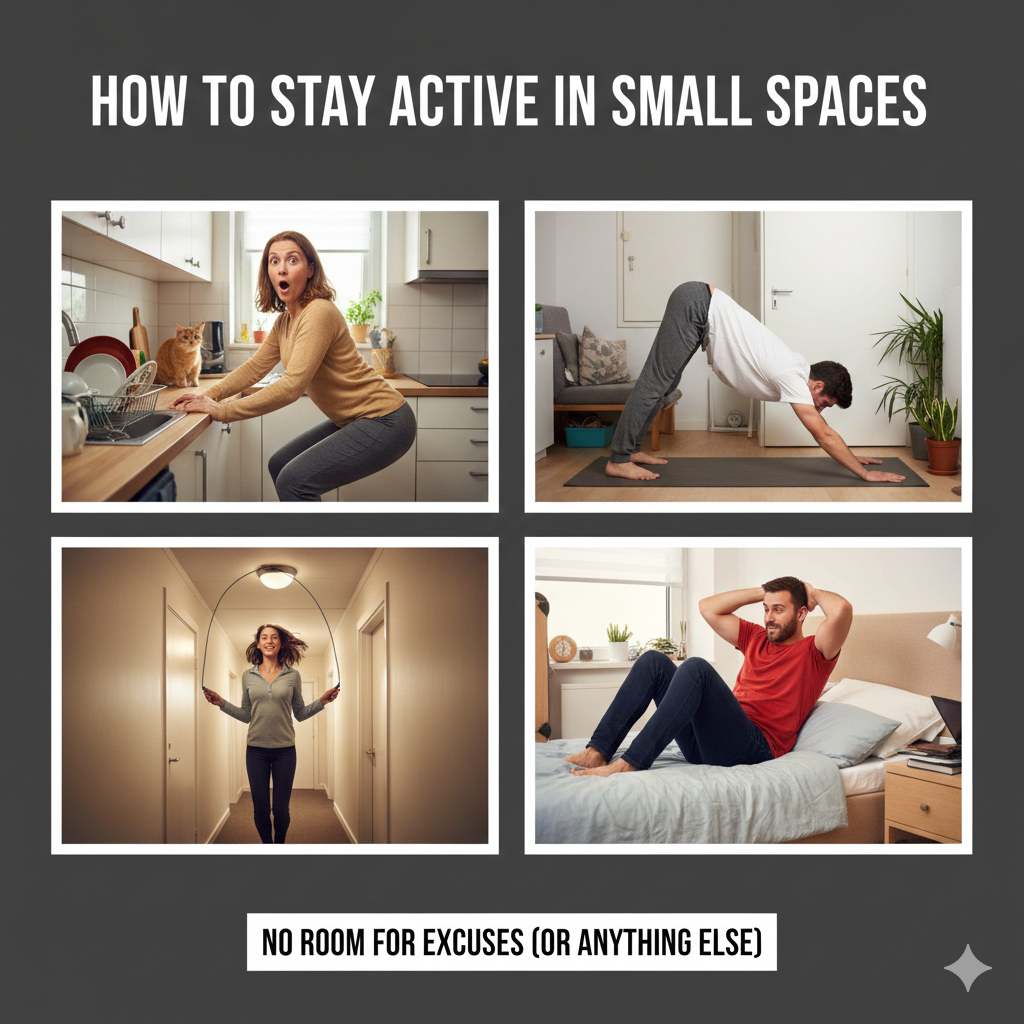
Living in a compact apartment or tiny home does not have to mean living a sedentary life. With a thoughtful approach to your environment and a realistic plan you can repeat, it is possible to stay active in small spaces without turning your living room into a permanent gym. The key is to remove friction: simplify your layout, choose efficient movements, and build a habit that fits your home rather than fighting it.
Understanding the Challenges of Staying Active in Small Spaces
Common Limitations of Small Apartments and Tiny Homes
Small homes present a unique set of constraints that can quietly discourage exercise. Limited floor area often means there is no dedicated workout zone, while low ceilings, narrow hallways, and close neighbors can make jumping, running in place, or using bulky equipment impractical. Many people also deal with multi-use rooms—where the same space must function as office, bedroom, dining area, and lounge—creating the sense that there is never enough “open” time or space to move.
Storage is another frequent obstacle. Even when motivation is high, large machines or scattered accessories quickly become visual clutter. If your equipment is difficult to retrieve and put away, your small apartment workouts are more likely to become occasional rather than consistent. Finally, noise considerations matter. Apartment-friendly workouts must respect shared walls and floors, which influences exercise selection and pacing.
https://www.teepublic.com/t-shirt/57718164-classic?store_id=2851997
Why Movement Matters: Health Risks of a Sedentary Lifestyle
Staying active is not only about aesthetics or athletic performance; it is foundational to long-term health. Prolonged sitting is linked to reduced cardiovascular fitness, poorer blood-sugar regulation, joint stiffness, and loss of muscle mass over time. In tight living quarters, daily steps can drop dramatically—especially for remote workers—making intentional movement essential rather than optional.
Regular activity also supports mental clarity and stress regulation. Short, consistent sessions can improve mood, sleep quality, and energy levels, even when you do not have room for elaborate home workout routines. When space is limited, movement becomes less about “working out hard” and more about maintaining a resilient body through frequent, well-chosen activity.
Smart Strategies to Maximize Your Limited Space
Decluttering and Furniture Layout for Workout-Friendly Rooms
The most effective space saving fitness tips often have little to do with exercise. Begin with a practical decluttering pass: remove items that occupy floor space without serving a daily purpose, and relocate rarely used objects to higher shelves or under-bed storage. The goal is not minimalism for its own sake, but creating a reliable “movement footprint” you can access quickly.
Next, adjust your furniture layout to support exercise in limited space. Aim to establish a small, consistent zone—often a rectangle the size of a yoga mat—where you can hinge, squat, plank, and lie down. If possible, place lightweight furniture (a small coffee table or ottoman) where it can slide aside in seconds. A folding chair can double as seating and as support for step-ups, incline push-ups, triceps dips, and mobility work.
Sound and neighbor considerations should guide your setup. A quality exercise mat reduces impact noise and protects floors. If you live above others, place your workout area away from bedrooms below when possible, and prioritize controlled strength work over high-impact jumping.
Essential Space-Saving Fitness Equipment for Small Areas
You can build a highly effective training toolkit with minimal storage requirements. The best equipment for tiny home exercise ideas is versatile, quiet, and easy to tuck away.
- Resistance bands (loop and long bands): Ideal for rows, presses, squats, deadlifts, and assisted stretching. They store in a drawer and scale well for strength progression.
- Adjustable dumbbells or a single kettlebell: One compact load can support swings, goblet squats, presses, carries, and deadlifts. Choose a weight that feels challenging but manageable for form.
- Suspension trainer (door-anchored): Enables full-body pulling and core work without occupying floor space when not in use. Ensure the anchor is secure and compatible with your door type.
- Slider disks or towels: Useful for hamstring curls, mountain climbers, and core drills on smooth floors—silent and highly portable.
- Jump rope (optional): Excellent for conditioning, but not always apartment-friendly. Consider a cordless rope or shadow-rope technique to reduce noise.
If you prefer a no equipment home workout, start there. Equipment is not mandatory; it simply expands options for progression and variety.
https://www.teepublic.com/t-shirt/57717944-eiffel-tower?store_id=2851997
Effective At-Home Workouts That Need Almost No Space
No-Equipment Exercises You Can Do in One Spot
When floor space is scarce, choose movements that challenge multiple muscle groups and require minimal travel. The following exercises work well for indoor workout ideas and can be performed on a mat-sized area:
- Squats and squat holds: Build lower-body strength and endurance without any equipment. Use slow tempo for added difficulty.
- Reverse lunges: Less forward movement than walking lunges, making them suitable for tight rooms.
- Glute bridges (and single-leg variations): Excellent posterior-chain work with little noise.
- Push-ups: Adjust difficulty with knee, incline (hands on a sturdy surface), or slow eccentric variations.
- Planks and side planks: Efficient core training with low impact.
- Dead bugs and bird-dogs: Strengthen core stability and coordination while reinforcing good posture.
- Calf raises: Simple, effective, and easy to progress with pauses or single-leg sets.
To increase intensity without added space, use tempo (slower lowering phases), isometric pauses, and reduced rest intervals. These methods keep training effective while remaining quiet and controlled for apartment friendly workouts.
Compact Workout Routines: HIIT, Yoga, and Strength in Small Spaces
Structured routines remove decision fatigue. Below are three compact options designed for small apartment workouts and tiny homes. Choose one based on your goals and energy level, and repeat it consistently.
10–15 Minute Low-Impact HIIT (Apartment-Friendly)
Complete 3–4 rounds. Work for 30 seconds, rest for 15 seconds between moves.
- Bodyweight squats (slow and controlled)
- Incline push-ups (hands on a couch or countertop)
- Reverse lunges (alternate legs)
- Plank shoulder taps (steady hips)
- Glute bridges
This format elevates the heart rate without jumping, making it suitable for indoor environments where noise is a concern.
15–25 Minute Strength Circuit (Minimal Gear Optional)
Perform 3 rounds with 60–90 seconds rest between rounds.
- Goblet squat (kettlebell/dumbbell) or tempo squat (bodyweight): 8–12 reps
- One-arm row (dumbbell/band) or band row: 10–15 reps per side
- Hip hinge (Romanian deadlift with weight) or single-leg hinge (bodyweight): 8–12 reps
- Overhead press (dumbbell/band) or pike push-up: 8–12 reps
- Side plank: 20–40 seconds per side
This approach supports progressive overload—crucial for strength gains—while keeping the footprint small and the setup simple.
20 Minute Yoga and Mobility Flow (One-Mat Space)
- Cat-cow and thoracic rotations: 2 minutes
- Downward dog to plank transitions: 2 minutes
- Low lunge with hip flexor stretch (each side): 2 minutes
- Warrior sequences (short stance if needed): 6 minutes
- Bridge pose and supine twists: 4 minutes
- Breathwork in constructive rest: 4 minutes
Yoga-based home workout routines are particularly well suited to small spaces because they emphasize control, mobility, and strength without equipment or impact.
Building a Sustainable Small-Space Fitness Habit
Creating a Daily Movement Routine Around Your Space
Consistency is easier when movement is woven into daily life. Instead of waiting for a perfect hour-long block, rely on short sessions that fit your environment. A practical approach is to establish “movement anchors”—predictable moments where activity becomes automatic, such as after morning coffee, between meetings, or before dinner.
Consider a simple daily structure:
- Morning (3–5 minutes): Mobility work—spine rotations, hip openers, gentle squats.
- Midday (8–15 minutes): A strength circuit or low-impact HIIT.
- Evening (5–10 minutes): Stretching, yoga, or a short walk if available.
This cadence supports energy and joint health while making it realistic to stay active in small spaces. Importantly, it also reduces the “all-or-nothing” mindset that often undermines progress.
Motivation Tips and Tracking Progress Without a Gym
Motivation is unreliable; systems are dependable. Keep your workout area easy to access, and reduce setup time to under one minute. Store bands in a visible basket, keep a mat rolled near the wall, and preselect routines for the week. When choice is limited, follow-through improves.
Progress tracking does not require complex apps. Choose two or three simple metrics:
- Reps and sets: Record key exercises weekly, aiming for gradual increases or improved form.
- Time under tension: Track longer holds or slower tempos when equipment is limited.
- Consistency: Count sessions per week and streaks of daily movement, even if brief.
If you need variety, rotate themes—strength on two days, conditioning on one day, mobility on two days—while repeating the same core movements for at least four weeks. This balance keeps indoor workout ideas fresh without sacrificing the repetition required for measurable improvement.
Conclusion
Limited square footage is a logistical challenge, not a barrier to fitness. By optimizing your layout, choosing compact tools when helpful, and relying on smart, quiet movements, you can build effective routines seen in the best apartment friendly workouts. Whether you prefer a no equipment home workout or a minimal-kit strength circuit, the path forward is the same: make movement accessible, repeatable, and aligned with how your home actually functions. With consistency, small spaces can support strong habits—and a stronger body.