
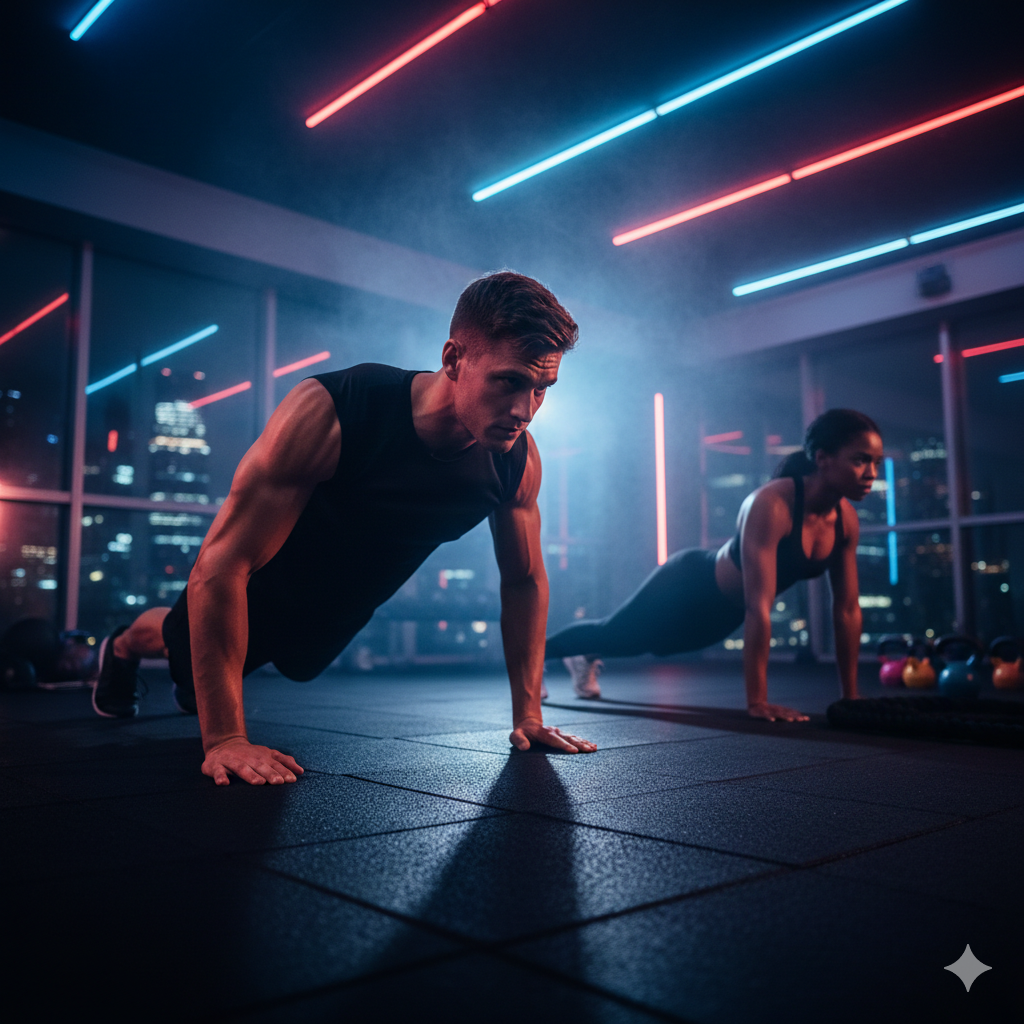
Staying in shape does not require a fully equipped gym, a large home studio, or expensive machines. With a small set of versatile tools—and a clear plan—you can build strength, elevate conditioning, and improve mobility in almost any environment. The key is to approach training with intent: prioritize foundational movement patterns, use progressive overload intelligently, and design a home workout routine that fits your space, schedule, and recovery.
Understanding Fitness with Minimal Gear
Why You Don’t Need a Full Gym to Get Fit
Most meaningful fitness outcomes come from consistency, sound programming, and progression—not from the quantity of equipment. A minimal equipment workout can deliver excellent results because the body responds to stress and adaptation, whether that stress comes from dumbbells, resistance bands, or well-chosen bodyweight progressions.
Strength can be built through squats, hinges, pushes, pulls, and carries using limited tools. Cardiovascular fitness improves when you sustain effort in circuits, intervals, or brisk low-impact sessions. Mobility and resilience develop through controlled ranges of motion, isometrics, and steady movement practice. In other words, you can stay fit with limited equipment by training movement patterns and energy systems, rather than chasing novelty.
https://www.teepublic.com/t-shirt/50452998-penguin-otter?store_id=2851997
Setting Realistic Goals for At-Home, Minimal-Equipment Workouts
Clear, practical goals prevent random workouts and reduce frustration. Start by selecting outcomes you can measure and influence directly within your constraints. Examples include:
- Complete three full body workout at home sessions per week for eight weeks.
- Improve push-up strength (e.g., add five reps to your best set).
- Increase lower-body capacity (e.g., step-ups for 10 minutes with steady pacing).
- Enhance mobility (e.g., reduce stiffness with a daily 10-minute routine).
- https://orenga.myspreadshop.com/adorable+animal-A6529a7c79d712c3a5a08a040?productType=813&sellable=zrZNkbVljAF07GbnJRAk-813-8&appearance=2
Choose one primary goal (strength, fat loss, general conditioning, or mobility) and one secondary goal to support it. Align your plan with your reality: time available, recovery, and any injury history. Realistic targets are not modest; they are actionable.
Essential Limited Equipment for Effective Home Workouts
Must-Have Budget-Friendly Fitness Tools
If you are building a compact setup, prioritize items with the broadest exercise range per dollar. The following budget fitness equipment options cover most training needs without consuming space:
- Resistance bands (loop and long bands): Excellent for rows, presses, hip hinges, assisted pull variations, and mobility work. They scale easily by changing tension or band length.
- Adjustable dumbbells or a pair of moderate dumbbells: Useful for presses, rows, squats, lunges, and loaded carries. Even one dumbbell can be effective for unilateral training.
- Kettlebell (optional but powerful): A single kettlebell supports swings, goblet squats, cleans, presses, and conditioning complexes.
- Pull-up bar (doorframe or mounted): Enables vertical pulling and hanging work. If a bar is not possible, bands and sturdy furniture can approximate pulling volume.
- Yoga mat: Not for “burn,” but for comfort, joint protection, and reliable footing during floor work.
- Jump rope (optional): High return for small space exercise when noise and flooring permit.
Not every home needs all of these. A band set and one weight implement can carry a surprisingly effective home fitness program for months.
How to Substitute Household Items for Gym Equipment
If you are starting from zero, household items can bridge the gap while you develop a no gym workout plan. Focus on stable, safe substitutions:
- Backpack loaded with books: Functions as a weight vest for squats, lunges, push-ups, step-ups, and carries.
- Water jugs or detergent bottles: Useful for farmer carries, overhead holds, and lightweight conditioning.
- Sturdy chair or bench: Supports step-ups, split squats, incline push-ups, and triceps work.
- Towel on a smooth floor: Enables hamstring curls, body saws, and sliding mountain climbers.
- Stairs: Ideal for low-impact cardio intervals and step-up conditioning.
Safety is paramount. Avoid unstable surfaces, do not overload furniture beyond its tolerance, and ensure items have secure handles and predictable balance.
Full-Body Workout Routines with Limited Equipment
Sample Weekly Workout Plan Using Minimal Gear
The following template is designed to stay fit with limited equipment while balancing strength, conditioning, and recovery. It fits most schedules, supports small space exercise, and can be repeated for 6–8 weeks with gradual progression.
Day 1: Full-Body Strength (30–45 minutes)
- Squat pattern: Goblet squat or backpack squat — 3–5 sets of 6–12 reps
- Push pattern: Push-ups (floor or incline) or dumbbell floor press — 3–5 sets of 6–12 reps
- Pull pattern: Band row, one-arm dumbbell row, or towel row under a sturdy table — 3–5 sets of 8–15 reps
- Hinge pattern: Romanian deadlift with dumbbells/backpack or hip hinge band pull-through — 3–4 sets of 8–12 reps
- Core: Plank variations — 3 rounds of 20–45 seconds
- How to Practice Mindful Listening
- Top 10 Foods for Muscle Building
- How do practice bodybuilding without weight
Day 2: Conditioning + Mobility (20–35 minutes)
- Cardio intervals: Jump rope, stair intervals, brisk marching with knee drive, or shadow boxing — 10–20 minutes
- Mobility flow: Hips, thoracic spine, ankles, shoulders — 10–15 minutes
Day 3: Full-Body Strength (Variation)
- Single-leg work: Split squats or step-ups — 3–4 sets of 8–12 per side
- Overhead/vertical push: Dumbbell press, pike push-up, or band press — 3–4 sets of 6–12
- Posterior chain: Glute bridge (loaded if possible) — 3–4 sets of 10–15
- Pull: Pull-up (if available) or band lat pulldown — 3–4 sets of 6–12
- Carry: Suitcase carry with dumbbell/jug — 3 rounds of 30–60 seconds per side
Day 4: Active Recovery
- Low-intensity movement: 20–40 minutes walk or gentle cycling
- Optional: Light stretching for areas that feel restricted
Day 5: Full-Body Circuit (Metabolic Strength)
- Perform 4–6 rounds, resting 60–90 seconds between rounds:
- Hinge: Kettlebell swings or dumbbell deadlift — 10–15 reps
- Push: Push-ups — 8–15 reps
- Pull: Band row — 12–20 reps
- Legs: Reverse lunge — 8–12 per side
- Core: Dead bug — 8–12 per side
Days 6–7: Rest or Light Movement
Use at least one day for true rest. On the other, choose an easy activity you enjoy. This protects recovery and improves long-term adherence to your effective home fitness plan.
Strength, Cardio, and Mobility Circuits You Can Do Anywhere
When time is limited, circuits condense training into a focused, repeatable format. Each option below works as a standalone minimal equipment workout or as a finisher.
1) Strength Circuit (12–20 minutes)
- Set a timer for 12–20 minutes and cycle through:
- Goblet squat or backpack squat — 8–12 reps
- One-arm row (dumbbell/band) — 10–15 per side
- Floor press or push-up — 8–12 reps
- Hip hinge (RDL or band hinge) — 10–12 reps
Maintain crisp form. Stop sets with 1–3 reps in reserve to keep quality high across rounds—an approach that supports strength training with minimal gear without unnecessary fatigue.
2) Cardio Circuit (10–18 minutes)
- Work 40 seconds, rest 20 seconds, repeat for 10–18 minutes:
- Fast step-ups or stair climbs
- Shadow boxing
- Low-impact squat-to-stand
- Marching plank or mountain climbers (as tolerated)
This circuit raises heart rate quickly while remaining compatible with small spaces. Adjust impact based on joints, flooring, and downstairs neighbors.
3) Mobility and Core Circuit (10–15 minutes)
- Repeat 2–3 rounds:
- World’s greatest stretch — 4–6 per side
- Thoracic rotations — 6–10 per side
- Glute bridge hold — 20–40 seconds
- Side plank — 15–30 seconds per side
- Ankle rocks (knee-to-wall) — 8–12 per side
Mobility is not an accessory; it improves movement efficiency and supports consistency by reducing discomfort and stiffness.
Tips to Stay Consistent and Progress with Limited Equipment
How to Track Progress and Increase Workout Intensity
Progress is still essential when equipment is scarce; it simply requires more creativity. Track the variables you can control:
- Repetitions: Add 1–2 reps per set until you reach the top of a target range.
- Sets: Add a set once you can complete all sets comfortably with strong technique.
- Tempo: Slow the lowering phase (e.g., 3–5 seconds) to increase time under tension without heavier loads.
- Range of motion: Progress from incline push-ups to floor push-ups, then to deficit or paused variations.
- Density: Do the same work in less time by shortening rest intervals.
- Unilateral loading: Single-leg and single-arm movements amplify stimulus with lighter weights.
Use a simple log: exercise, sets, reps, and a brief note on effort. Over time, this becomes a reliable blueprint for progressive overload in your home workout routine.
Motivation, Habits, and Safety Tips for Long-Term Results
Consistency is a skill. Make the process easier by reducing friction and standardizing decisions. Schedule workouts as fixed appointments, keep your training area ready, and rely on repeatable sessions rather than constant reinvention. A well-structured no gym workout plan is more sustainable than an ever-changing playlist of exercises.
To maintain motivation, connect training to immediate benefits—better energy, improved posture, fewer aches, clearer focus—not only distant aesthetics. Set “minimum effective” rules for busy weeks, such as 15 minutes of movement or one full-body circuit. Completing something small preserves identity and momentum.
Safety should remain non-negotiable. Warm up for 5–8 minutes with joint circles, light cardio, and a few rehearsal sets. Prioritize form over speed, especially in fatigue. If pain is sharp or persistent, regress the movement, reduce volume, or consult a qualified professional. Sustainable progress comes from patience, not recklessness.
Conclusion
You can stay fit with limited equipment by focusing on fundamentals: disciplined programming, progressive overload, and consistent practice of full-body movement patterns. A few pieces of budget fitness equipment—or even well-chosen household substitutes—are enough to build a robust routine that develops strength, conditioning, and mobility. Commit to a realistic schedule, track measurable progress, and keep your sessions purposeful. With these principles, effective home fitness becomes not a compromise, but a durable training system you can maintain anywhere.
Celestial Stackmaster
Core Loop: Vertical block stacking with slicing physics.
Precision Rewards: “Perfect” drops snap into place with a glow effect.
Dynamic Difficulty: Block speed increases as you climb higher.
Atmospheric Visuals: A cosmic “Zenith” background with color-shifting fog that evolves with your score.
Responsive Controls: Fully playable on desktop (click) and mobile (tap).
Camera System: Dynamic camera that tracks your progress toward the stars.
How to Play
Objective: Stack blocks as high as possible without missing the tower.
Controls: Click or Tap anywhere to drop the moving block onto the stack.
Pro Tip: Align the block perfectly with the one below to keep its full size; otherwise, the overhanging part will be sliced off!