
Building an active family lifestyle does not require a home gym, marathon training plans, or long blocks of uninterrupted time. It requires intention, a few dependable routines, and activities that feel welcoming to every age in the household. When movement becomes part of how your family connects—between school drop-offs, meals, homework, and weekends—fitness stops competing with family time and starts enhancing it.
This guide explains how to incorporate fitness into family time with practical strategies, realistic scheduling, and fun family activities that support long-term family health and wellness. The goal is not perfection. It is consistency, shared energy, and the quiet confidence that comes from taking care of your bodies together.
Understanding the Benefits of Family Fitness Time
Why Exercising Together Matters for Kids and Parents
Children learn what “normal” looks like by observing adults. When parents treat movement as a regular, positive part of life—rather than punishment for eating dessert or a chore to endure—kids absorb a healthier narrative about exercise. Exercising together also removes a common barrier for adults: guilt about taking time away from the family. A shared walk, a short circuit in the living room, or a bike ride turns self-care into togetherness.
Family fitness also strengthens communication. Physical activity naturally creates moments for encouragement, teamwork, and playful competition. Over time, these experiences build trust: a parent sees a child persevere through a difficult set of movements; a child sees a parent start again after getting winded. These small demonstrations of resilience can be more influential than any lecture about healthy habits.
https://www.teepublic.com/t-shirt/50452998-penguin-otter?store_id=2851997
Physical, Emotional, and Social Benefits of Family Workouts
The physical benefits are straightforward: improved cardiovascular fitness, stronger muscles and bones, better posture, and healthier body composition. For kids, regular activity supports motor development, coordination, and sleep quality—factors that often influence attention and mood. For parents, moving consistently can reduce stress, lower blood pressure, and improve stamina for daily responsibilities.
The emotional benefits are just as compelling. Movement is an effective regulator of anxiety and irritability for both adults and children. A brief family workout can diffuse tension after school or work and create a calmer transition into evenings. Shared activity also promotes a sense of belonging; everyone contributes, adapts, and participates at their level without needing to “win.”
Socially, exercise with kids can teach cooperation, sportsmanship, and respect for individual differences. Siblings learn to support one another. Teens, often reluctant to talk directly, may open up more easily during a walk, a hike, or a casual game. Fitness becomes a low-pressure setting for connection.
Simple Ways to Add Fitness into Everyday Family Routines
Turning Household Chores and Errands into Active Moments
Daily tasks can double as movement when you treat them as brief training opportunities. You do not need to label them as workouts; simply design them to include more walking, lifting, bending, and carrying.
- Make chores interval-based: Set a timer for 10 minutes and move with purpose—vacuuming briskly, carrying laundry up stairs, or sweeping in a continuous flow—then rest for one minute and repeat.
- Use “carry” tasks to build strength: Let older kids carry lighter grocery bags, a backpack of library books, or a small basket of laundry. This builds functional strength and responsibility.
- Park farther away on purpose: Add a few extra minutes of walking during errands. Over a week, these small distances accumulate meaningfully.
- Take walking meetings as a family: If you need to discuss schedules, school plans, or weekend logistics, do it on a neighborhood walk rather than at the kitchen counter.
- Turn tidying into a movement game: Use “pick up and put away” rounds with squats (to pick items up) and toe raises (while reaching for shelves) to embed simple strength work.
These approaches are especially effective for families who feel pressed for time. They transform existing responsibilities into ways to incorporate fitness into family time without adding new commitments to the calendar.
Screen-Time Swaps: Quick Movement Breaks the Whole Family Can Do
Rather than positioning screens as the enemy, treat them as a cue for balance. A simple rule—“movement first, then screens” or “movement between episodes”—creates structure without ongoing negotiation. The key is to keep the movement breaks short enough to feel doable and consistent.
Consider these screen-time swaps that work across ages:
- Five-minute family mobility: Shoulder rolls, gentle twists, hip circles, and calf stretches. Ideal after homework or long car rides.
- Living-room circuit: Choose four movements for 30 seconds each: marching or jogging in place, wall sits, incline push-ups on a counter, and jumping jacks (or step jacks for low impact). Repeat twice.
- Dance intervals: Play two songs. Move continuously for the first, rest during the chorus of the second, then finish strong. It feels like play while improving stamina.
- Commercial-break challenges: During ads, everyone does a set number of squats, lunges, or plank seconds. Adjust difficulty by age and ability.
These micro-sessions help establish a family fitness routine that is realistic. They also teach children that movement can be woven into the day in small, effective doses.
Fun Family Fitness Activities for All Ages
Indoor and Outdoor Workout Ideas for Busy Families
When schedules are full, the most sustainable family workout ideas are those that require minimal setup and offer flexible intensity. Aim for activities that can be scaled: the same game can be gentle for younger kids and challenging for parents or teens.
Indoor options:
- Obstacle courses: Use pillows, tape lines, and chairs to create crawling, balancing, and hopping stations. Time each round, then try to beat it safely.
- Yoga or stretching together: A short evening routine improves mobility and sleep. Let children choose a pose to “teach” the family to increase engagement.
- Stair circuits (if available): Walk up and down for a set time, adding side steps or carrying light items for older participants.
- Strength basics with household items: Water bottles for light weights, a backpack with books for squats, or a towel for assisted stretches.
Outdoor options:
- Family walks with a purpose: Try a “color walk” where kids spot objects of different colors, or a photo scavenger hunt that keeps everyone moving.
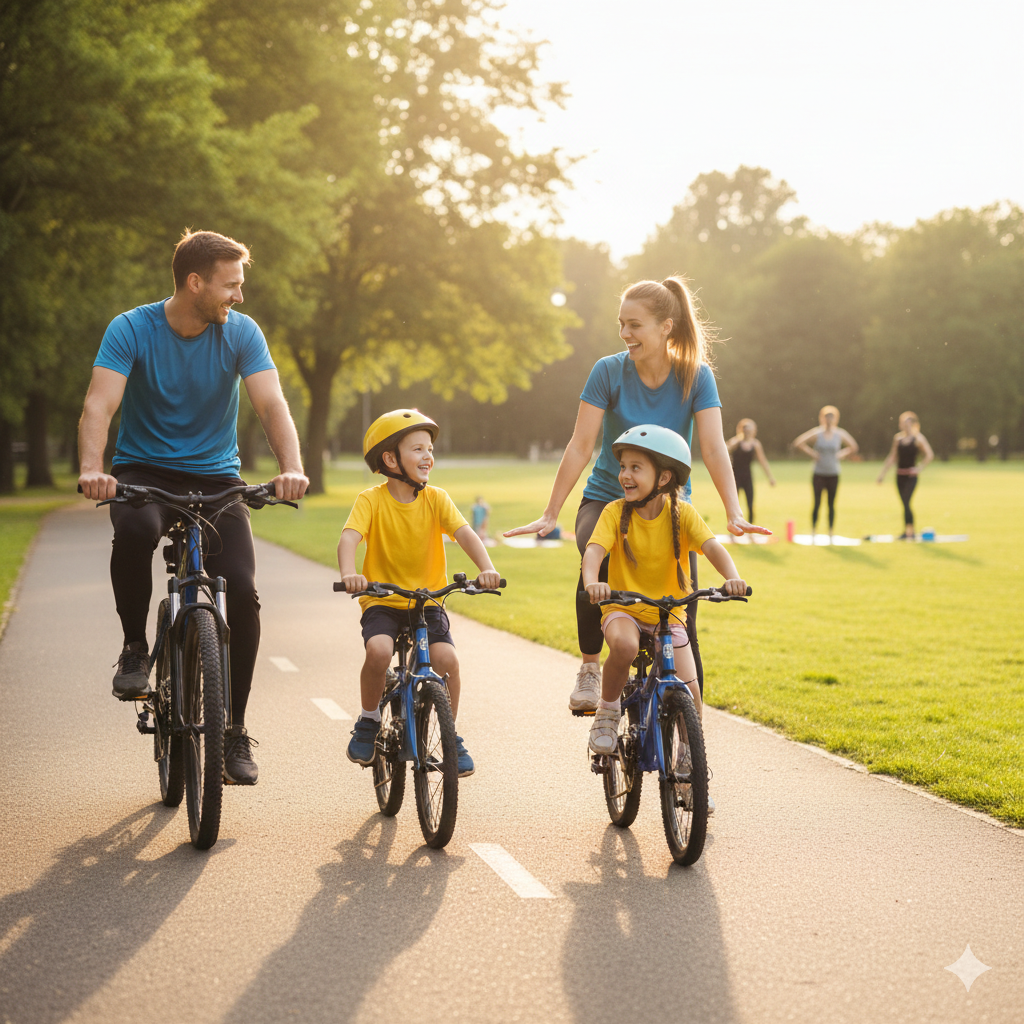
- Bike and scooter loops: Choose a safe route and assign roles—one person sets a gentle pace, another chooses the turnaround point.
- Playground strength: Parents can do incline push-ups on a bench while kids climb. Rotate between play and simple exercises so no one feels sidelined.
- Backyard games: Tag variations, relay races, or ball games provide intervals naturally, improving cardio without feeling like formal training.
The best approach is variety. Rotating options prevents boredom and supports different aspects of fitness: endurance, strength, agility, and coordination.
Weekend Adventures: Active Outings That Feel Like Play, Not Exercise
Weekends offer the ideal setting for longer, low-pressure movement. The most effective outings are those that deliver “incidental exercise”—you are active because the day is enjoyable, not because you are forcing a workout.
- Nature hikes with simple milestones: Pick a trail with a viewpoint, creek, or picnic spot. Children handle distance better when there is a destination.
- Museum or city walking days: Choose a walkable area and explore on foot. Add a step goal if it motivates your family, but keep the tone light.
- Swimming or open-gym sessions: Water play is excellent for all ages and supports joint-friendly cardio for adults.
- Community events: Charity walks, fun runs, or family sports days create external motivation and a sense of shared accomplishment.
- Seasonal activities: Sledding, skating, leaf-raking, and beach days all count. A robust approach to family fitness embraces what each season offers.
These outings reinforce that an active family lifestyle is not a narrow program. It is a broad, adaptable way of living that can accommodate different interests and energy levels.
Making Family Fitness a Consistent Habit
Setting Goals, Schedules, and Rules Everyone Can Follow
Consistency comes from clarity. Instead of vague intentions such as “we should be more active,” define what success looks like for your household and make it visible.
- Choose a weekly baseline: For example, three 20-minute family activity sessions plus one weekend outing. A modest, repeatable plan beats an ambitious plan that collapses.
- Put it on the calendar: Treat movement like an appointment. After-dinner walks on specific days or Saturday morning park time becomes a predictable rhythm.
- Create simple household rules: Examples include “Everyone moves for 10 minutes before weekend screen time” or “We take a walk after Sunday dinner.” Rules reduce decision fatigue.
- Use age-appropriate responsibilities: Let kids pick an activity from a pre-approved list. Let teens choose the music, route, or challenge format. Autonomy increases participation.
Ensure that the plan includes flexibility. Busy weeks happen. A strong family fitness routine allows for shorter sessions without framing them as failure.
Motivating Kids and Teens: Rewards, Challenges, and Tracking Progress
Motivation works best when it is positive, specific, and connected to effort rather than appearance. Children thrive on immediate feedback. Teens often respond better to autonomy and measurable progress.
- Use effort-based rewards: A family choice night, picking the weekend adventure, or earning points toward a shared experience (such as a day trip) reinforces participation without turning movement into a transaction.
- Run short challenges: Try a “two-week step streak,” a “plank ladder,” or a “walk every day after dinner” challenge. Keep it brief and achievable to build momentum.
- Track in simple ways: Use a wall chart, a shared note on a phone, or a jar with tokens for completed activities. Visibility keeps the habit top of mind.
- Normalize different levels: Make it explicit that everyone can modify. A younger child can march while others run in place; a parent can use low-impact options during a busy or tired week.
Most importantly, praise what you want repeated: showing up, trying again, encouraging a sibling, and finishing strong. This approach supports lasting family health and wellness and keeps the emotional tone constructive.
Conclusion
Family fitness is less about designing the perfect program and more about weaving movement into the life you already live. When you treat activity as a shared language—walks that invite conversation, chores done with energy, weekend outings that feel like play—you create a home environment where exercise with kids is natural rather than forced.
Start small, choose routines you can repeat, and let enjoyment guide your choices. Over time, those short movement breaks and simple adventures become the foundation of how to be active as a family—consistently, confidently, and together.
The Best Recovery Tools for Athletes
How to Practice Mindful Drinking
Top 5 Superfoods for Brain Power
Top 5 Tips for Healthy Eating on the Go
Slither Arcade
Features
- Classic Gameplay: Grow your snake by eating apples while avoiding self-collision.
- Dynamic Difficulty: The game speed increases as you eat more food.
- Juicy Polish: Screen shakes on eating, pulsing food animations, and high-score tracking.
- Responsive Controls: Use Arrow keys, WASD, or swipe on touch devices/mouse.
- Visuals: Custom-generated stylized assets and a minimalist neon background.
How to play:
- Controls: Use Arrow Keys or WASD to change direction. On mobile, Swipe in the direction you want to turn.
- Objective: Eat the glowing red apples to grow and increase your score. The game ends if you collide with your own tail.
The snake wraps around the screen edges, allowing for strategic maneuvers! Enjoy your game.Controls Reminder: The golden apple slows time for 5 seconds