
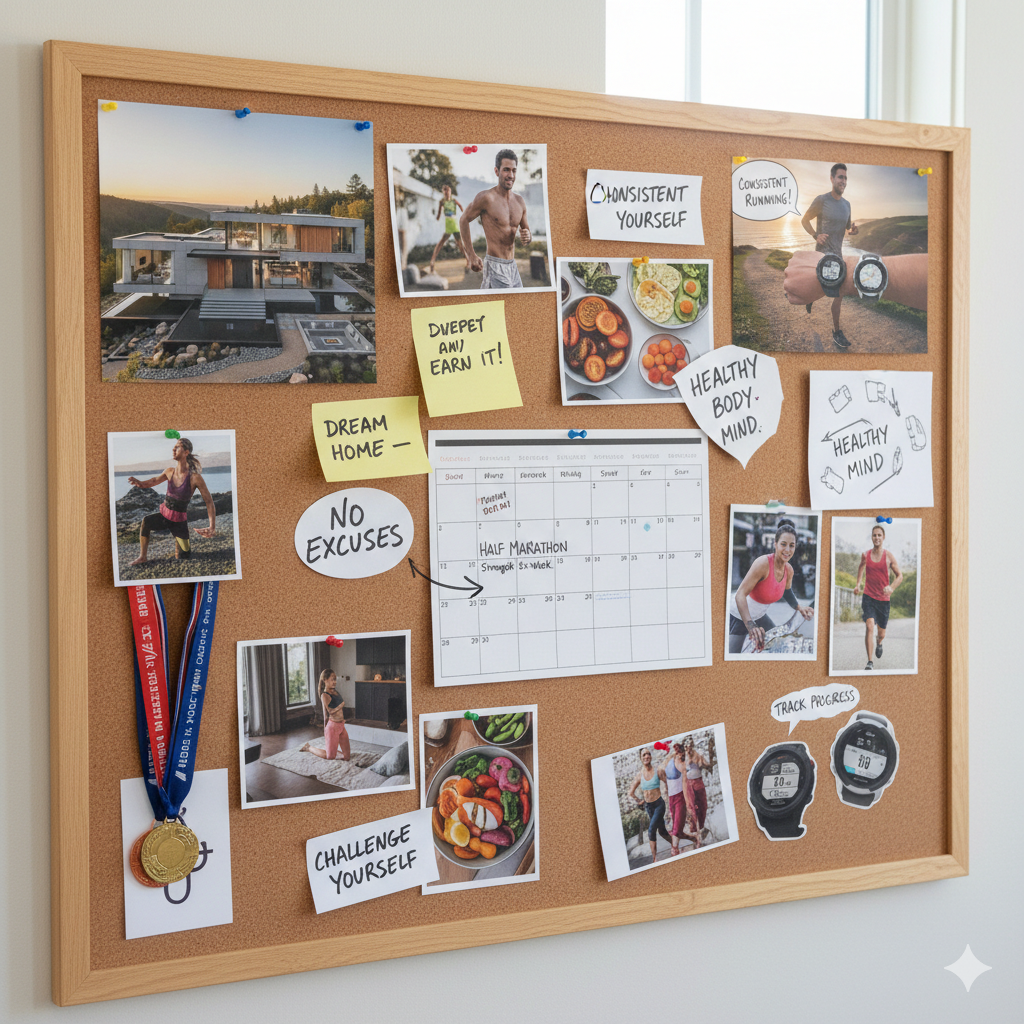
Motivation is rarely a constant. It rises with early enthusiasm and fades under stress, busy schedules, or slow progress. A fitness vision board helps bridge that gap by turning abstract intentions into visible, emotionally compelling reminders of what you are building—and why. When designed with care, it becomes more than a collage. It becomes a decision-making tool that reinforces fitness goal setting, strengthens commitment, and keeps your daily actions aligned with your long-term direction.
This guide explains how to create a fitness vision board that supports sustainable progress, whether your priorities include weight loss, strength, endurance, or a stronger fitness mindset. You will learn how to plan it, build it, and use it for consistent follow-through.
Understanding Your Fitness Vision Board Goals
What Is a Fitness Vision Board & Why It Works
A fitness vision board is a curated collection of images, words, and prompts that represent the outcomes you want and the person you intend to become through training. Unlike a simple list of workout goals, a vision board engages attention and emotion—two forces that strongly influence behavior. When you see your priorities daily, you reduce decision fatigue, minimize distraction, and reinforce identity-based habits such as “I train consistently” or “I fuel my body well.”https://www.teepublic.com/t-shirt/50453002-penguin?store_id=2851997
It works because it makes goals concrete. Your brain responds to vivid cues more readily than vague aspirations. A thoughtfully designed board can function as a personal gym motivation board, reminding you of your purpose before a workout, after a stressful day, or during periods when progress feels slow.
Clarifying Your Fitness Goals (Weight Loss, Strength, Endurance, Mindset)
The most effective vision board ideas begin with specificity. Before collecting images, clarify what “success” means in measurable and meaningful terms. Your vision board should represent outcomes, but also the process and values that will produce them.
- Weight loss: Focus on sustainable behaviors and milestones—consistent training, balanced meals, improved sleep, or a target waist measurement. A weight loss vision board is most powerful when it emphasizes health, confidence, and capability rather than unrealistic standards.
- Strength: Define performance objectives such as a deadlift goal, a first pull-up, or improved push-up volume. Include cues for technique, mobility, and recovery to support long-term progression.
- Endurance: Anchor your board in events and benchmarks: a 5K time, a long hike, or weekly mileage consistency. Visual prompts for pacing, breathing, and training structure can keep you grounded.
- Mindset: Many plateaus are psychological rather than physical. Incorporate prompts about discipline, patience, self-respect, and resilience. A strong fitness mindset turns “motivation” into routine.
As you clarify your goals, distinguish between what you want to achieve and what you are willing to do repeatedly. Long-term transformation is built on repeatable actions.
Planning Your Fitness Vision Board
Choosing a Theme and Style for Your Vision Board
A cohesive theme makes your board easier to interpret at a glance and more pleasant to revisit. Choose a style that matches your personality and environment—something you will actually want to look at daily.
- Minimalist: Clean design, fewer elements, high clarity. Ideal if you prefer focus over decoration.
- Athletic performance: Training metrics, movement photos, competition imagery, and skill progression.
- Wellness-centered: Sleep routines, meal prep, stress management, mobility work, and mental health cues.
- Identity-based: Words and visuals describing who you are becoming: consistent, strong, composed, resilient.
Decide early whether you want a physical board, a digital version, or both. A physical board can be tactile and memorable; a digital board is portable and easy to update. Many people use a dual approach: a physical board at home and a digital version as a phone wallpaper for constant fitness motivation.
Gathering Inspiring Images, Quotes, and Affirmations
Collect materials that feel personal rather than generic. The goal is not to impress anyone; it is to create cues that trigger commitment. Consider gathering content in these categories:
- Outcome imagery: Photos that represent your goal state—finishing a race, lifting confidently, moving with agility, feeling energized.
- Process cues: Running shoes by the door, a barbell setup, a meal prep container, a calendar with training sessions marked.
- Environmental prompts: A calm kitchen, a tidy training space, or a trail that symbolizes your preferred routine.
- Quotes and affirmations: Choose language that is specific and steady rather than dramatic. Examples include “Consistency over intensity,” “Train for longevity,” or “I keep promises to myself.”
If you are prone to all-or-nothing thinking, avoid slogans that encourage extremes. Select statements that reinforce sustainability, self-respect, and progression.
How to Create a Fitness Vision Board Step by Step
Step-by-Step Guide to Building a Digital or Physical Vision Board
1) Define your board’s purpose
Write a short intention statement before you start assembling. For example: “This board supports my workout goals by keeping my training schedule, nutrition habits, and recovery priorities visible.” A clear purpose keeps your board focused and prevents it from becoming a random collage.
2) Choose your format and tools
- Physical board: Poster board or corkboard, magazines, printed photos, scissors, glue, pins, markers, and optional washi tape.
- Digital board: Canva, PowerPoint, Google Slides, or a vision-board app. Select a background size that fits your device (desktop wallpaper, phone lock screen, or tablet).
3) Select 6–12 core anchors
Pick a small set of elements that capture your primary objectives. Examples include: a target race distance, a strength benchmark, a weekly training schedule, a recovery routine, a motivating affirmation, and a reminder of your “why.” Fewer anchors often create stronger focus.
4) Add supportive details without clutter
Once the main anchors are placed, add secondary cues that reinforce behavior: hydration, mobility, protein goals, step targets, or bedtime consistency. Keep everything readable. If the board feels visually noisy, your attention will skip it.
5) Include practical reminders
Motivation improves when friction decreases. Add small prompts that remove barriers: “Pack gym bag the night before,” “Schedule workouts like meetings,” or “Plan three go-to breakfasts.” These cues translate inspiration into action.
6) Finalize and place it where it will be seen
Once complete, set it up immediately. A vision board has no value hidden in a drawer. If you created a digital version, export it in the correct resolution and set it as your wallpaper.
Tips for Making Your Fitness Vision Board More Motivating and Personal
- Use identity language: Replace “I want to work out” with “I am a person who trains consistently.” This supports a durable fitness mindset.
- Balance aspiration with realism: Use images that inspire you, but ensure the path is believable. Unrealistic ideals erode motivation over time.
- Highlight behaviors, not just outcomes: Include sleep, mobility, nutrition, and stress regulation. These are often the hidden levers behind visible change.
- Make it measurable: Add clear benchmarks such as “3 strength sessions/week,” “8,000 steps/day,” “10-minute mobility after training,” or a performance goal date.
- Reflect your preferences: If you dislike running, do not build a board around it. Your board should support the plan you can sustain.
Above all, treat it as a living document. A vision board is not a one-time craft project; it is a personal framework for consistent execution.
Using Your Fitness Vision Board for Long-Term Success
Where to Display Your Vision Board for Daily Motivation
Visibility determines effectiveness. Place your board where it will intersect with your routine and decision points:
- Bedroom or closet: A powerful location if morning training is part of your plan.
- Home gym or workout corner: Ideal for reinforcing your identity as someone who shows up.
- Kitchen or pantry area: Useful for nutrition consistency and mindful choices.
- Phone lock screen or desktop: A digital fitness vision board keeps your priorities present throughout the day.
If you share your space, choose a discreet placement that still provides daily exposure. The objective is consistent contact, not public display.
How to Review, Update, and Track Progress with Your Vision Board
Your board becomes more powerful when paired with a simple review routine. Set a recurring weekly check-in—ten minutes is sufficient—to keep it relevant and actionable.
- Weekly review: Ask what went well, what created friction, and what needs adjustment. If the board no longer reflects your actual plan, update it.
- Monthly refinement: Replace goals that are completed or no longer meaningful. Add new milestones to maintain forward momentum.
- Progress tracking: Pair the board with a training log, habit tracker, or calendar. Visual inspiration works best when it connects to evidence of action.
- Seasonal resets: Training phases change. Strength cycles, endurance blocks, and recovery periods should be reflected so your board supports the right focus at the right time.
When you treat the board as a strategic tool—not decoration—it becomes a reliable system for fitness motivation and long-term consistency.
Conclusion
Creating a vision board is not about wishful thinking; it is about designing an environment that makes follow-through more likely. By clarifying your goals, choosing a focused theme, and building a board that emphasizes both outcomes and daily behaviors, you create a durable compass for your training. If you have been searching for how to create a fitness vision board that genuinely supports your workout goals, start simple, keep it visible, and review it regularly. Over time, the board becomes a record of your evolving standards—and a practical reminder that progress is built through repeated, intentional choices.
How to Incorporate Mindfulness into Your Commute
How to Meditate for Increased Patience
Top 5 Nutrition Tips for Marathon Runners
Celestial Stackmaster
Core Loop: Vertical block stacking with slicing physics.
Precision Rewards: “Perfect” drops snap into place with a glow effect.
Dynamic Difficulty: Block speed increases as you climb higher.
Atmospheric Visuals: A cosmic “Zenith” background with color-shifting fog that evolves with your score.
Responsive Controls: Fully playable on desktop (click) and mobile (tap).
Camera System: Dynamic camera that tracks your progress toward the stars.
How to Play
Objective: Stack blocks as high as possible without missing the tower.
Controls: Click or Tap anywhere to drop the moving block onto the stack.
Pro Tip: Align the block perfectly with the one below to keep its full size; otherwise, the overhanging part will be sliced off!