
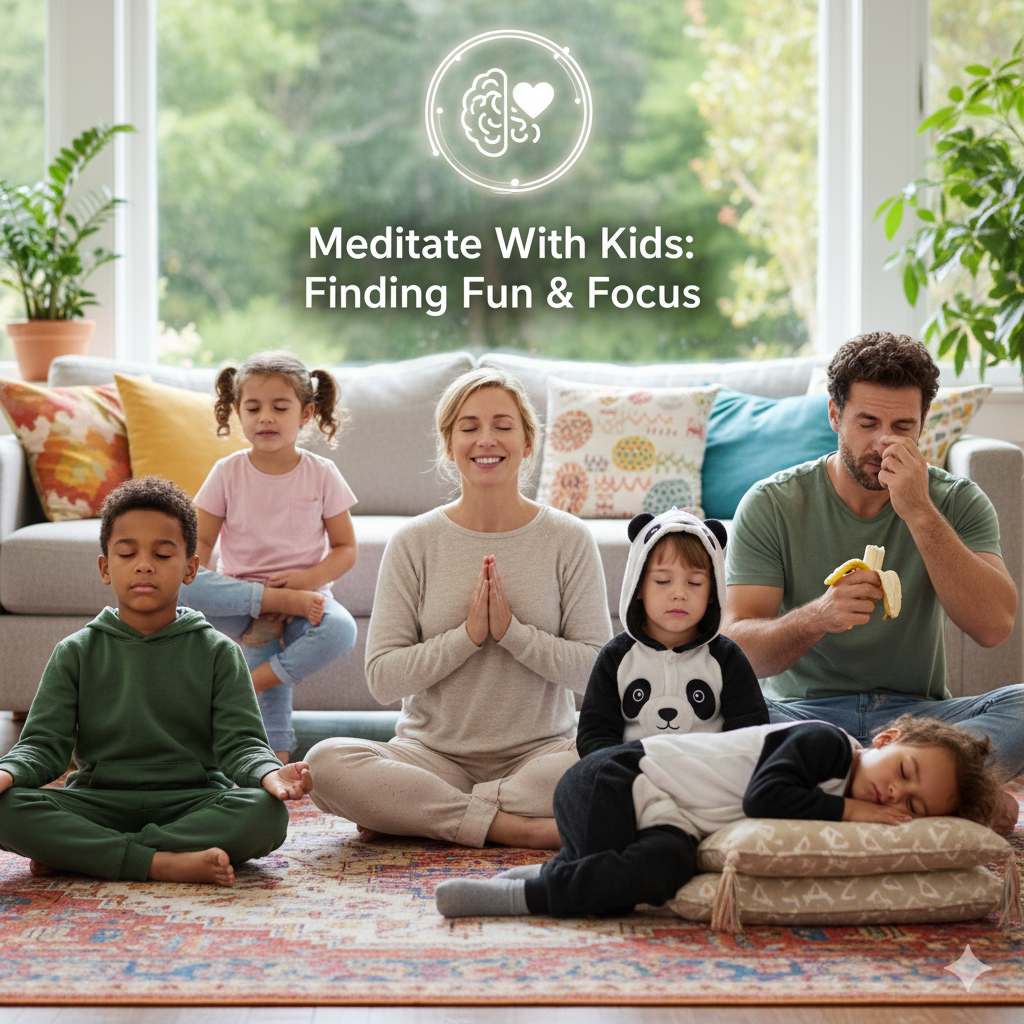
Introducing meditation for kids can feel like an ambitious goal in a busy household. Yet when approached with warmth, structure, and age-appropriate expectations, it becomes one of the simplest ways to help children develop emotional steadiness and attention skills. A consistent family meditation practice does not require long sessions, perfect silence, or special equipment. It requires a clear intention, a supportive environment, and techniques suited to how children naturally learn—through play, imagination, and repetition.
What Is Meditation for Kids and Why It Matters
Meditation for kids is the practice of guiding children to notice their inner experience—breath, body sensations, thoughts, and emotions—without pressure to change what they feel. In children, meditation often looks less like sitting perfectly still and more like brief, structured moments of mindful attention. It may include listening carefully to a sound, following the rise and fall of the belly, or using a guided story that teaches calm focus.
In a culture that rewards constant stimulation, mindfulness for children creates a counterbalance. It gives children a reliable way to pause, regulate their nervous system, and return to the present. Over time, they learn that feelings come and go, that impulses can be noticed rather than immediately acted upon, and that calm is a skill—not a personality trait.
Benefits of Meditating with Kids (Emotionally, Mentally, Socially)
The benefits of meditation for kids are both immediate and cumulative. A short practice can help a child settle after school or transition to bedtime. A sustained routine can strengthen self-awareness and resilience in ways that extend far beyond the meditation session.
- Emotional benefits: Children become better at recognizing emotions early—before frustration becomes a meltdown. Meditation supports self-soothing, patience, and a more stable mood, particularly during transitions or uncertainty.
- Mental benefits: Simple mindfulness exercises train attention, working memory, and cognitive flexibility. Children practice returning to a focal point (such as breath or sound), which can translate into improved focus and task persistence.
- Social benefits: When children notice their internal states, they tend to respond more thoughtfully to others. Meditation can strengthen empathy, reduce reactive behavior, and support more respectful communication at home and in school settings.
Importantly, meditating with children can reshape the emotional climate of the household. A parent who practices alongside a child models regulation in real time, making calm feel attainable rather than imposed.
Common Myths and Questions Parents Have About Kids’ Meditation
Parents often hesitate because they assume meditation must look a certain way. Clarifying a few misconceptions helps set realistic expectations.
- Myth: “My child is too energetic to meditate.” High energy is not a barrier; it is information. Many kids meditation techniques use movement, sensory focus, or brief intervals that match a child’s developmental stage.
- Myth: “Meditation requires emptying the mind.” The goal is not an empty mind. The goal is noticing what is present—thoughts included—and practicing gentle return to an anchor such as breathing or listening.
- Question: “How long should we meditate?” For children, shorter is usually better. One to five minutes can be effective when done consistently.
- Question: “What if my child laughs, fidgets, or refuses?” That is normal. Meditation with kids is a skill-building activity, not a performance. Restlessness can be met with flexible techniques and calm boundaries.
How to Prepare Your Child (and Yourself) to Meditate
How to meditate with kids begins before the first breath-count or guided visualization. Preparation is largely about reducing friction: clarifying expectations, choosing a predictable routine, and ensuring the adult leads with steadiness. Children take their cues from the tone you set.
Approach the practice as an invitation rather than a correction. If meditation is presented as a punishment for being “too loud” or “too emotional,” children will resist it. If it is framed as a tool that helps everyone feel better, it becomes a shared language of care.
Creating a Kid-Friendly Meditation Space at Home
A dedicated meditation corner can help children associate a physical space with calm attention. It does not need to be elaborate. A consistent location matters more than aesthetics.
- Keep it simple: A small rug, a cushion, or a chair is enough. A clutter-free area reduces sensory overload.
- Add a gentle anchor: A soft blanket, a small hourglass timer, or a “calm jar” (glitter in water) can serve as a visual cue to settle.
- Make it welcoming, not rigid: Some children prefer sitting, others prefer lying down. Allow options while maintaining one core rule: the body stays safe and relatively still for the agreed time.
- Reduce distractions: Silence notifications, lower harsh lighting, and keep screens out of sight. Even brief interruptions can derail a child’s attention.
When to Meditate with Kids: Best Times, Length, and Frequency
Timing can determine whether mindfulness for children feels effortless or impossible. Choose moments when the household naturally transitions and the child’s basic needs have been met.
- Best times: After waking (to set a calm tone), after school (to downshift), or before bed (to support sleep readiness). For some families, a brief “reset” before homework is ideal.
- Length: Toddlers may start with 30–60 seconds. Preschoolers often do well with 1–3 minutes. School-age children can build toward 5–10 minutes. Teens may prefer 10–15 minutes, especially with guided options.
- Frequency: Aim for consistency rather than intensity. Three to five days per week can create momentum; daily practice is excellent when it remains sustainable.
Use a predictable structure: a short beginning cue (“We are going to practice being calm and noticing our breath”), a simple practice, and a brief closing (“What did you notice?”). Children thrive on this kind of clear arc.
Step-by-Step Guide: How to Meditate with Kids of Different Ages
Effective guided meditation for kids respects development. Younger children need concrete images and sensory anchors; older children can handle more nuanced reflection. The steps below can be adapted to fit your child’s temperament and attention span.
Simple Meditation Techniques for Toddlers and Preschoolers
1) Start with a clear, short intention.
Use language your child understands: “We will practice quiet bodies for one minute and listen to our breathing.” Keep the goal specific and achievable.
2) Choose a playful anchor.
Toddlers and preschoolers benefit from imaginative cues that translate abstract ideas into tangible experiences.
- “Teddy belly breathing”: Place a small stuffed animal on your child’s belly while lying down. Invite them to watch it rise and fall. Count five slow breaths together.
- “Smell the flower, blow the candle”: Inhale gently through the nose as if smelling a flower; exhale slowly as if blowing out a candle. Repeat three to five cycles.
- “Listening ears” practice: Ring a soft bell or tap a glass. Ask your child to raise a hand when they can no longer hear the sound. This simple mindfulness activity for children trains attention without requiring stillness for long.
3) Keep sessions brief and end on success.
For young children, stopping while they are still engaged is more beneficial than pushing for extra minutes. A positive ending builds willingness for the next session.
4) Close with a simple reflection.
Ask one gentle question: “Did your belly move?” or “Was the sound long or short?” Avoid over-processing. The goal is noticing, not analysis.
Guided Meditations and Mindfulness Games for School-Age Kids and Teens
1) Begin with posture and permission.
Invite your child to sit comfortably, feet on the floor or cross-legged. Offer a choice: eyes closed or softly focused. Remind them that wandering thoughts are normal.
2) Use structured, age-appropriate guidance.
School-age children respond well to short scripts and interactive mindfulness activities for children.
- Five-finger breathing: Trace one hand with the index finger of the other. Inhale while tracing up a finger, exhale while tracing down. Repeat for all five fingers. This is one of the most accessible kids meditation techniques for focus and calm.
- Body scan (2–5 minutes): Guide attention from feet to head. Use concise prompts: “Notice your feet. Notice your legs. Notice your belly.” Encourage relaxation without forcing it.
- Thoughts-as-clouds visualization: Invite them to imagine thoughts passing across the mind like clouds. The practice is to observe and return to breathing, not to chase each thought.
- Mindful minutes game: Set a timer for one minute. The goal is to notice each inhale and exhale. If attention wanders, simply restart counting at one. This creates a measurable, nonjudgmental challenge.
3) Add relevance for teens.
Teenagers are more likely to engage when the practice connects to their lived experience: academic pressure, social dynamics, sleep, sports performance, or emotional intensity. Offer autonomy: let them select a guided meditation for kids that matches their mood—calm, confidence, focus, or stress relief.
4) End with a practical carryover.
Ask: “When might this help later today?” This bridges the practice to real-world regulation—before a test, after an argument, or when feeling overwhelmed.
Tips, Challenges, and Making Meditation a Daily Habit
Even the best plan will meet resistance. Children are honest about boredom, discomfort, and skepticism. The key is to treat challenges as part of the process, not evidence of failure. Consistency is built through small wins and predictable routines.
How to Keep Kids Engaged and Handle Restlessness
Restlessness is not a problem to eliminate; it is a cue to adjust the method. When children struggle to settle, refine the practice rather than insisting on longer stillness.
- Use shorter intervals: Two minutes of genuine attention is more valuable than ten minutes of frustration.
- Offer guided structure: Many children do better with a guided meditation for kids than with silence. A calm voice provides an external anchor until internal attention develops.
- Incorporate movement: Try mindful stretching, slow walking, or “shake and settle” (ten seconds of shaking out arms and legs, followed by ten seconds of stillness).
- Normalize distraction: Teach a simple script: “Wandering is fine. Notice it. Return to breath.” This prevents perfectionism and keeps the tone encouraging.
- Avoid turning it into a discipline tool: If meditation is used only after misbehavior, it becomes associated with shame. Keep it neutral and supportive.
Turning Meditation into a Fun Family Ritual
A family meditation practice becomes sustainable when it feels like a shared value rather than another obligation. Ritual creates meaning, and meaning creates repetition.
- Create a consistent cue: A short phrase, a bell, or lighting a candle (with supervision) signals that it is time to settle.
- Rotate “leaders”: Let children choose the day’s technique: belly breathing, listening practice, five-finger breathing, or a short guided track. Ownership increases participation.
- Pair it with existing routines: Attach meditation to something that already happens daily—after brushing teeth, before reading, or right after dinner.
- Keep reflection brief: One sentence each: “I noticed my shoulders were tight,” or “My mind was busy.” This builds emotional vocabulary without making the moment heavy.
Over time, teaching kids to meditate becomes less about the session itself and more about the shared skill of pausing. Children begin to recognize cues of stress and reach for calm strategies independently, which is one of the most meaningful outcomes of mindfulness for children.
Conclusion
Learning how to meditate with kids is an investment in practical resilience. With a child-friendly space, realistic timing, and flexible, age-appropriate methods, meditation for kids can become a steady source of calm in the home. Start small, stay consistent, and focus on the essentials: noticing, returning, and practicing together. The benefits are not only personal—better emotional regulation and attention—but relational, strengthening patience, empathy, and the atmosphere of the entire family.