
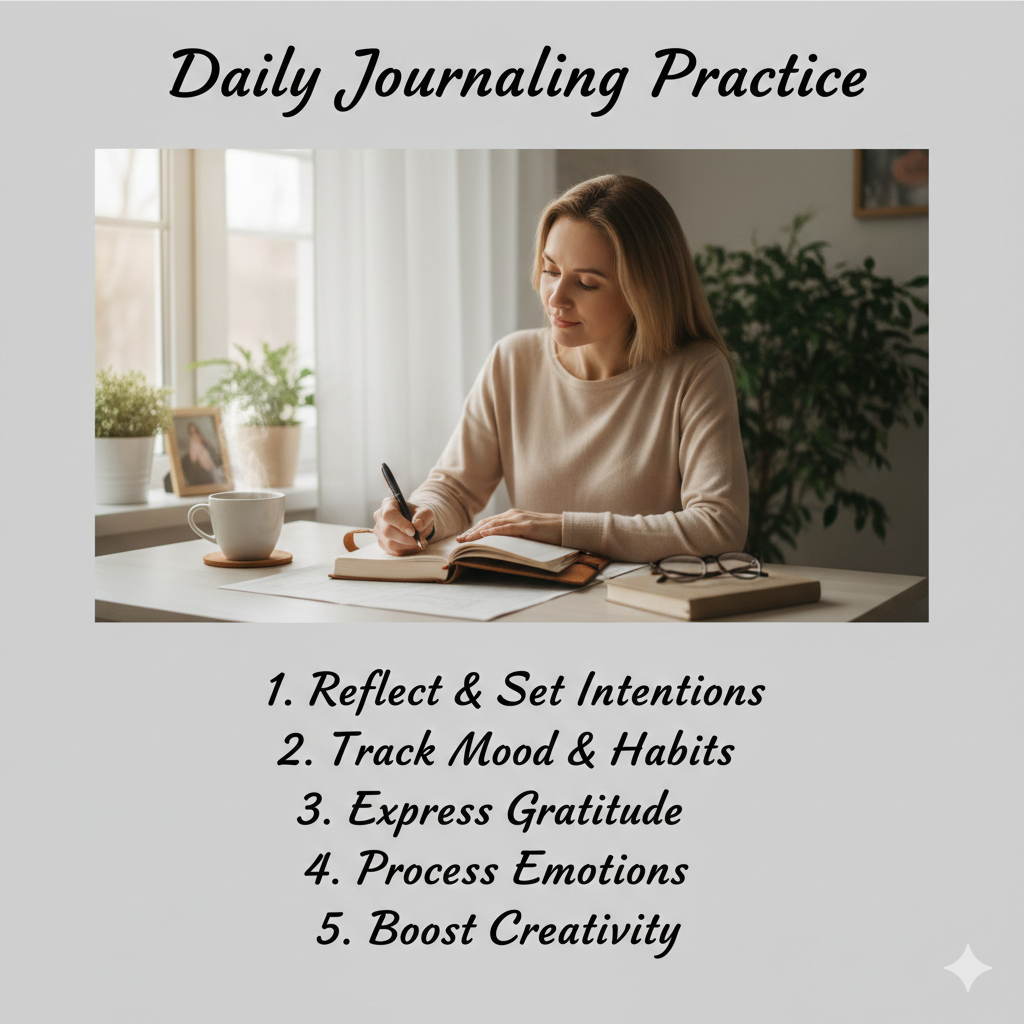
Starting a daily journaling practice is one of the most accessible ways to cultivate clarity, emotional balance, and self-direction. Yet many people abandon journaling after a few enthusiastic days because they aim for perfection, choose an unfitting format, or underestimate how much structure helps. The good news is that journaling does not require literary talent, long sessions, or a dramatic life story. It requires a method you can sustain, a routine that respects your schedule, and prompts that keep your mind engaged.
This guide explains how to start journaling in a way that feels natural and durable. You will learn the core benefits of daily journaling, how to choose a format that matches your personality, and how to build a journaling routine that holds up even on busy days.
Why Start a Daily Journaling Practice?
Benefits of Daily Journaling for Mental Health and Well-Being
Journaling is a quiet form of mental organization. When thoughts remain unspoken, they tend to loop, intensify, and blur. Writing, by contrast, gives the mind a container. For many people, mental health journaling becomes a practical way to reduce stress by translating diffuse worries into concrete sentences that can be examined rather than endured.
Over time, a consistent practice can help you:
- Regulate emotions by naming what you feel and identifying triggers with greater precision.
- Strengthen self-awareness through patterns you can only see in hindsight—recurring fears, needs, and values.
- Improve resilience by documenting how you handled difficult periods and what genuinely helped.
- Support healthier decisions because clarity often precedes change.
Journaling does not replace professional support when it is needed. However, it can complement therapy, coaching, and lifestyle changes by giving you a reliable tool for reflection between sessions and across seasons of life.
How Journaling Improves Focus, Creativity, and Productivity
A journal is not only a place for feelings; it is also a workshop for attention. When you write down priorities, unresolved questions, and next actions, you reduce the cognitive burden of holding everything in your head. That shift can translate into better focus and calmer execution.
From a performance perspective, journaling often improves:
- Focus, by clarifying what matters today and what can wait.
- Creativity, by allowing rough ideas to exist without immediate judgment—many insights arrive in imperfect sentences.
- Productivity, through quick planning, post-task review, and identifying obstacles that repeatedly disrupt your work.
For professionals and students alike, journaling becomes a private planning room—one that turns intention into action without the noise of constant input.
Choosing the Right Journaling Method for You
Types of Journals: Bullet, Gratitude, Reflective, and Digital
Journaling for beginners is easiest when the method matches both your temperament and your constraints. If you like structure, choose a format with clear categories. If you prefer freedom, choose a reflective style. If you struggle with consistency, choose something minimal and repeatable.
- Bullet journal: A flexible system that combines planning, tracking, and notes using symbols, short entries, and collections. If you enjoy organization and want a hybrid of planner and diary, explore bullet journal ideas such as habit trackers, weekly spreads, and project logs.
- Gratitude journal: A simple format focused on what is working. It is particularly effective for shifting attention away from chronic negativity and toward evidence of progress, support, and meaning.
- Reflective journal: A narrative approach for processing experiences, decisions, and emotions. This is often the best choice if you want deeper insight and personal growth.
- Digital journal: Ideal if you type faster than you write, travel frequently, or want searchable entries. Digital journaling can also support habit consistency with reminders and templates.
You do not need to select one method forever. Many people rotate: bullet journaling for weekdays and reflective writing on weekends, or gratitude journaling in the morning and a short review at night.
Tools and Supplies: Notebooks, Apps, and Pens That Make You Want to Write
The best tools are the ones you will actually use. A journal should feel inviting, not precious. Choose materials that reduce friction and encourage immediacy.
- Notebook: A durable, medium-sized notebook often strikes the best balance—portable enough to carry, spacious enough to write comfortably. Dot-grid pages suit bullet journaling; lined pages suit reflective entries.
- Pens: A smooth, reliable pen matters more than luxury. If your pen skips or smudges, you will hesitate. Aim for comfort and consistency.
- Apps: Look for simple features: quick entry, tagging, search, and optional encryption. If you are building a journaling habit, choose an app that opens fast and feels uncluttered.
One practical rule: keep your journal visible. Accessibility is a form of discipline. If you must search for your notebook each day, your routine becomes a negotiation rather than a default.
How to Start and Stick to a Daily Journaling Routine
Step-by-Step: Setting Up a Simple, Sustainable Journaling Habit
Consistency is not built through intensity; it is built through repeatability. The most sustainable journaling routine is one you can complete even when you are tired, busy, or uninspired.
- Define your purpose in one sentence. Examples: “I journal to reduce anxiety,” “I journal to think better,” or “I journal to track progress.” A clear purpose prevents the practice from feeling optional.
- Choose a minimum viable entry. Commit to 3–5 minutes or 5–10 lines. If you write more, excellent, but your baseline must be small.
- Attach journaling to an existing habit. Pair it with coffee, the end of a workday, brushing your teeth, or shutting down your laptop. Habit stacking removes decision fatigue.
- Use a simple structure. For example: (1) What happened today? (2) What mattered? (3) What is next? Structure makes it easier to begin.
- Choose a consistent time window. Morning journaling can shape the day; evening journaling can help you decompress. Select the window you can protect most reliably.
- Track completion lightly. A small checkmark on a calendar or a simple streak counter provides momentum without turning journaling into a performance metric.
When you are learning how to start journaling, your primary goal is not eloquence. It is continuity. The quality of your insights rises naturally as the habit stabilizes.
Overcoming Common Journaling Roadblocks and Writer’s Block
Most journaling obstacles are predictable. Addressing them in advance prevents minor friction from becoming a reason to quit.
- “I do not have time.” Reduce the scope. A two-minute entry is still a daily practice. Write a single paragraph, a short list, or three sentences.
- “I do not know what to write.” Use prompts, templates, or a repeatable set of questions. Remove the burden of inventing a topic.
- “I am worried someone will read it.” Use a locked drawer, a password-protected app, or write in a coded shorthand. Privacy is essential to honest reflection.
- “I missed a day and feel behind.” Do not backfill. Simply write today’s date and continue. A journal is a record, not a test.
- “My entries sound repetitive.” That repetition is data. Patterns reveal what you need to change, what you avoid, and what you value.
Writer’s block often disappears when you permit unfinished thoughts. Begin with a plain sentence such as: “Today feels heavy because…” or “The main thing on my mind is…” Momentum follows motion.
Journaling Prompts and Ideas to Keep You Inspired
Daily Journal Prompts for Self-Reflection and Personal Growth
Strong journaling prompts do more than fill the page; they direct attention toward insight. Rotate prompts to avoid autopilot and to encourage different forms of thinking—emotional, practical, philosophical, and strategic.
- What is one feeling I experienced strongly today, and what triggered it?
- What did I avoid today, and what would it cost me to face it?
- What decision is waiting for me, and what information do I still need?
- What did I do well today, even if it felt small?
- What pattern keeps repeating in my life, and what might it be teaching me?
- What do I need more of right now: rest, connection, structure, or challenge?
- What belief is shaping my behavior, and is it still true?
- What would I tell a friend in my situation—and why am I not telling myself the same?
- What am I grateful for today, and what does it reveal about what I value?
- What is one meaningful step I can take tomorrow?
If your goal is stress relief, keep prompts gentle and grounding. If your goal is growth, choose prompts that invite honest accountability without harshness.
Creative Journaling Ideas to Make Your Practice More Enjoyable
Creativity does not require artistic skill; it requires permission to experiment. Introducing variety can refresh your daily journaling practice while preserving the habit’s core simplicity.
- One-line-a-day journaling: Capture a single sentence each day. This is ideal when life is intense and time is scarce.
- Dialogue journaling: Write a conversation between “Current Me” and “Future Me,” or between your fear and your wiser voice.
- Theme weeks: Dedicate each week to a theme—health, career, relationships, learning—and keep entries focused and coherent.
- Micro-reviews: End each day with three bullets: highlight, challenge, lesson. The format is fast yet revealing.
- Visual elements: Add simple boxes, separators, or minimal doodles if it helps you return to the page. For bullet journaling, incorporate clean trackers or monthly reflections rather than overly complex layouts.
The purpose of creative variation is not decoration; it is engagement. The practice should feel like a tool you look forward to using, not an obligation you endure.
Conclusion
A sustainable journaling practice is built on clarity and kindness: clarity about what the journal is for, and kindness about how imperfect the entries may be. Start small, choose a format that fits your life, and rely on prompts when your mind feels blank. With time, journaling becomes more than a habit. It becomes a reliable method for thinking, recovering, deciding, and growing.
If you want the simplest possible starting point, commit to five minutes a day for two weeks. Write what is true, write what you notice, and write what you will do next. That is enough to begin—and often enough to continue.