
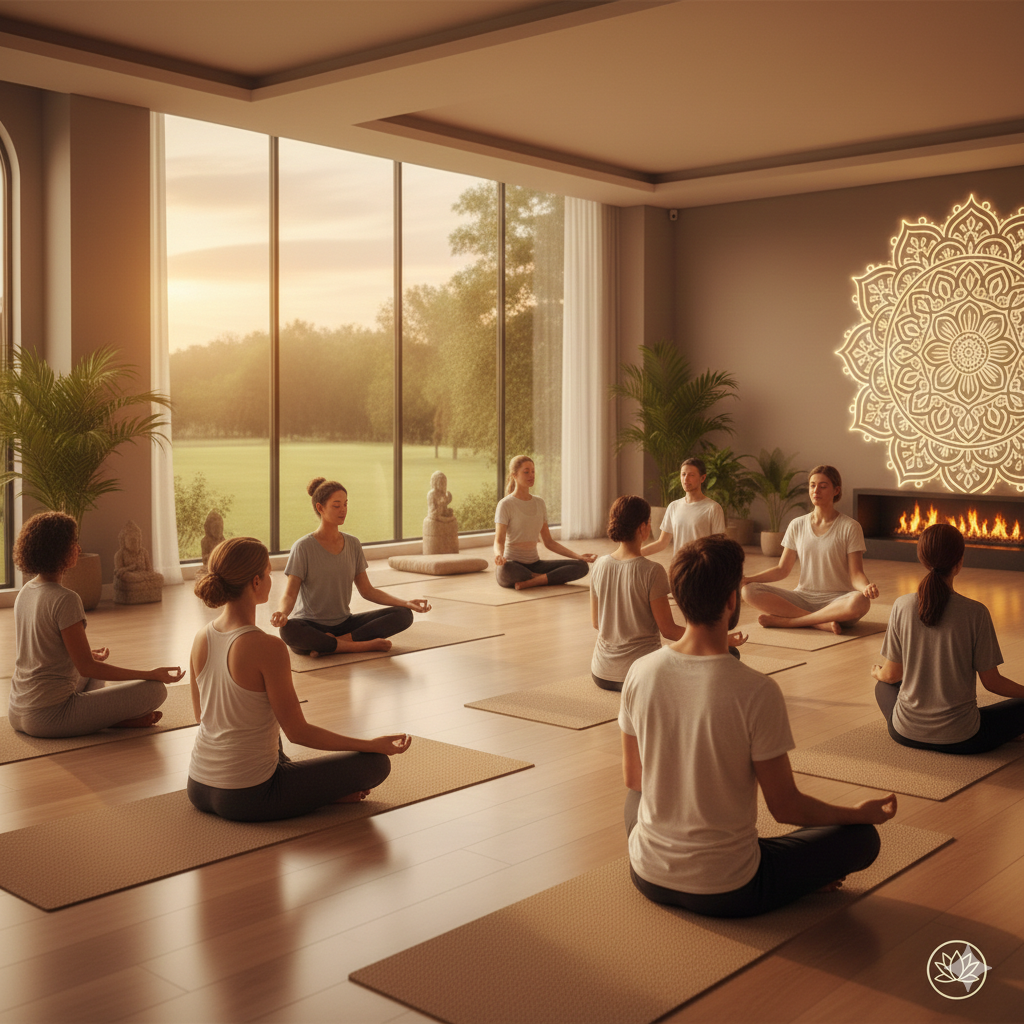
Creativity rarely appears on command. It emerges when attention is steady, the mind is quiet enough to notice subtler connections, and internal pressure loosens its grip. Meditation can create that mental climate. By training awareness and regulating stress responses, it becomes easier to access original ideas, sustain focus, and approach problems with flexibility rather than force. This article explores practical meditation techniques for creativity—ranging from mindfulness to guided imagery—and shows how to build a daily meditation routine that supports long-term creative growth.
Understanding Meditation Techniques for Enhanced Creativity
What Is Creative Meditation and How Does It Work?
Creative meditation is not a separate mystical category of practice; it is the deliberate use of contemplative methods to support imaginative thinking, insight, and novel problem-solving. At its core, it works by shifting the brain from habitual, reactive loops into a more receptive, spacious mode of attention. When the nervous system settles, cognition becomes less defensive and more exploratory—ideal conditions for experimentation and original synthesis.
https://www.teepublic.com/t-shirt/53246542-yoga?store_id=2851997
Many creative breakthroughs occur during “soft focus” states: moments when concentration is present, yet not rigid. Meditation cultivates that balance. Instead of chasing ideas, you learn to observe thoughts, sensations, and emotions without immediate judgment. Over time, this reduces mental noise and creates room for unexpected associations—an essential mechanism to boost creative thinking in any discipline, from design and writing to product development and research.
https://www.teepublic.com/t-shirt/53135728-yoga-wellness?store_id=2851997
Key Benefits of Meditation for Creative Thinking and Innovation
The benefits extend beyond relaxation. Consistent practice strengthens mental capacities that directly support innovation and artistic output:
- Improved attentional control: You can stay with a concept long enough to develop it, without scattering your energy.
- Greater cognitive flexibility: You become less attached to a single approach, which is central to meditation for innovation and iterative work.
- Reduced performance anxiety: Lower stress makes experimentation safer, encouraging risk-taking and bolder choices.
- Enhanced emotional clarity: Recognizing emotional patterns helps you avoid sabotaging momentum through self-criticism or avoidance.
- Stronger pattern recognition: A calmer mind detects relationships and nuances that are easily missed in a hurried state.
In practice, these changes help enhance creative flow: less friction at the start, fewer interruptions midstream, and a more confident return after setbacks.
Best Meditation Techniques to Unlock Creativity
Mindfulness Meditation Practices for Boosting Creative Flow
Mindfulness for creativity begins with a simple premise: attention can be trained. By repeatedly returning to a stable anchor, you develop the ability to notice distractions without being pulled into them. This is especially valuable for creative professionals who must work despite uncertainty.
1) Breath-anchor mindfulness (10–15 minutes)
Sit comfortably and bring attention to the natural breath—nostrils, chest, or abdomen. When thoughts arise (they will), label them lightly—“planning,” “judging,” “remembering”—and return to the breath. This practice refines concentration and reduces the impulse to micromanage outcomes, making it easier to enter and sustain a productive creative state.
https://www.teepublic.com/t-shirt/53009291-happy-valentine?store_id=2851997
2) Open-monitoring mindfulness (8–12 minutes)
Instead of focusing tightly on the breath, allow awareness to include sounds, sensations, and thoughts as they come and go. You are not selecting or rejecting; you are observing. Open monitoring is a powerful method to boost creative thinking because it trains the mind to tolerate ambiguity—often the birthplace of insight—and to detect emerging ideas without prematurely evaluating them.
3) Sensory mindfulness for makers (5–10 minutes)
Before starting creative work, spend a few minutes attending to a single sensory field: the feeling of your hands, the visual texture of the environment, or the sounds in the room. This grounds attention in direct experience, easing the transition from abstract rumination into tangible production—especially helpful for artists, designers, and craftspeople.
Guided Visualization and Imagery Techniques for Creative Inspiration
Guided visualization for artists and innovators uses mental imagery to stimulate associative networks and evoke emotional tones that can feed the work. Unlike daydreaming, visualization is intentional: it gives the imagination a structured arena where new forms and solutions can surface.
1) The “creative studio” visualization (10 minutes)
Close your eyes and imagine entering a personal studio or workspace. Notice details: light, materials, tools, scents, sounds. Then visualize a current project on a table—unfinished, neutral, open. Ask internally: “What does this work need next?” Wait for an answer in images, words, or feelings. Record any impressions afterward. This technique often bypasses overthinking by inviting intuitive responses.
2) Future-work preview (7–12 minutes)
Imagine a day in the near future where the project is complete. Visualize how it looks, how it functions, and how others interact with it. Then walk backward in time: what steps made it possible? This method can clarify priorities and reveal missing components, making it a practical bridge between inspiration and execution.
3) Symbolic imagery prompt (5–8 minutes)
Choose a single symbol—“door,” “river,” “mirror,” “fire.” In meditation, hold the symbol gently and watch how it evolves. What emotions does it evoke? What stories emerge? For writers and visual creators, this is one of the most efficient creative meditation exercises for generating motifs, themes, and compositions without forcing a concept.
How to Build a Daily Meditation Routine for Creativity
Step-by-Step Daily Meditation Plan for Creative Professionals
A daily meditation routine works best when it is modest, repeatable, and connected to your creative schedule. Consistency matters more than intensity. The plan below is designed to support both idea generation and sustained production.
- Morning (8–12 minutes): Breath-anchor mindfulness. Set a clear intention: “I will work with curiosity,” or “I will experiment without judgment.”
- Pre-work transition (3–5 minutes): Sensory grounding. Let the body settle, then open your tools or documents immediately after.
- Midday reset (5 minutes): Open-monitoring mindfulness. Observe mental clutter, then return to the next task with less residue.
- Evening (7–10 minutes): Guided visualization—creative studio or future-work preview—followed by brief notes. This consolidates insights and primes the subconscious overnight.
If your schedule is demanding, compress it: one focused session is sufficient. Even 10 minutes per day can measurably improve attention stability and emotional regulation—two pillars of sustainable creative output.
Tips to Overcome Common Meditation Challenges for Creatives
Creative people often face distinctive obstacles: restless minds, high sensitivity, and perfectionism. The solution is not stricter control but smarter structure.
- “My mind is too busy.” Treat busyness as the training material. Use a light label (“thinking”) and return to the anchor. Progress is the return, not the absence of thought.
- “I fall asleep.” Meditate upright, reduce session length, and practice earlier in the day. A slightly brighter room also helps.
- “I get impatient.” Switch from breath focus to open monitoring, or use a timed practice with a clear endpoint. Impatience often fades when expectations are explicit.
- “I want results immediately.” Creativity responds to conditions, not coercion. Track small indicators—starting faster, revising with less frustration, noticing better ideas.
- “I feel blocked, so I avoid practice.” Use a five-minute minimum. The aim is continuity. Momentum returns when the ritual remains intact.
Advanced Strategies to Sustain Long-Term Creative Growth
Combining Breathwork, Journaling, and Meditation for Deep Creativity
For deeper creative development, combine methods that regulate physiology, clarify cognition, and capture insights. This triad is particularly effective when you need both emotional depth and technical precision.
1) Settling breathwork (2–4 minutes)
Use slow, even breathing—inhale for four counts, exhale for six. A longer exhale signals safety to the nervous system and reduces inner urgency, making space for nuanced perception.
2) Meditation (10–20 minutes)
Choose one: breath-anchor for focus, open monitoring for ideation, or a brief visualization to provoke imagery. Keep the technique stable for at least a week before changing it; creativity thrives when the mind trusts the process.
3) Structured journaling (5–10 minutes)
Immediately afterward, write without censorship. Then refine with two prompts:
- “What feels most alive or interesting?” (tracks authentic signal)
- “What is the next smallest executable step?” (turns insight into action)
This sequence prevents valuable impressions from evaporating and gradually trains you to translate inner material into concrete creative decisions.
Using Meditation to Break Creative Blocks and Spark New Ideas
To overcome creative block, meditation can be applied tactically. Blocks are rarely a lack of talent; they are often a combination of fear, fatigue, unclear constraints, or excessive self-evaluation. The goal is to reintroduce movement—mentally and behaviorally.
1) The “name the block” practice (6–8 minutes)
Sit quietly and locate the block in the body. Is it tightness in the chest, heaviness in the stomach, tension in the jaw? Name what is present: “pressure,” “uncertainty,” “comparison,” “boredom.” Labeling reduces fusion with the feeling and restores choice.
2) Constraint meditation (5 minutes)
Hold a single constraint in mind: a limited color palette, a word count, one user need, a single message. Breathe with it. Then ask: “What is possible inside this boundary?” Constraints reduce overwhelm and often catalyze originality by narrowing the search space.
3) Micro-iteration reset (3 minutes + action)
Meditate briefly on the breath, then immediately create a small iteration—one sketch, one paragraph, one prototype variation—without judging quality. This interrupts paralysis and reestablishes a feedback loop, which is the true engine of creative progress.
Used consistently, these strategies do more than unblock a single project. They build resilience: the capacity to meet uncertainty with composure, and to keep generating options when the first idea fails.
Conclusion
Meditation techniques for enhanced creativity are not about forcing inspiration; they are about building the mental conditions where inspiration can reliably emerge. Mindfulness strengthens attention and flexibility, guided imagery stimulates associative thinking, and a well-designed daily meditation routine anchors these benefits in real work habits. Over time, integrating breathwork and journaling deepens the process, while targeted practices help you overcome creative block when it inevitably appears. With consistency and a measured approach, meditation becomes a practical tool to enhance creative flow and sustain innovation across the long arc of your craft.
Slither Arcade
Features
- Classic Gameplay: Grow your snake by eating apples while avoiding self-collision.
- Dynamic Difficulty: The game speed increases as you eat more food.
- Juicy Polish: Screen shakes on eating, pulsing food animations, and high-score tracking.
- Responsive Controls: Use Arrow keys, WASD, or swipe on touch devices/mouse.
- Visuals: Custom-generated stylized assets and a minimalist neon background.
How to play:
- Controls: Use Arrow Keys or WASD to change direction. On mobile, Swipe in the direction you want to turn.
- Objective: Eat the glowing red apples to grow and increase your score. The game ends if you collide with your own tail.
The snake wraps around the screen edges, allowing for strategic maneuvers! Enjoy your game.Controls Reminder: The golden apple slows time for 5 seconds