
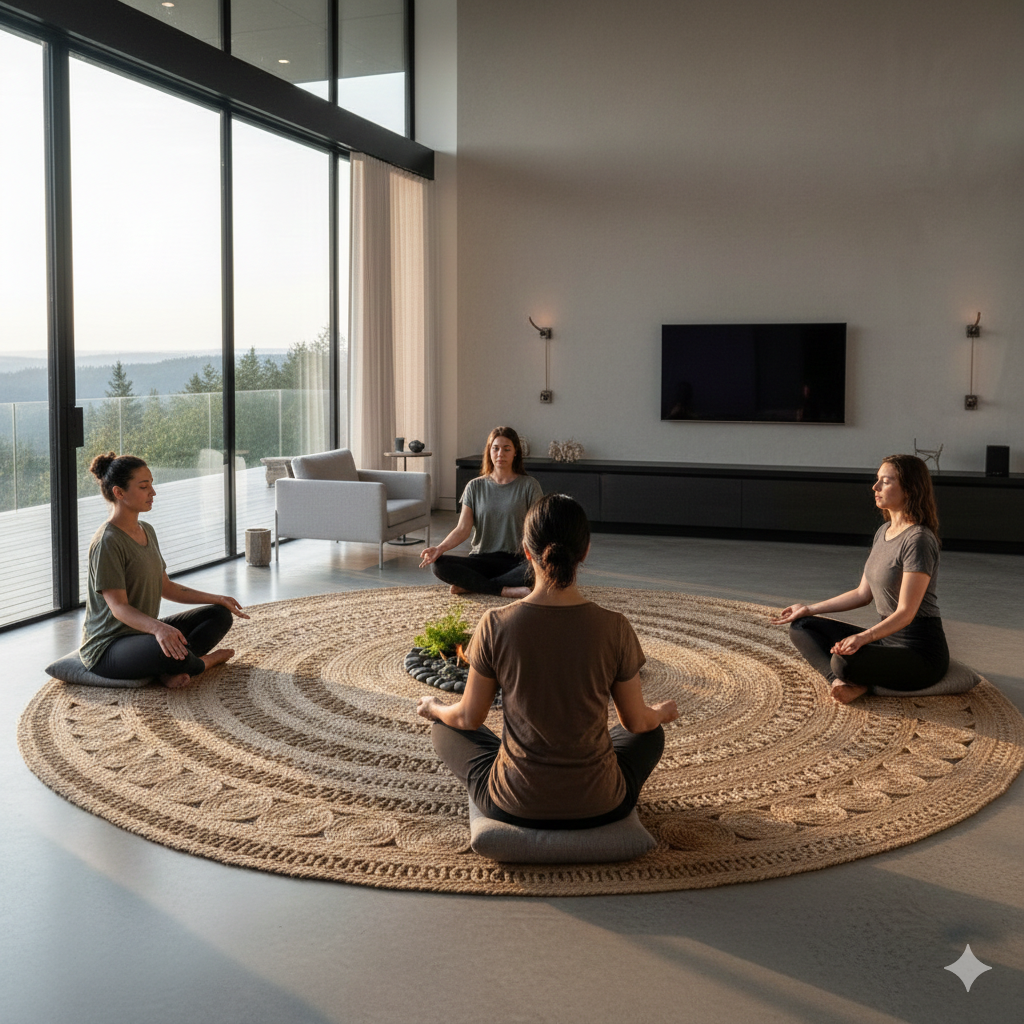
When your thoughts accelerate and your attention splinters, the nervous system often responds as if danger is near—tightening the body, narrowing perception, and amplifying worry. Grounding meditation offers a practical antidote: it restores contact with present-moment reality through breath, sensation, and deliberate attention. Rather than forcing calm, these practices help you stabilize—returning to what is tangible, measurable, and safe right now. The result is a steadier mind, a more regulated emotional landscape, and a body that can soften without losing alertness.
Understanding Grounding Meditation Techniques
What Is Grounding Meditation? Definition and Core Principles
Grounding meditation is a set of mindfulness-based practices designed to anchor awareness in immediate experience—most commonly the breath, the body, and the sensory environment. If you have ever wondered how to ground yourself during stress, grounding practices provide structured ways to shift from rumination to direct perception.
While styles differ, most meditation techniques for grounding share several core principles:
- Present-time orientation: attention is guided toward what is happening now rather than what might happen later.
- Somatic contact: the body becomes a reference point—feet, hands, posture, temperature, and breath act as stabilizers.
- Nonjudgmental noticing: sensations and thoughts are observed without immediate interpretation or struggle.
- Gentle repetition: returning again and again to an anchor trains the mind toward steadiness rather than perfection.
Grounding is not emotional suppression. It is emotional containment—creating enough internal space to feel what you feel without being overtaken by it.
Benefits of Grounding: Mental, Emotional, and Physical Wellness
When practiced consistently, grounding can reshape your relationship with stress. Many people use grounding meditation as a form of stress relief meditation because it interrupts spirals of mental overactivity and restores a sense of agency.
- Mental clarity: reduced cognitive noise, improved focus, and fewer intrusive loops.
- Emotional regulation: steadier mood, improved tolerance for uncertainty, and more measured responses under pressure.
- Physical ease: softened muscular tension, smoother breathing patterns, and a downshift from chronic activation.
For those seeking anxiety grounding methods, the key advantage is reliability: sensory anchors are available in virtually any setting, making grounding practices portable and discreet.
Essential Grounding Meditation Techniques for Beginners
Simple Breath-Focused Grounding Meditation Step-by-Step
Breath is one of the most accessible mindfulness grounding exercises because it is always present and easy to observe. This practice is particularly useful when you feel mentally scattered or emotionally elevated.
- Set your posture. Sit upright but not rigid. Place both feet on the floor if possible. Let your hands rest on your thighs or in your lap.
- Choose a breath location. Select one place to feel breathing most clearly—nostrils, chest, or belly. Commit to that single anchor for the session.
- Inhale naturally. Notice the beginning, middle, and end of the inhale. Avoid controlling the breath at first; simply track it.
- Exhale with awareness. Feel the release on the exhale. If tension is present, allow the exhale to signal a subtle softening in the jaw, shoulders, or abdomen.
- Label distractions lightly. When the mind wanders, use a simple label—“thinking,” “planning,” “remembering”—and return to the breath without criticism.
- Close with orientation. After 3–10 minutes, open your awareness to sounds, light, and the sensation of the floor beneath you. This helps transfer calm into daily activity.
If anxiety is pronounced, consider extending the exhale slightly (for example, inhale for four counts, exhale for six) to encourage a settling response, while keeping the breath comfortable and unforced.
Body Scan and Somatic Awareness Techniques for Feeling Rooted
A body scan meditation builds grounding by reconnecting attention with physical sensation. It is especially helpful when you feel dissociated, “in your head,” or numb. Unlike analysis, somatic awareness is direct: warmth, pressure, tingling, contact, and movement.
Try this brief sequence:
- Start with points of contact. Feel the weight of your body where it meets the chair, bed, or floor. Notice pressure and support.
- Scan slowly from feet to head. Move attention through ankles, calves, knees, thighs, pelvis, abdomen, chest, hands, arms, shoulders, neck, and face.
- Use neutral language. Replace “tight” with “strong sensation,” or “bad” with “intense.” Neutral phrasing reduces reactivity.
- Invite micro-adjustments. If you notice gripping, make a small change—uncurl toes, drop shoulders, soften the tongue against the palate.
- End by sensing the whole body. Hold a global awareness of the body as one field of sensation, anchored by gravity.
This technique improves interoception—the capacity to perceive internal signals—making it a cornerstone practice for grounding meditation and emotional steadiness.
Advanced Grounding Practices for Deep Stability
Visualization Grounding: Roots, Nature, and Earth Connection Meditations
Visualization grounding techniques can deepen stability by engaging the mind’s imaginative capacity while keeping attention tethered to embodiment. They are most effective when paired with real sensory cues (such as the pressure of your feet or the temperature of air on your skin).
Use this structured practice:
- Begin with the feet. Feel the soles of your feet or the base of your spine. Identify where your body meets support.
- Imagine roots extending downward. Visualize roots growing from your feet into the ground—steady, wide, and resilient. Let the image develop slowly.
- Coordinate with the breath. On each inhale, draw steadiness upward through the roots. On each exhale, release agitation downward—without forcing it away.
- Connect to natural stability. Picture earth, stone, or a mature tree—symbols of patience and endurance. Allow your body to mirror that quality.
- Return to sensation. Close by re-emphasizing physical contact: feet, legs, hips, and the support beneath you.
This practice can be particularly helpful before high-pressure meetings, difficult conversations, or transitions—moments when composure matters more than intensity.
Sensory and Object-Based Grounding: Using Touch, Sound, and Movement
Not all grounding requires stillness. In fact, for some nervous systems, gentle movement and sensory engagement provide the most immediate stabilization. These methods can function as rapid anxiety grounding methods when the mind is racing.
Touch-based grounding
- Textural focus: Hold a smooth stone, a coin, or a piece of fabric. Explore edges, temperature, and weight with full attention.
- Self-contact: Place one hand on the chest and one on the abdomen. Feel the rise and fall of breath and the warmth of the palms.
Sound-based grounding
- Three-layer listening: Identify near sounds (breath, clothing), mid-range sounds (room ambience), and far sounds (traffic, wind). This widens perception and reduces mental constriction.
- Single sound anchor: Choose one steady sound—such as a fan—and return to it whenever attention drifts.
Movement-based grounding
- Walking meditation: Walk slowly and feel heel-to-toe contact, weight shifts, and balance corrections. Keep the gaze soft and slightly downward.
- Orienting movement: Turn your head gently and look around the space, naming a few neutral objects. This signals safety to the brain through environmental confirmation.
These approaches broaden the scope of grounding meditation beyond the cushion. They are practical, adaptable, and often more accessible during acute stress.
How to Make Grounding Meditation a Daily Habit
Creating a Grounding Routine: Best Times, Spaces, and Intentions
A daily grounding practice becomes easier when it is tied to predictable cues rather than fluctuating motivation. Consistency is built through design.
- Choose dependable times: mornings for clarity, mid-day for recalibration, evenings for decompression. Even five minutes is meaningful when done regularly.
- Define a simple space: a chair by a window, a corner with a mat, or a quiet spot at your desk. Familiarity reduces friction.
- Set a precise intention: not “I should relax,” but “I will feel my feet and breathe for seven minutes.” Specificity improves follow-through.
- Use transition rituals: one deep breath before starting, one slow exhale to close. Small rituals help your mind recognize the practice as a stable refuge.
Over time, grounding becomes less of an intervention and more of a baseline—a way of inhabiting your day with steadier attention.
Tips for Staying Consistent and Troubleshooting Common Challenges
Even effective practices meet resistance. The solution is usually not more effort, but smarter adjustments.
- If you feel restless: shorten the session and switch to walking meditation or a movement-based anchor. Grounding can be dynamic.
- If you keep “failing” to focus: redefine success as returning. Each return strengthens attention; distraction is part of training, not a sign of inadequacy.
- If emotions intensify: widen the anchor. Combine breath with external sounds or open-eye practice. If overwhelm persists, consider guidance from a qualified clinician or teacher.
- If you forget to practice: attach grounding to an existing habit—after brushing teeth, before the first email, or after lunch. Habit stacking is often more reliable than reminders alone.
- If you expect immediate transformation: track subtle wins: fewer impulsive reactions, improved sleep onset, a quicker return to equilibrium after stress.
Grounding is cumulative. The quiet stability you build in ordinary moments becomes the resource you draw on when life becomes demanding.
Conclusion
Grounding meditation is not a single method but a versatile toolkit: breath anchors for simplicity, body scan meditation for embodied clarity, visualization grounding techniques for deep steadiness, and sensory-based practices for real-world resilience. Together, these approaches offer practical answers to the question of how to ground yourself—especially when stress or anxiety threatens to pull you away from the present. With a modest, consistent routine, grounding becomes more than a coping strategy; it becomes a dependable way of meeting your life with composure, clarity, and strength.
Slither Arcade
Features
- Classic Gameplay: Grow your snake by eating apples while avoiding self-collision.
- Dynamic Difficulty: The game speed increases as you eat more food.
- Juicy Polish: Screen shakes on eating, pulsing food animations, and high-score tracking.
- Responsive Controls: Use Arrow keys, WASD, or swipe on touch devices/mouse.
- Visuals: Custom-generated stylized assets and a minimalist neon background.
How to play:
- Controls: Use Arrow Keys or WASD to change direction. On mobile, Swipe in the direction you want to turn.
- Objective: Eat the glowing red apples to grow and increase your score. The game ends if you collide with your own tail.
The snake wraps around the screen edges, allowing for strategic maneuvers! Enjoy your game.Controls Reminder: The golden apple slows time for 5 seconds