
The Ringed Jewel: A Deep Dive into the Magnificent Planet Saturn 🪐✨
“Explore the magnificent planet Saturn! Delve into its iconic rings, diverse moons like Titan and Enceladus, turbulent atmosphere, and the groundbreaking discoveries from the Cassini mission. Uncover why Saturn remains the jewel of our solar system.”
Among the pantheon of our solar system’s planets, Saturn undeniably stands as the most iconic and visually stunning. With its breathtaking system of icy rings, shimmering majestically against the backdrop of space, Saturn has captivated astronomers and stargazers for centuries. Often dubbed the “Jewel of the Solar System,” this gas giant is a world of immense beauty, fierce winds, complex moons, and scientific intrigue that continues to unfold with every new mission and observation.
A Giant Among Giants: Saturn’s Basic Profile
Saturn is the sixth planet from the Sun and the second-largest planet in our solar system, dwarfed only by its colossal neighbor, Jupiter. It’s a gas giant, meaning it lacks a solid surface like Earth. Instead, it’s primarily composed of hydrogen and helium, with traces of other elements, gradually transitioning from a gaseous outer atmosphere to a liquid metallic core under immense pressure. Its sheer size is staggering: you could fit over 760 Earths inside Saturn, yet it’s surprisingly lightweight. Saturn is the only planet in our solar system less dense than water; theoretically, if you could find a bathtub large enough, Saturn would float!
The planet’s atmosphere is a turbulent realm of extreme weather, featuring high-speed winds that can reach up to 1,800 kilometers per hour (1,118 mph) at its equator, creating visible banded cloud patterns. Unlike Jupiter’s Great Red Spot, Saturn’s atmospheric features are often more subtle, though phenomena like the mysterious hexagonal storm at its north pole (a stable, six-sided jet stream) add to its enigmatic allure.

The Crown Jewels: Saturn’s Rings Explained
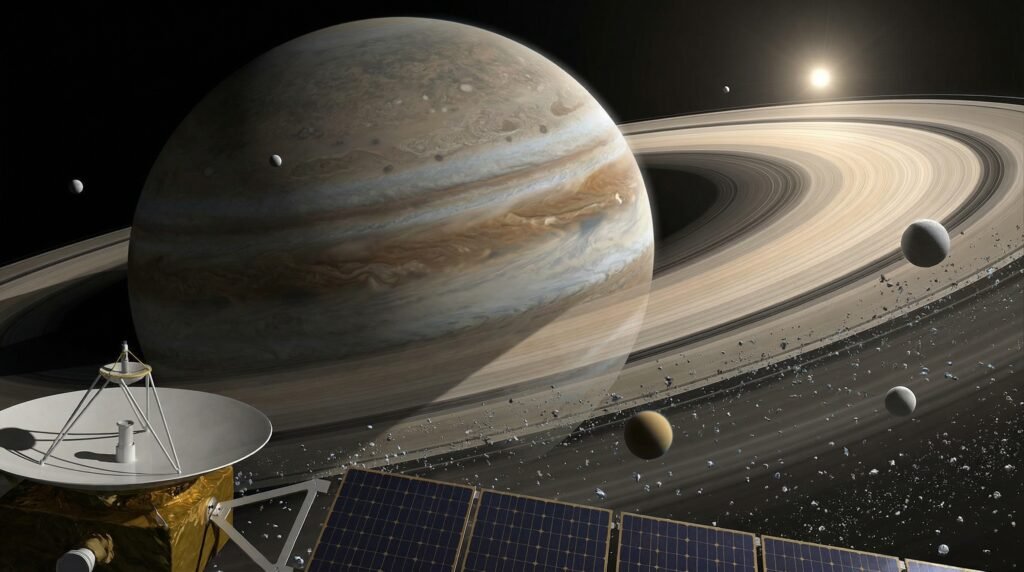
No discussion of Saturn is complete without marveling at its spectacular ring system. These are not solid structures, but rather an intricate celestial ballet of billions of small particles, ranging in size from tiny dust grains to house-sized boulders, all orbiting the planet. Composed almost entirely of water ice, with a small percentage of rocky material, these particles reflect sunlight brilliantly, making the rings visible even through amateur telescopes.
The rings stretch out over 282,000 kilometers (175,000 miles) from the planet, but they are incredibly thin – typically only about 10 meters (30 feet) thick. While they appear as a solid structure from a distance, close-up images reveal thousands of individual ringlets and gaps, some carved out by the gravitational influence of small “shepherd moons.” The main rings are designated A, B, and C, with the Cassini Division (a prominent gap) separating the A and B rings. Beyond these, fainter rings like the D, E, F, and G rings extend far into space.
The origin of Saturn’s rings is still a subject of scientific debate. The leading theories suggest they are either remnants of a shattered moon (or moons) that came too close to Saturn and were torn apart by its immense gravity, or material left over from the formation of the solar system that never coalesced into a larger body. Data from the Cassini mission suggests the rings might be relatively young, perhaps only tens of millions of years old, implying they might eventually dissipate over hundreds of millions of years.
A Moon for Every Mood: Saturn’s Diverse Satellites
Beyond its dazzling rings, Saturn boasts an astonishing family of 146 confirmed moons, the most of any planet in our solar system. Each moon is a unique world, offering glimpses into the diverse processes that shape planetary systems.
- Titan: Saturn’s largest moon, Titan, is one of the most intriguing bodies in the solar system. It’s the only moon with a dense atmosphere and the only known world besides Earth to have stable bodies of liquid on its surface – not water, but methane and ethane lakes and rivers. This nitrogen-rich atmosphere, complex organic chemistry, and potential for subsurface liquid water make Titan a prime candidate for astrobiological research, potentially harboring some form of primitive life.
- Enceladus: Another remarkable moon, Enceladus, is a small, icy world that hosts vast subsurface oceans of liquid water. What makes Enceladus truly extraordinary are the powerful plumes of water ice and vapor that erupt from its south pole, spewing material into space. These geysers provide direct evidence of an active, warm, saltwater ocean beneath its icy crust, complete with hydrothermal vents that could provide the energy and chemicals necessary for life.
- Mimas: Known for its striking resemblance to the “Death Star” from Star Wars, due to its massive Herschel crater, Mimas is a smaller icy moon whose prominent crater is a testament to violent impacts in its past.
- Pan and Atlas: These tiny “shepherd moons” orbit within the ring system, using their gravity to sculpt the ring particles into distinctive shapes, like the “flying saucer” appearance of Pan, which creates a prominent gap in the A ring called the Encke Gap.
The sheer variety of Saturn’s moons offers an invaluable laboratory for planetary scientists studying everything from planetary formation to the potential for extraterrestrial life.
Exploration and Discovery: Peering Through the Veil
Humanity’s understanding of Saturn has evolved dramatically through daring space missions.
- Pioneer 11 (1979): The first spacecraft to fly by Saturn, providing early images and data on its rings and magnetic field.
- Voyager 1 (1980) & Voyager 2 (1981): These twin probes offered much more detailed views, revealing the complexity of the rings, discovering new moons, and studying the atmosphere.
- Cassini-Huygens (2004-2017): This ambitious joint NASA/ESA/ASI mission revolutionized our knowledge of Saturn and its system. Cassini orbited Saturn for 13 years, sending back breathtaking images and invaluable data. It deployed the Huygens probe onto Titan’s surface, providing humanity’s first direct look at an alien moon’s surface. Cassini’s “Grand Finale” involved a series of dives into Saturn’s atmosphere, gathering unprecedented data before its planned destruction.
These missions have not only expanded our scientific understanding of Saturn but have also provided us with awe-inspiring images that remind us of the boundless wonders of our universe.
The Future of Saturn Studies
Even after the spectacular end of the Cassini mission, Saturn continues to be a focal point for astronomers. Ongoing analysis of Cassini’s vast dataset still yields new discoveries, and future missions are being proposed to return to Saturn’s moons, particularly Enceladus and Titan, to further investigate their potential for life.
Saturn remains a symbol of cosmic elegance and scientific curiosity. Its radiant rings, swirling storms, and diverse family of moons continue to inspire and challenge our understanding of planetary evolution and the conditions necessary for life beyond Earth. As we continue to gaze upon this ringed jewel, it serves as a powerful reminder of the infinite mysteries waiting to be unraveled in the vast expanse of space.
SEO Keywords and Meta Description:
SEO Keywords:
- planet Saturn
- Saturn’s rings
- gas giant planet
- moons of Saturn
- Titan moon
- Enceladus moon
- Cassini mission
- solar system planets
- facts about Saturn
- Saturn atmosphere
- Saturn exploration
- planetary science
- outer planets
- ringed planet
- characteristics of Saturn