

Athens, cradle of democracy and philosophy, is a city where ancient ruins coexist harmoniously with a vibrant, contemporary metropolis. Beyond its iconic monuments, the Greek capital offers an intoxicating blend of culture, gastronomy and Mediterranean atmosphere. This guide explores its rich history, must-see attractions, refined cuisine and essential practical advice to help you design an unforgettable stay in Athens.
Discovering the Rich History of Athens
The Ancient Landmarks of Athens
Athens’ historic core is an open-air museum, where every stone seems to echo the legacy of antiquity. The Acropolis, perched on its limestone hill, dominates the city and symbolizes the apogee of classical Greece. It gathers major monuments such as the Parthenon, the Erechtheion with its Caryatids and the Temple of Athena Nike, each bearing witness to the architectural ingenuity of the 5th century BC.
At the foot of the Acropolis lies the Ancient Agora, once the political, commercial and social heart of Athens. Here, citizens gathered to debate, trade and participate in the first democratic processes. The well-preserved Temple of Hephaestus and the reconstructed Stoa of Attalos offer a vivid illustration of daily life in classical times.
Further east, the Temple of Olympian Zeus, although partially ruined, impresses with its colossal Corinthian columns, recalling the ambitions of the emperors who sought to leave their mark on the city. Nearby, Hadrian’s Arch serves as a symbolic gateway between ancient and Roman Athens. To fully appreciate this historical wealth, a visit to the Acropolis Museum and the National Archaeological Museum is essential: they house masterpieces of sculpture, pottery and jewelry that illuminate centuries of Athenian civilization.
Key Historical Events That Shaped Modern Athens
The Athens visible today is the result of a succession of decisive historical eras. After its classical golden age, the city went through Roman, Byzantine and Ottoman dominations, each leaving a distinct cultural imprint. Byzantine churches, Ottoman-era hammams and neoclassical mansions coexist in the urban fabric, illustrating this complex heritage.
In the 19th century, following the Greek War of Independence, Athens was chosen as the capital of the modern Greek state. This period saw the construction of elegant neoclassical buildings, such as the University of Athens, the National Library and the Academy, forming the so-called “Neoclassical Trilogy” on Panepistimiou Street. These edifices reflect the desire of the young nation to reconnect with its ancient past while embracing modernity.
In 1896, Athens hosted the first modern Olympic Games, reaffirming its symbolic stature on the world stage. More recently, the 2004 Olympic Games triggered major urban transformations, with new infrastructures and a revamped metro system. Despite the economic challenges of the 21st century, Athens has reinvented itself as a dynamic European capital, renowned for its cultural vitality, artistic districts and thriving gastronomic scene.
Top Attractions to Visit in Athens
The Acropolis and Parthenon
No trip to Athens is complete without an ascent to the Acropolis. This emblematic plateau offers not only an immersion in ancient history, but also panoramic views over the entire city, from Mount Lycabettus to the Saronic Gulf. The Parthenon, dedicated to the goddess Athena, remains the masterpiece of Doric architecture, with its harmonious proportions and sculpted friezes that once depicted mythological scenes.
To fully appreciate the site, it is advisable to arrive early in the morning or late in the afternoon, when the light enhances the marble and the crowds are less dense. The Acropolis circuit allows you to discover, in addition to the Parthenon, the Propylaea, monumental gateway to the sanctuary, the Erechtheion and the Theater of Dionysus, considered the cradle of Greek tragedy. Equipped with a detailed guide or an audio-guide, visitors can better understand the religious, political and artistic role of this sacred hill.
After the visit, the Acropolis Museum, at the foot of the site, provides a complementary perspective. Its contemporary architecture, glass floors revealing archaeological excavations and carefully curated collections make it one of the most remarkable museums in Europe. Here, the original Caryatids, Parthenon sculptures and numerous artefacts recovered from the Acropolis site are displayed with precision and clarity.
Explore the Plaka Neighborhood
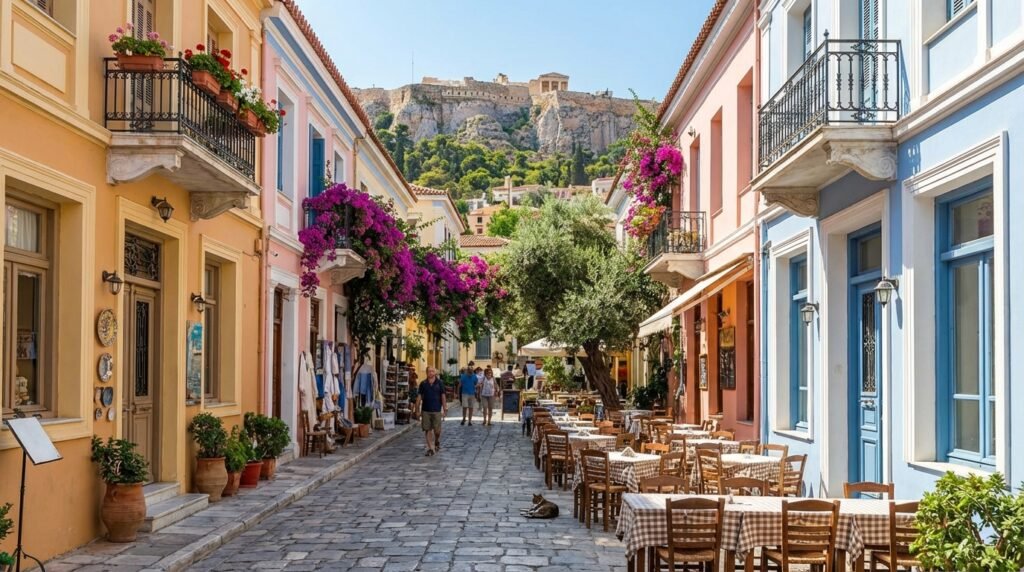
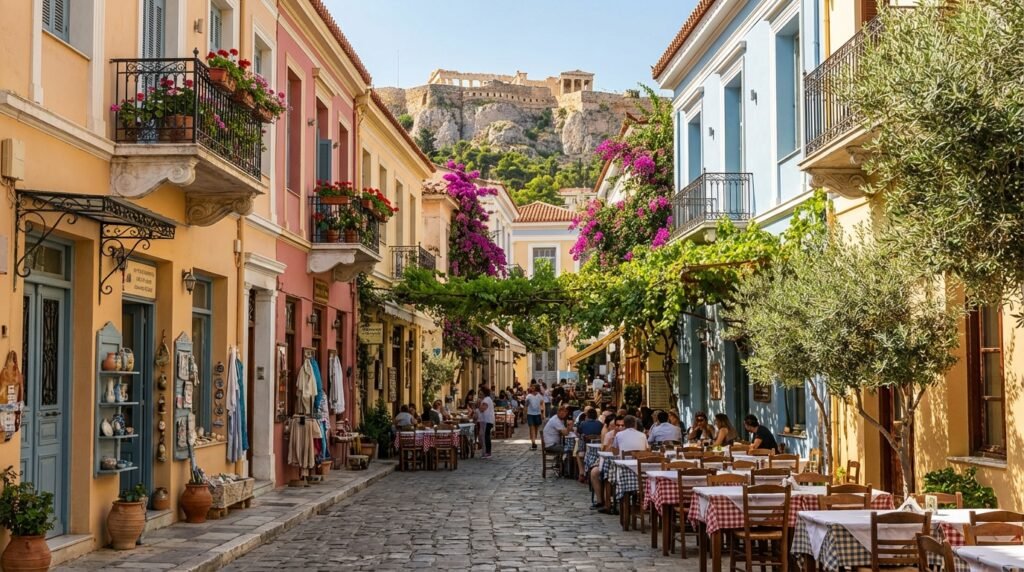
Just below the Acropolis extends Plaka, the oldest quarter of Athens, often described as the “neighborhood of the gods”. Its labyrinth of cobbled streets, neoclassical dwellings with pastel facades and floral balconies, as well as its small squares shaded by plane trees, give it a timeless charm. It is the ideal area for a leisurely stroll after exploring the archaeological sites.
Plaka is home to numerous churches, small museums and artisan shops. You can find traditional Greek products there: handcrafted ceramics, leather sandals, jewelry inspired by antiquity and local gastronomic specialties. Despite its popularity with tourists, certain side streets preserve a more authentic atmosphere, especially as you approach the Anafiotika district, a cluster of whitewashed houses reminiscent of the Cycladic islands.
The neighborhood is also renowned for its terraces, cafés and taverns, where you can enjoy Greek coffee or a glass of ouzo in a picturesque setting. At night, Plaka is illuminated and the view of the Acropolis lit up offers a striking spectacle. It is a privileged environment for immersing yourself in the Athenian ambiance, between heritage and conviviality.
A Culinary Journey Through Athens
Traditional Greek Dishes to Try
Athenian cuisine reflects the richness of the Greek terroir and the Mediterranean diet. Olive oil, fresh vegetables, aromatic herbs, fish and grilled meats are at the heart of many recipes. Among the unmissable starters, tzatziki (yogurt with cucumber and garlic), taramasalata (fish roe spread) and fava (purée of split peas) are typically served with warm pita bread.
For the main course, moussaka — a gratin of eggplants, minced meat and béchamel — is a great classic of Greek gastronomy. Souvlaki, meat skewers marinated with herbs, and gyros, served in pita with tomato, onion and sauce, are also emblematic street-food options. Seafood lovers will appreciate grilled octopus, fresh fish and kalamarakia (fried squid), often simply seasoned with lemon and olive oil.
Vegetarians will find numerous options, such as gemista (tomatoes and peppers stuffed with rice and herbs), spanakopita (spinach and feta pie) and the famous horiatiki, the Greek salad combining tomatoes, cucumbers, olives and feta. To finish on a sweet note, baklava with nuts and honey or loukoumades, small fritters drizzled with syrup, offer a delicate and fragrant conclusion to the meal.
Best Restaurants and Taverns in Athens
Athens boasts an impressive range of restaurants, from traditional taverns to cutting-edge gastronomic establishments. In Plaka and Monastiraki, many family-run tavernas serve classic dishes in a convivial atmosphere, often accompanied by live bouzouki music. These venues allow visitors to discover home-style cooking, based on tried and tested recipes passed down through generations.
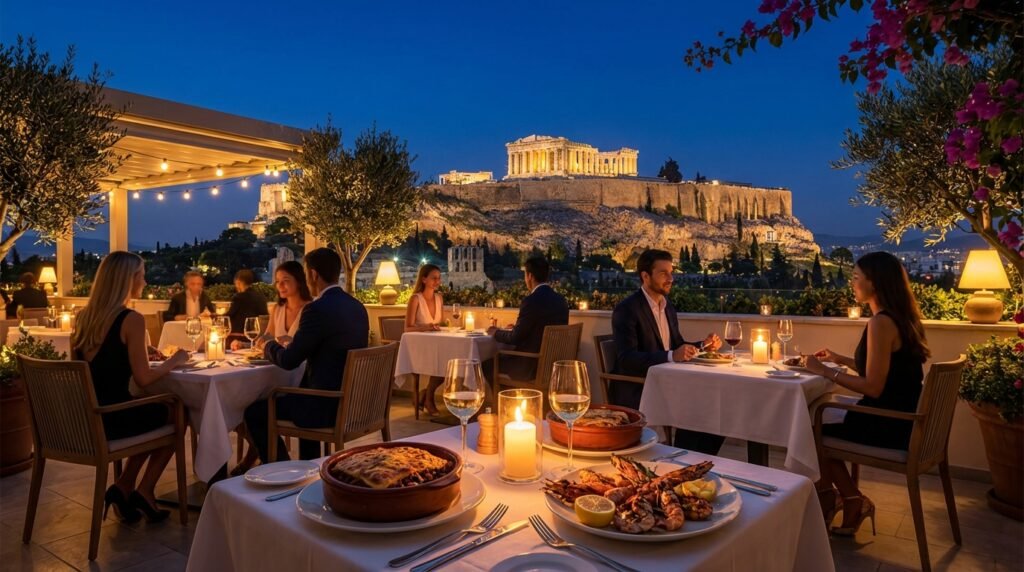
For a more contemporary culinary experience, the neighborhoods of Syntagma, Kolonaki and Psyrri host innovative restaurants where young chefs revisit Greek traditions with creativity. Tasting menus featuring seasonal and locally sourced products highlight the diversity of Greek regions, from Epirus cheeses to Cretan olive oils. Some establishments also offer exceptional views of the Acropolis, ideal for an evening combining fine dining and contemplation.
To explore the city’s gastronomic diversity, it can be helpful to participate in a food tour or to visit the Central Market (Varvakios Agora). This lively market allows you to discover fresh produce, local cheeses, charcuterie and spices used in Athenian cuisine. By choosing addresses frequented by locals and checking recent reviews, visitors are assured of experiencing the best of Athens’ culinary scene.
Tips for Planning Your Trip to Athens
Best Times to Visit Athens
Athens enjoys a Mediterranean climate characterized by hot, dry summers and mild winters. The most pleasant seasons for exploring the city are spring (April to June) and autumn (September to early November). Temperatures are then moderate, the light particularly beautiful, and the main sites less crowded than in the summer months.
July and August can be very hot, with temperatures often exceeding 35°C, which makes visits to outdoor archaeological sites more demanding. However, this period has the advantage of offering long days and numerous cultural events, concerts and festivals. If you travel in summer, it is advisable to plan outdoor visits early in the morning or late in the afternoon and to take advantage of the midday hours to rest in the shade or visit museums.
Winter in Athens is generally mild, with occasional rain and fewer tourists. This can be an attractive option for those seeking a quieter and more affordable stay, provided they plan for shorter days and potentially more variable weather. Regardless of the season, it is recommended to check the opening times of the sites and to book accommodation in advance, especially during school holidays and long weekends.
Essential Travel Tips for Tourists
To make the most of your stay in Athens, a few practical tips can make all the difference. First, the city’s public transportation system is efficient and economical. The metro, tram and buses serve the main districts and tourist attractions. Purchasing a transport pass for several days often proves to be cost-effective and convenient for unlimited travel. Taxis are widely available but it is preferable to use reputable apps or official taxi ranks.
In the historic center, walking is the best way to discover the charms of Athens. Comfortable shoes, a hat, sunscreen and a reusable water bottle are essential, especially during the warmer months. Many public fountains and cafés allow you to refill your bottle, which is both practical and environmentally friendly.
On the safety front, Athens is generally a safe city, but as in any large metropolis, it is wise to be vigilant in crowded areas and to keep an eye on personal belongings, particularly in public transportation and around major tourist sites. As for payments, cards are widely accepted, but having some cash on hand can be useful for small purchases, markets and certain traditional establishments.
Finally, a few words of Greek, such as “kalimera” (good morning), “efharisto” (thank you) and “parakalo” (please/you’re welcome), are always appreciated and help foster warmer interactions. By respecting local customs, dressing appropriately when visiting religious sites and showing patience during busy times, travelers will find Athenians to be welcoming and helpful hosts.
In conclusion, Athens is far more than a simple stopover to the Greek islands. It is a city with multiple facets, where ancient history, contemporary creativity and Mediterranean lifestyle converge. By combining visits to its iconic monuments, explorations of lively neighborhoods, discoveries of refined cuisine and well-prepared practical organization, each traveler can create a tailor-made experience. Athens rewards those who take the time to immerse themselves in its streets, its museums and its cafés, revealing a capital that is both timeless and resolutely turned towards the future.
Top Attractions” and “Best Time to Visit

Zoo-doku