
Zoisite Gemstone Guide: Tanzanite, Anyolite, and the Power of Transformation
Discover the fascinating world of Zoisite. learn about its geological origins, value factors, and healing properties.
What Is Zoisite? Origins, Meaning, and Key Properties
Zoisite is a captivating mineral that bridges the worlds of geology, fine jewelry, and energetic healing. Known best as the host mineral of tanzanite, it appears in an impressive array of colors and forms, from vivid blue-violet to rich green, rose-pink, and mottled ruby combinations. Whether you are a gem collector, jewelry enthusiast, or someone drawn to its metaphysical properties, understanding zoisite in depth will help you choose and use this stone with discernment.
Geological Formation and History of Discovery
Zoisite is a calcium aluminium hydroxy sorosilicate belonging to the epidote group of minerals. It forms primarily in metamorphic environments, where intense heat and pressure transform pre-existing rocks. Typically, zoisite develops in:
- Regional metamorphic rocks such as schists and gneisses.
- Hydrothermally altered rocks where mineral-rich fluids deposit new minerals.
- Contact metamorphic zones near igneous intrusions.
This mineral crystallizes in the orthorhombic system, often forming prismatic, granular, or massive aggregates. Its composition, combined with trace elements like vanadium, manganese, or chromium, gives rise to its varied color palette and distinct gem varieties.
https://www.teepublic.com/t-shirt/50348403-superhero-child?store_id=2851997
Zoisite was first described in the early 19th century. It was named after Sigmund Zois, a Slovenian nobleman and mineral collector who played a pivotal role in its recognition. The mineral’s global profile remained relatively modest until the discovery of gem-quality blue zoisite in northern Tanzania in the 1960s. Renamed “tanzanite” for marketing purposes, this variety propelled zoisite into the international spotlight and established it as a major player in the colored gemstone market.
Physical, Chemical, and Metaphysical Properties of Zoisite
From a scientific perspective, zoisite’s core properties are well-defined:
- Chemical formula: Ca2Al3(SiO4)(Si2O7)O(OH)
- Crystal system: Orthorhombic
- Hardness: 6 to 7 on the Mohs scale (varies slightly by variety)
- Luster: Vitreous to sub-vitreous
- Cleavage: Perfect in one direction (an important factor for cutting and setting)
- Transparency: Transparent to opaque, depending on type and quality
Zoisite often exhibits strong pleochroism, particularly in its tanzanite variety, meaning it can show different colors when viewed from different crystallographic directions. This optical behavior contributes significantly to its visual appeal but also requires expert cutting to maximize color.
On a metaphysical level, zoisite is widely associated with transformation, vitality, and spiritual growth. Practitioners attribute to it the ability to:
- Stimulate personal evolution and the courage to pursue one’s authentic path.
- Balance mental, emotional, and spiritual bodies, encouraging integration and coherence.
- Revitalize depleted energy, supporting recovery from stress or emotional fatigue.
While these properties are not scientifically proven, they form an important part of zoisite’s contemporary appeal and its use in crystal healing, meditation, and Feng Shui.
Types of Zoisite: Varieties, Colors, and Value Factors
Zoisite is not a single-color gemstone but a family of related materials with distinct appearances and markets. Understanding the main varieties is essential if you plan to buy zoisite jewelry or collect specimens.
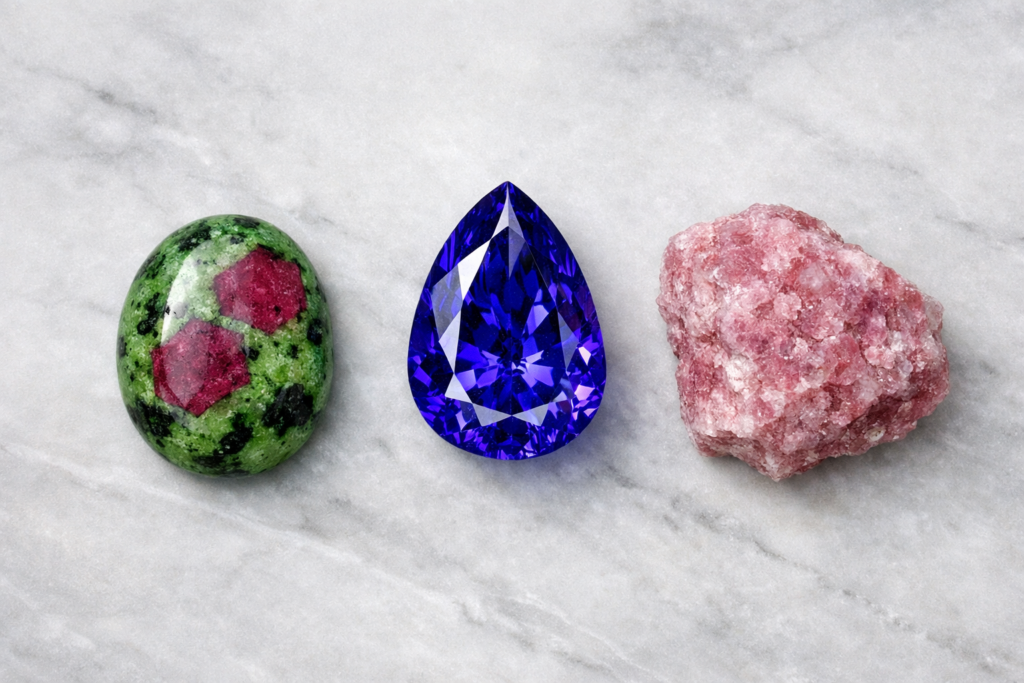
Tanzanite, Thulite, and Anyolite: How They Differ
Tanzanite (Blue to Violet Zoisite)
Tanzanite is the most famous zoisite variety, prized for its exceptional blue-violet hue. Found exclusively in a small area near Mount Kilimanjaro in Tanzania, it owes its color to traces of vanadium. Most tanzanite is heat-treated to transform a brownish or greenish starting color into the vivid blue-violet tones that the market values highly.
Key characteristics of tanzanite include:
- Strong pleochroism, showing blue, violet, and sometimes burgundy depending on orientation.
- Fine clarity in higher grades, often eye-clean, making it excellent for faceted gemstones.
- Gem-quality transparency, which enhances brilliance and saturation.
Thulite (Pink to Reddish Zoisite)
Thulite is a manganese-bearing pink variety of zoisite typically found in massive or granular form. It occurs notably in Norway (its type locality), but also in other regions around the world. Thulite is usually opaque to translucent and is commonly cut into cabochons, beads, or ornamental carvings rather than faceted stones.
Thulite is recognized for:
- Soft to rich pink color, sometimes mottled or veined with white or gray.
- Durable composition suitable for jewelry, though best in protective settings.
- Accessibility; it is generally more affordable than tanzanite.
Anyolite (Ruby in Zoisite)
Anyolite is a striking rock composed of green zoisite with black hornblende and red ruby crystals. Often marketed simply as “ruby in zoisite,” it is mined mainly in Tanzania. Anyolite is typically opaque and used for ornamental objects, carvings, and bold statement jewelry pieces.
Its visual allure stems from:
- Strong contrast between vivid green zoisite and red ruby spots or patches.
- Unique, painterly patterns, making each piece visually distinct.
- Robustness suitable for pendants, cabochons, and large beads.
These three varieties illustrate the breadth of zoisite’s aesthetic possibilities, ranging from high-end luxury gems to accessible and artistic materials.
Color, Clarity, Cut, and Carat Weight: What Affects Zoisite’s Value
As with most gemstones, several interlinked factors govern the value of zoisite, particularly in its tanzanite form.
Color
Color is the primary driver of value in tanzanite and an important factor for thulite and anyolite.
- Tanzanite: The most valuable stones display a rich, saturated blue with purplish overtones. Lighter or more muted stones are less expensive. Top-grade tanzanite often appears intensely blue in daylight and more violet under incandescent light.
- Thulite: Even, vivid pink with minimal brown or gray tones commands a premium. Strong mottling or dull coloration reduces desirability for fine jewelry.
- Anyolite: A harmonious balance of green zoisite and visible ruby inclusions enhances both aesthetic and value. Excessive dark hornblende patches can detract from overall appearance.
Clarity
In transparent material such as tanzanite, clarity is crucial. Eye-clean stones with minimal inclusions fetch higher prices. Inclusions that break the surface, affect durability, or significantly disrupt brilliance reduce value. For opaque or translucent varieties like thulite and anyolite, clarity is less about transparency and more about pattern coherence and absence of disruptive fractures.
Cut
Cutting zoisite is both an art and a technical challenge, especially due to cleavage and pleochroism.
- Well-cut tanzanite shows intense, even color across the face of the stone and excellent brilliance.
- Poor cutting can leave windows (pale patches), uneven saturation, or weak sparkle.
- Thulite and anyolite are usually cut as cabochons or freeform pieces that emphasize pattern and color placement.
Carat Weight
Zoisite’s price per carat generally increases with size, particularly for fine tanzanite. Larger stones with strong color and good clarity are rare and command a premium. However, excessively large stones of mediocre color may not be as desirable as smaller, higher quality gems.
Other factors, such as origin (for high-end tanzanite), treatment status, and overall craftsmanship, also influence value. Careful assessment of all these elements is essential before purchasing significant pieces.
Zoisite in Jewelry: Buying, Wearing, and Caring for Your Stone
Zoisite’s beauty comes with specific considerations for buyers and wearers. Its hardness and cleavage require attentive handling, but with proper care, zoisite jewelry can be worn and enjoyed for many years.
How to Choose Authentic Zoisite and Avoid Imitations
The popularity of tanzanite has led to a proliferation of imitations and misrepresentations. To ensure you are acquiring genuine zoisite, consider the following guidelines:
- Purchase from reputable sources: Choose established jewelers or dealers with a track record in colored gemstones. Look for professional credentials or membership in recognized trade organizations.
- Request certification for valuable gems: For high-value tanzanite, ask for an independent gemstone report from a trusted laboratory. This document should confirm species (zoisite), variety (tanzanite), and note any treatments.
- Be cautious of unrealistic pricing: If the price seems too low for deeply saturated, large tanzanite, it may be synthetic, heavily treated, or misrepresented glass or cubic zirconia.
- Examine color and pleochroism: Genuine tanzanite displays subtle color shifts and pleochroism. Uniform, overly intense, or “flat” color can indicate synthetic or imitation material.
- Check for common look-alikes: Blue spinel, blue sapphire, and coated quartz can be sold dishonestly as tanzanite. For thulite and anyolite, dyed stones or composite materials sometimes masquerade as natural pieces.
When purchasing thulite or anyolite, authenticity concerns are typically less complex, but quality variation is significant. Inspect surface polish, structural stability (avoid stones with extensive surface-reaching fractures), and visual appeal before committing.
Cleaning, Storing, and Protecting Zoisite Jewelry
Zoisite’s hardness of 6 to 7 makes it moderately durable but not impervious to scratches or impacts. It also has perfect cleavage in one direction, meaning it can split if struck in a vulnerable orientation. Appropriate care routines are therefore essential.
Cleaning Zoisite
- Use lukewarm water, a mild, non-abrasive soap, and a soft brush or cloth.
- Gently scrub the stone and setting, especially behind the gem, where oils and debris accumulate.
- Rinse thoroughly to remove all soap residue.
- Dry with a soft, lint-free cloth.
Avoid ultrasonic and steam cleaners for zoisite, particularly tanzanite, as sudden temperature changes and vibrations can exacerbate internal stress or cleavage planes. Do not use harsh chemicals, bleach, or abrasive cleaners.
Storing Zoisite
- Store zoisite jewelry separately in a soft pouch or lined compartment to prevent scratches from harder gemstones such as diamonds, sapphires, or rubies.
- Keep tanzanite away from extreme heat or prolonged direct sunlight, which may affect color over long periods.
- Avoid tossing zoisite pieces loosely into jewelry boxes, where they may collide with other items.
Protecting Zoisite When Worn
- Remove zoisite rings and bracelets before engaging in sports, gardening, heavy lifting, or household cleaning.
- Avoid exposure to sharp blows or pressure, especially near the edges and girdle.
- Put on zoisite jewelry after applying perfume, hairspray, or lotions to minimize chemical contact.
With these simple precautions, zoisite can retain its beauty and structural integrity over time, whether set in refined tanzanite rings or bold anyolite pendants.
Zoisite’s Spiritual, Healing, and Feng Shui Uses
Beyond its role as a gemstone, zoisite enjoys a prominent place in spiritual and holistic practices. Each variety is associated with specific energetic qualities, though all share an overarching theme of renewal and alignment.
Emotional, Physical, and Chakra Healing Properties of Zoisite
While these attributes are based on traditional and contemporary metaphysical systems rather than empirical science, many individuals find working with zoisite supportive and grounding.
Emotional Healing
- Tanzanite: Often linked with emotional clarity and transformation, tanzanite is said to help dissolve old patterns, encourage honest self-expression, and promote a calm, composed state of mind during significant life changes.
- Thulite: Associated with compassion, self-love, and social confidence, thulite is believed to soften emotional wounds, foster openness, and support healthy relationships.
- Anyolite: Considered a stone of courage and enthusiasm, anyolite is said to rekindle passion for life, combat emotional apathy, and harmonize conflicting inner impulses.
Physical Vitality
In crystal healing, zoisite is frequently recommended to support overall vitality. Practitioners suggest it may:
- Encourage recovery from exhaustion and burnout.
- Support resilience during or after periods of illness or stress.
- Stimulate regenerative energy on a subtle level.
These uses are complementary and should not replace conventional medical care, but they form part of many holistic wellness practices.
Chakra Associations
- Tanzanite: Commonly linked with the throat chakra (communication), third eye (intuition), and crown chakra (spiritual connection). It is thought to facilitate insight, uplift consciousness, and support clear, truthful expression.
- Thulite: Typically associated with the heart chakra, promoting emotional healing, love, and kindness toward self and others.
- Anyolite: Often connected with both the heart and root chakras, blending grounded stability with heartfelt enthusiasm and courage.
Individuals working with chakras may place the relevant zoisite variety on the corresponding area during meditation or energy sessions, or wear it as jewelry to maintain a continuous energetic link.
How to Use Zoisite in Meditation, Crystal Grids, and Home Energy
Zoisite’s versatility makes it suitable for a wide range of spiritual applications. Whether you prefer quiet personal meditation or elaborate crystal layouts, it can be integrated with intention.
Meditation with Zoisite
- Set your intention: Decide whether you seek emotional balance, intuitive insight, or renewed motivation.
- Choose the appropriate variety: Use tanzanite for spiritual clarity, thulite for heart-centered work, or anyolite for courage and life force.
- Hold or place the stone: Hold it in your hand, place it over the relevant chakra, or position it before you as a focal point.
- Breathe and observe: Focus on your breath, allowing any sensations or insights to emerge without judgment.
Regular practice can deepen your connection to the stone and to the qualities you aim to cultivate.
Crystal Grids with Zoisite
Zoisite can serve as either a central stone or a supporting element in crystal grids designed for transformation, healing, or creative renewal.
- Transformation grid: Place a tanzanite or blue zoisite at the center, surrounded by clear quartz points and grounding stones such as smoky quartz or black tourmaline.
- Heart-healing grid: Use thulite or anyolite at the center, arranged with rose quartz, green aventurine, or rhodonite for emotional balance and self-compassion.
- Vitality and motivation grid: Feature anyolite with energizing stones like carnelian, sunstone, or garnet, directed toward renewed enthusiasm and creative drive.
Activate the grid with a clear intention, either spoken aloud or silently, and leave it in place for a defined period while you work toward your goals.
Feng Shui and Home Energy
In Feng Shui, crystals are used to enhance or balance the energy of specific areas within a home or workspace. Zoisite can be thoughtfully positioned to support particular life domains.
- Tanzanite or blue zoisite: Place in a study, office, or meditation room to support insight, clear communication, and focused thinking.
- Thulite: Position in relational areas of the home, such as the bedroom or living room, to encourage harmonious interactions, empathy, and emotional warmth.
- Anyolite: Use in creative spaces, near entryways, or in family gathering zones to invigorate the atmosphere, invite courage, and uplift mood.
Ensure stones are kept clean, both physically and energetically, by dusting regularly and periodically recharging them through methods such as brief exposure to early morning light, sound (bells, singing bowls), or mindful intention-setting.
Conclusion
Zoisite is far more than the mineral behind tanzanite’s celebrated blue. It is a diverse and sophisticated gemstone family that encompasses vibrant blues, tender pinks, verdant greens, and dramatic ruby-rich patterns. From its metamorphic origins to its role in fine jewelry and spiritual practices, zoisite offers a rich blend of beauty, symbolism, and meaning.
By understanding its geological formation, key varieties, and value factors, you can make informed decisions when purchasing zoisite jewelry or specimens. With attentive care, these stones can remain luminous and structurally sound for decades. For those drawn to its energetic qualities, zoisite provides a versatile tool for emotional healing, meditation, and enhancing the energy of living and working spaces.
Whether you approach zoisite as a collector, a connoisseur of colored gemstones, or a practitioner of crystal healing, this mineral invites a deeper relationship with transformation, vitality, and authentic expression.
The Ultimate Guide to the Groove, History, and Culture
Santorini Travel Guide: Top Attractions, Oia & Best Time to Visit
The Best Sports Watches for Tracking Performance
Top 10 Healthy Habits for a Better Life
zoisite, tanzanite, anyolite, rubyinzoisite, gemology, crystalhealing, hulite, emstonejewelry
Combat Protocol
WASD – Move
Mouse – Look around
Left Click – Fire Weapon
R – Reload
Eliminate all hostile units in the sector!
(Works better on computer)