
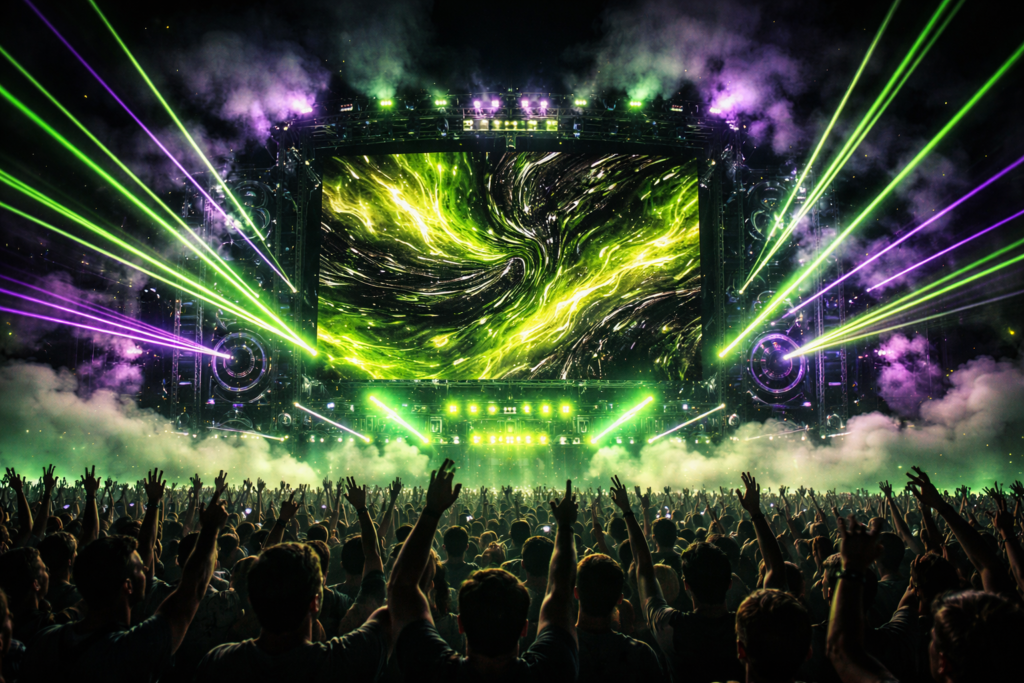
Dubstep: The Sound That Shook Modern Electronic Music
Dubstep is one of the most distinctive and polarizing genres in modern electronic music. Recognized by its heavy basslines, lurching rhythms, and futuristic sound design, it evolved from an underground UK movement into a global phenomenon that reshaped festival stages, pop music, and the broader EDM landscape.
This guide explains what dubstep is, where it came from, how it works musically, and where it’s heading in 2026.
What Is Dubstep?
At its core, dubstep is a style of electronic dance music known for powerful sub-bass, half-time rhythms, and a dark, often futuristic atmosphere. It typically sits around 140 BPM and emphasizes space, tension, and bass impact over melodic complexity.
Origins: From Croydon to the World
Dubstep emerged in South London (specifically Croydon) in the late 1990s as a dark offshoot of UK Garage. Producers stripped away the R&B vocals of Garage, focusing instead on sub-bass pressure designed for massive sound systems.
-
“Dub” refers to the Jamaican tradition of remixing with heavy echo and bass.
-
“Step” refers to the “2-step” garage rhythms that informed its drum patterns.
Key Characteristics of the Dubstep Sound
While the genre has branched out, these core traits define its identity:
-
The Half-Time Feel: Even at 140 BPM, the drums are programmed to feel like 70 BPM. The snare usually hits on the third beat, creating a slow, heavy “head-nodding” groove.
-
Sub-Bass Pressure: Deep, low-end frequencies that you feel in your chest rather than just hearing with your ears.
-
The “Wobble”: Created using Low-Frequency Oscillators (LFOs) to modulate the volume or filter of a bass synth, producing the signature “wub-wub” sound.
-
Syncopation: Shuffled hi-hats and off-beat percussion that create a sense of mechanical swing.
The Evolution: Deep vs. Brostep
Dubstep’s history is a tale of two sounds: the underground “Deep” style and the mainstream “Brostep” explosion.
1. Foundations (Early 2000s)
Pioneers like Digital Mystikz (Mala & Coki), Skream, and Benga played minimal, meditative tracks in dark clubs like DMZ and Forward>>. This era was about atmosphere and “physical” bass.
2. The North American “Boom” (2010s)
Around 2011, artists like Skrillex and Excision introduced a high-energy, midrange-heavy sound characterized by:
-
Aggressive “talking” bass growls.
-
Cinematic, theatrical build-ups.
-
Explosive, high-impact “drops.”
Essential Dubstep Subgenres
Production & Sound Design
Modern dubstep is a masterclass in digital synthesis. Producers use tools like Serum, Vital, and Phase Plant to create complex textures.
-
Resampling: Recording a bass sound and then chopping and processing it multiple times to create “glitchy” movements.
-
Sidechaining: Ducking the bass volume whenever the kick drum hits to ensure the low end stays clear and punchy.
The Future of Dubstep
In 2026, dubstep is moving toward a “Bass Music Fusion.” The lines between Dubstep, Trap, and Drum & Bass are blurring. We are seeing a massive return to “Deep” roots alongside high-tech audiovisual shows that use LED walls and synchronized pyrotechnics to enhance the physical experience of the bass.
Conclusion
Whether it’s a minimal track in a dark basement or a neon-soaked festival anthem, dubstep remains a pillar of modern music. It taught a generation of listeners to appreciate the “weight” of sound and pushed the boundaries of what synthesizers can do.
Santorini Travel Guide: Top Attractions, Oia & Best Time to Visit
https://www.teepublic.com/t-shirt/50280539-beautiful-butterfly?store_id=2851997
dubstep, bassmusic, edm, skrillex, riddim, sounddesign
Crystal Collector
Combat Protocol
WASD – Move
Mouse – Look around
Left Click – Fire Weapon
R – Reload
Eliminate all hostile units in the sector!
(Works better on computer)