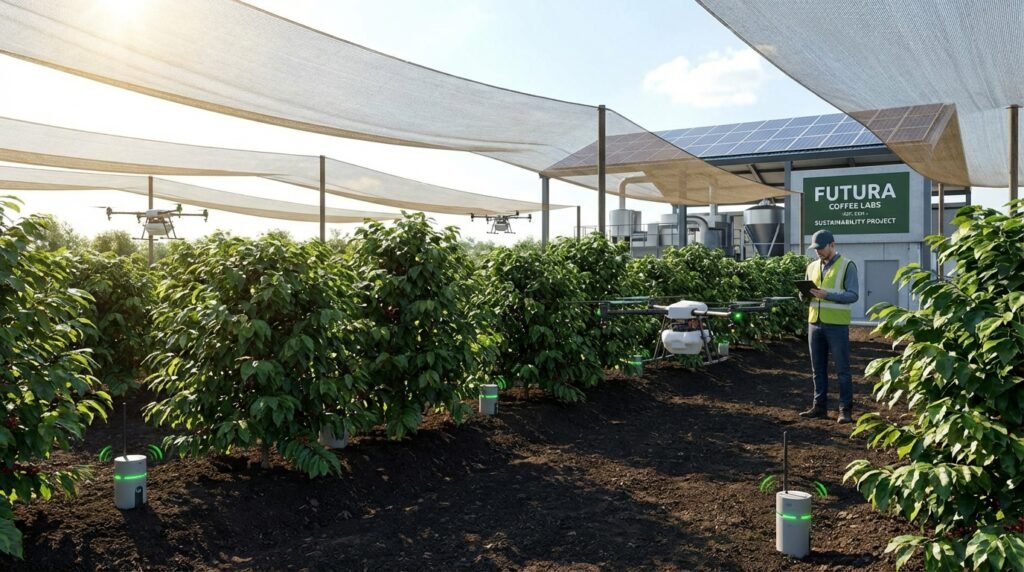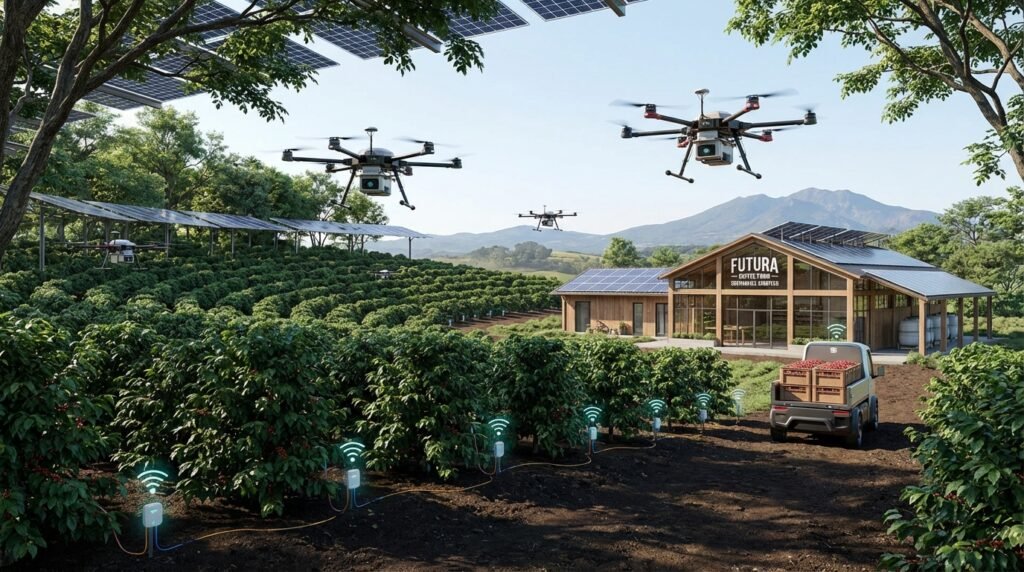
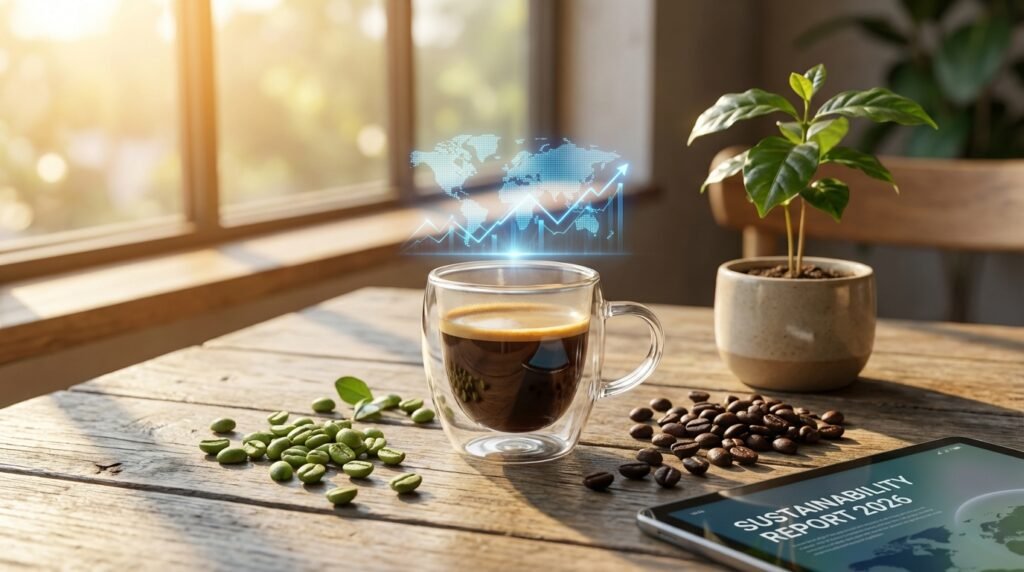
Comprehensive professional assets generated for the 2026 global coffee ecosystem report.
The 2026 Coffee Renaissance: Engineering the Future of the World’s Favorite Bean ☕️
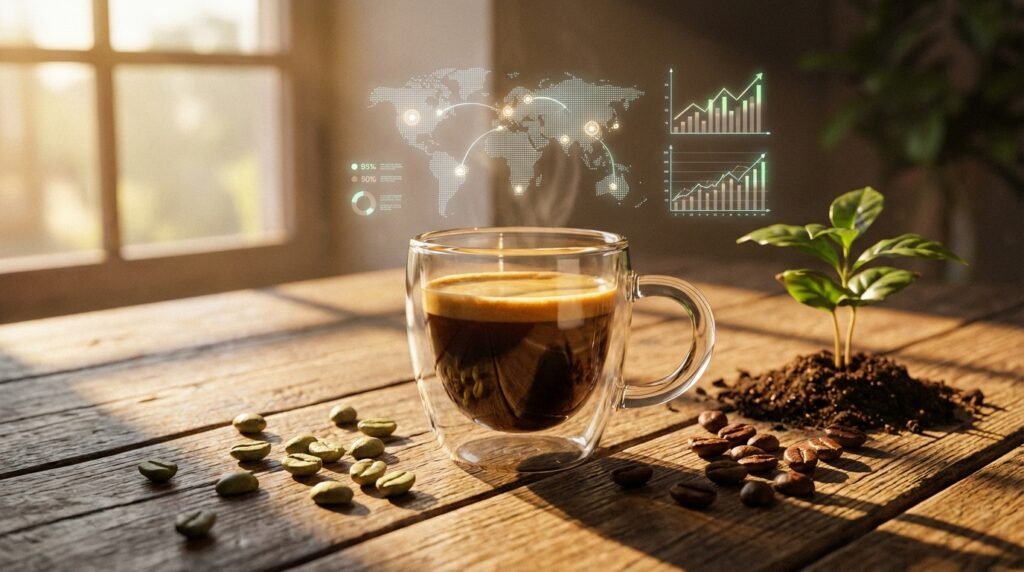
The year is 2026, and the steam rising from your morning mug carries more than just the aroma of roasted Typica or Bourbon. It carries the data of a thousand sensors, the resilience of a changing climate, and the blueprint of a global economic shift.
Coffee is no longer just a “pick-me-up.” It has become the frontline of the #FutureOfFood, a high-stakes #Commodity battleground, and a shining beacon for the #CircularEconomy. In this deep dive, we explore how the coffee industry has transformed over the last half-decade, moving from a vulnerable agricultural product to a high-tech, hyper-sustainable global powerhouse.
I. The New Geography of Flavor: #CoffeeOrigin in a Changing World
For decades, the “Bean Belt”—that tropical strip between the Tropics of Cancer and Capricorn—was a stable map of production. But as of 2026, the map has been redrawn.
The Altitude Migration
Climate change has forced Arabica coffee higher up the mountains. Traditional low-altitude farms in Brazil and Vietnam have pivoted toward #AgriTech solutions to combat rising temperatures, while new players are emerging.
- The Rise of East Africa: Countries like Rwanda and Ethiopia have leveraged 2026’s high market prices to invest in national washing stations that utilize solar-powered fermentation tanks.
- The Southeast Asian Shift: Thailand and Laos are no longer just “emerging” markets; they are producing some of the most sought-after specialty microlots in the world, often fetching prices that rival the best Panamanian Geishas.
- https://orenga.myspreadshop.com/alchemymagic-A66904faa6041a648a8a2a718?productType=444&sellable=Bvpx7kyZQ0Twk1nG17Zr-444-23&appearance=803
Resilience Through Genetics
The 2026 harvest is defined by biotech. We aren’t talking about “Franken-coffee,” but rather the sophisticated cross-breeding of wild, forgotten species. The discovery of Coffea stenophylla—a heat-tolerant wild species from West Africa—has been successfully hybridized with commercial Arabica, creating a plant that tastes like high-end specialty coffee but can survive in temperatures 2-3∘C higher than its predecessors.
II. #AgriTech: The Digital Nervous System of the Farm
In 2026, the “humble farmer” is often a data scientist in boots. The integration of technology into the soil has stabilized the #CoffeeMarket in ways we only dreamed of in 2020.
Precision Agriculture and IoT
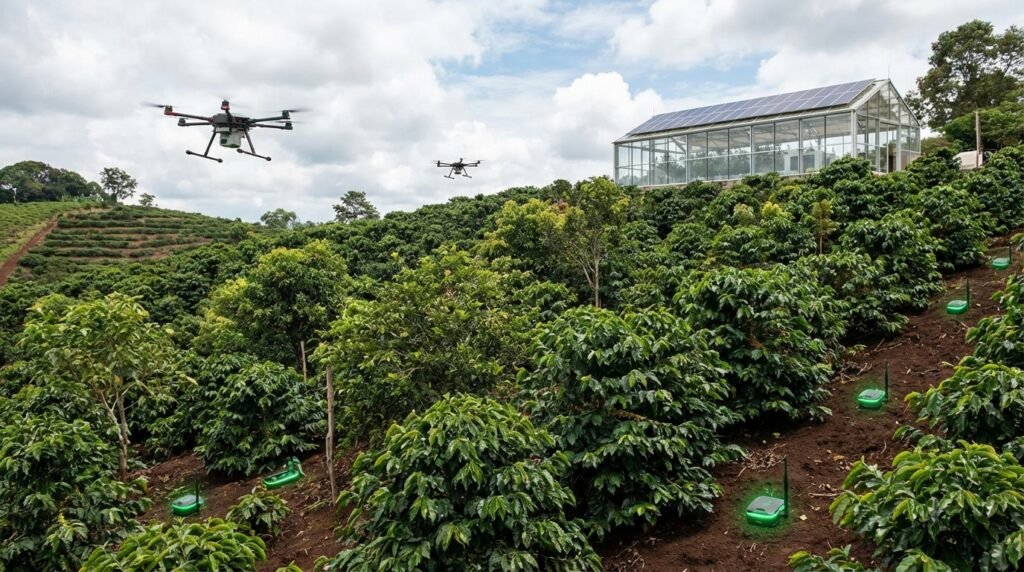
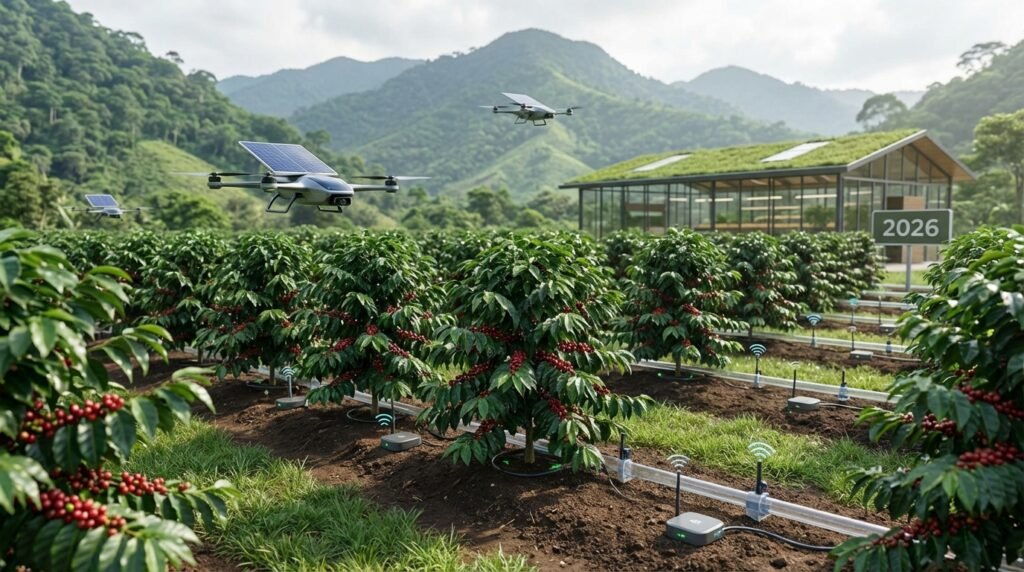
The modern coffee finca is wired. Internet of Things (IoT) sensors buried in the volcanic soil of Guatemala provide real-time updates on moisture levels, nitrogen content, and pH balance directly to a farmer’s smartphone.
- Targeted Irrigation: Instead of blanket watering, AI-driven systems deliver the exact milliliter of water needed to each individual tree, reducing water waste by over 40%.
- Drone Scouting: Autonomous drones fly over vast estates, using multispectral imaging to spot the first signs of “Coffee Leaf Rust” (Hemileia vastatrix) weeks before it’s visible to the human eye. This allows for localized, organic treatments rather than mass chemical spraying.
Blockchain and Radical Transparency
By 2026, the consumer demands to know more than just the country of origin. Using QR codes on every bag, drinkers can trace their beans back to the exact GPS coordinates of the plot where they were grown. This isn’t just a gimmick; it’s an accountability tool that ensures Fair Trade 2.0, where the farmer receives a verifiable “digital tip” or a higher percentage of the final retail price directly via smart contracts.
III. The #CircularEconomy: Ending the Era of Waste
Perhaps the most significant shift in 2026 is how we view the “waste” of coffee. For over a century, we only used the seed (the bean) and discarded the rest. Today, the coffee industry is a zero-waste pioneer.
The Rebirth of the Coffee Cherry
The “cascara” (the dried skin of the coffee fruit) was once a pollutant dumped into rivers. In 2026, it is a global superfood.
- Cascara Flour: Used in gluten-free baking, it is higher in iron and potassium than almost any other flour.
- Bio-Packaging: The fibrous husks of the coffee cherry are now processed into biodegradable “paper” cups and shipping boxes, replacing single-use plastics.
Spent Grounds as Urban Ore
In major cities, coffee shops have become “urban mines.” Specialized collection services gather spent grounds to be used as:
- Carbon-Negative Fuel: Pressed into pellets for industrial heating.
- Vegan Leather: Companies are now using coffee oils and fibers to create durable, high-end “coffee leather” for the fashion industry.
- Biocontrol in Agriculture: High-nitrogen grounds are being returned to local urban farms as a natural pesticide and fertilizer, completing the loop.
IV. #SmartBrewing: The Laboratory in Your Kitchen
The “Third Wave” of coffee was about the craft; the “Fourth Wave” in 2026 is about precision and personalization.
The Rise of the Molecular Brew
The 2026 kitchen features brewers that allow users to manipulate the molecular profile of their water. Since coffee is 98% water, high-end machines now mineralize distilled water in real-time to match the specific chemical profile of the water in Oslo or Tokyo, ensuring the “authentic” experience of a world-class cafe.
AI Sommeliers
Your 2026 espresso machine knows you. It syncs with your wearable health tech to suggest a roast profile based on your sleep quality or stress levels.
- Micro-Dosing: Machines can now blend high-caffeine Robusta with decaf Arabica on the fly to give you exactly 85mg of caffeine—the scientifically optimal amount for your 9:00 AM meeting.
V. The #CoffeeMarket and #Commodities Outlook
Economically, coffee has shifted from a volatile agricultural product to a sophisticated financial asset.
Hedging Against Volatility
With the help of AI-driven predictive modeling, the 2026 market is less prone to the “boom and bust” cycles of the past. Buyers use predictive weather data to secure long-term contracts, providing stability for smallholder farmers who were previously at the mercy of the C-Market price.
The New Luxury Tier
We are seeing the emergence of “Vintages” in coffee, similar to fine wine. A 2025-harvest Ethiopian Yirgacheffe, vacuum-sealed and cryogenically frozen at the peak of freshness, can now be traded on specialty exchanges for thousands of dollars per kilogram.
VI. #SustainableCoffee: More Than a Buzzword
Sustainability in 2026 is measured by Carbon Sequestration. “Shade-grown” coffee has evolved into “Regenerative Forest Coffee.” By planting coffee trees under a canopy of native fruit and timber trees, farmers are creating biodiversity corridors. In 2026, many coffee farms are actually carbon sinks, earning more from carbon credits than they do from the beans themselves. This provides a crucial secondary income stream that protects farmers during low-yield years.
Conclusion: A Cup Full of Hope
As we look at the state of coffee in 2026, the narrative has shifted from one of crisis to one of incredible innovation. Through #AgriTech, we have saved the bean from the brink of climate collapse. Through the #CircularEconomy, we have turned a wasteful habit into a regenerative industry. And through #SmartBrewing, we have brought a level of artistry and science into our homes that was once reserved for labs.
Every time you take a sip of coffee today, you are participating in a global movement. You are supporting a farmer in a remote mountain range, a technologist in a lab, and a planet that is slowly learning how to feed itself without destroying itself.
The future of coffee is bright, it’s sustainable, and most importantly—it tastes better than ever
#Coffee2026#CoffeeOrigin#SustainableCoffee#CoffeeUsages#AgriTech#CoffeeMarket#Commodities#FutureOfFood#SmartBrewing#CircularEconomy
Visual Direction
Crystal Collector
Combat Protocol
WASD – Move
Mouse – Look around
Left Click – Fire Weapon
R – Reload
Eliminate all hostile units in the sector!
(Works better on computer)