
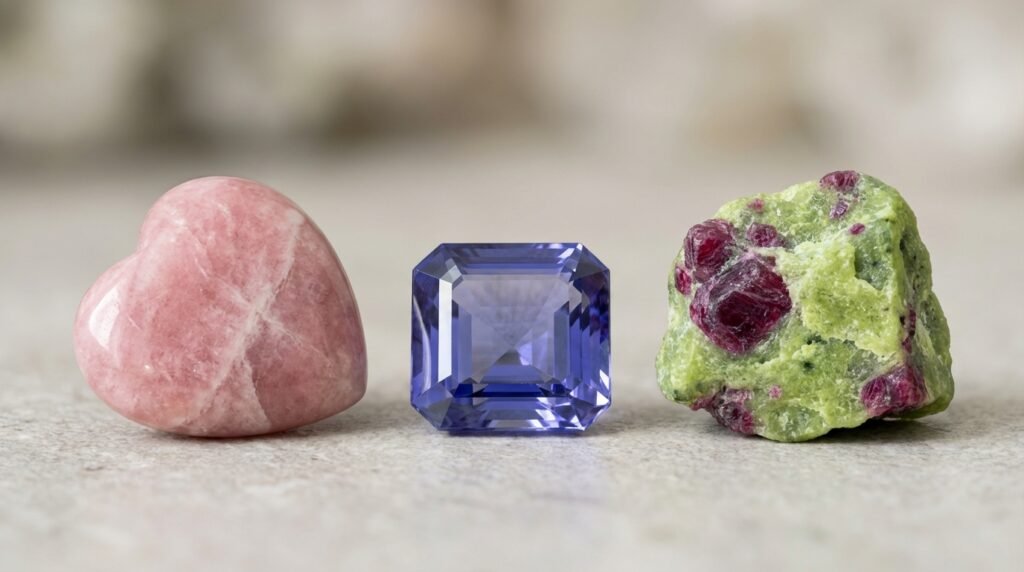
Zoisite is a captivating group of minerals that bridges the gap between geology, beauty, and energetic work. Best known for its gem-quality variety tanzanite, this mineral family also includes striking forms such as thulite and green zoisite with ruby. Collectors, crystal enthusiasts, and jewelry lovers alike are drawn not only to its vivid colors but also to its reputed metaphysical attributes.
In this comprehensive guide, you will discover how zoisite forms, its main types, its spiritual and healing associations, and how to select and care for it—whether you are adding it to a crystal collection, integrating it into your spiritual practice, or investing in fine jewelry.
What Is Zoisite? Origins, Meaning, and Properties
Zoisite is a calcium aluminum hydroxy sorosilicate mineral belonging to the epidote group. Its chemical formula, Ca2Al3(SiO4)(Si2O7)O(OH), reveals a complex atomic structure that underpins its durability and optical effects. It was first discovered in the early 19th century in Austria and named after the Slovenian scientist Sigmund Zois, who recognized its significance.
From a gemological perspective, zoisite ranges from opaque to transparent. Its hardness on the Mohs scale averages around 6 to 7, making some varieties suitable for jewelry while others are best kept as cabochons, beads, or polished specimens. The mineral forms in a variety of hues, from soft pink to vivid blue-violet and lush green, each shade reflecting subtle differences in trace elements and formation conditions.
The symbolic meaning of zoisite often centers on growth, renewal, and alignment with one’s authentic path. Many people consider it a stone of transformation, helping to shift stagnant patterns and reinvigorate personal purpose. This sense of revitalization is especially associated with the more vivid varieties, such as tanzanite and the green zoisite with ruby inclusions.
Geological Formation and Mineralogical Classification of Zoisite
Zoisite typically forms in regional metamorphic environments, where existing rocks are transformed by heat, pressure, and chemically active fluids. It commonly develops in metamorphosed dolomitic limestones, schists, and gneisses. Under these conditions, calcium- and aluminum-rich rocks recrystallize, giving rise to zoisite alongside other minerals such as garnet, amphibole, and feldspar.
Mineralogically, zoisite belongs to the sorosilicate class, characterized by paired silicate tetrahedra (Si2O7 groups). It is closely related to clinozoisite, differing mainly in crystal symmetry. Zoisite crystallizes in the orthorhombic system, often forming prismatic or columnar crystals with prominent striations. Massive and granular habits are also common, especially in ornamental and carving-grade material.
Significant deposits of zoisite occur in Tanzania, Norway, Austria, Switzerland, Kenya, Pakistan, and the United States, among other localities. Tanzanite, the most famous variety, is found almost exclusively in a limited area near Mount Kilimanjaro, which contributes to its rarity and desirability in the gemstone market.
Color Varieties: Tanzanite, Thulite, and Other Zoisite Types
Zoisite’s broad color palette is one of its defining features. The main varieties include:
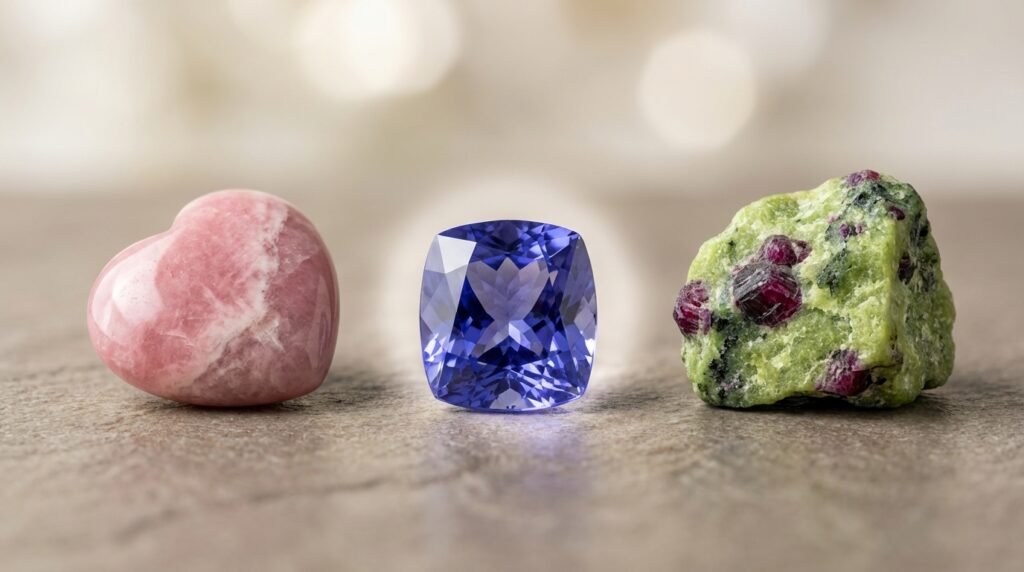
- Tanzanite: This blue to violet gemstone is the most celebrated form of zoisite. Its color results primarily from trace amounts of vanadium and is often enhanced by heat treatment. Tanzanite exhibits strong pleochroism, showing different colors—typically blue, violet, and sometimes burgundy—when viewed from different angles. It is prized in fine jewelry and considered a modern alternative to sapphire.
- Thulite: Thulite is the pink to reddish variety of zoisite, colored by manganese. Frequently found in Norway, it is usually opaque to translucent and is typically cut as cabochons or carved into ornamental objects. Its soft rosy tones make it popular for beads, pendants, and decorative pieces.
- Anyolite (Ruby in Zoisite): Anyolite is a striking green zoisite matrix with embedded ruby crystals and often dark hornblende inclusions. The vivid contrast of green, red, and black makes it a favorite for carvings, spheres, and statement jewelry. It combines the visual and energetic qualities of both zoisite and corundum.
- Green Zoisite: Not all green zoisite contains ruby. Pure green stones can be translucent to opaque and are used for carving, cabochons, and ornamental pieces. Their coloration arises from chromium or other trace elements.
- Other Variants: Less common hues, including yellowish, brownish, or colorless zoisite, do occur but are usually of greater interest to mineral collectors than to the jewelry trade.
The diversity of zoisite types allows enthusiasts to tailor their choices according to aesthetic preference, metaphysical focus, and practical use.
Metaphysical and Healing Properties of Zoisite
In metaphysical traditions, zoisite is widely regarded as a gemstone of renewal, vitality, and conscious evolution. It is often recommended for those seeking to revitalize their energy after burnout, align their life with deeper purpose, or integrate emotional experiences into a more coherent sense of self.
While each variety of zoisite has specific energetic nuances, many practitioners agree on core themes: transformation, growth, and the harmonization of the physical and subtle bodies. Zoisite is also believed to encourage self-expression and authenticity, helping individuals honor their unique path without being overwhelmed by external expectations.
Emotional, Spiritual, and Chakra Associations of Zoisite
Different forms of zoisite are associated with distinct emotional and spiritual benefits, often linked to the chakras:
- Emotional healing: Zoisite is frequently described as a stabilizing influence on mood, supporting emotional resilience. It may be used to counteract feelings of apathy, discouragement, or emotional numbness by gently reawakening passion and curiosity. Those going through major transitions—such as career changes, relocations, or relationship shifts—often turn to zoisite as a symbolic ally during transformation.
- Spiritual growth: On a spiritual level, zoisite is associated with awakening one’s inner truth and aligning with a more authentic life direction. It is said to help integrate spiritual insights into everyday choices, encouraging a grounded, practical spirituality rather than escapism.
- Chakra connections:
- Tanzanite is commonly linked to the throat, third eye, and crown chakras, supporting communication, intuition, and higher consciousness.
- Thulite is often associated with the heart and solar plexus, merging emotional warmth with personal confidence.
- Ruby in zoisite is frequently connected to the heart and root chakras, blending love, passion, and grounding energy.
- Green zoisite without ruby is typically aligned with the heart chakra, aiding compassion, balance, and emotional healing.
As with all crystal traditions, these associations are symbolic rather than scientifically proven. Many people use them as tools for focus, intention-setting, and personal reflection.
Zoisite in Meditation, Energy Work, and Manifestation Practices
Zoisite is widely used in meditation and energy work due to its perceived ability to harmonize the physical and energetic aspects of being. Its presence is said to create a field of steady, regenerative energy, which can be particularly helpful during times of deep introspection or transformation.
Common ways to work with zoisite in spiritual practices include:
- Meditation: Holding a piece of zoisite, placing it over a relevant chakra, or positioning it nearby is believed to enhance focus and emotional processing. Tanzanite, for instance, is often used in meditations aimed at expanding intuition or connecting with higher guidance, while ruby in zoisite may be chosen to ground spiritual insights into action.
- Energy healing: Practitioners of Reiki and other energy modalities sometimes incorporate zoisite into sessions, placing stones on or around the body to support energy flow. The combination of ruby and green zoisite is thought to stimulate the life force while encouraging compassionate self-awareness.
- Manifestation rituals: Because zoisite symbolizes growth and transformation, many people use it in manifestation work. One common approach is to program the stone by holding it and clearly stating intentions related to personal development, healing, or purposeful change. The crystal then serves as a physical reminder of the commitment to these goals.
- Journaling and reflection: Keeping a zoisite stone nearby while journaling, especially about life direction or emotional healing, can enhance the sense of ritual and help focus attention on inner exploration.
Results with any crystal practice are highly individual. For many, the principal benefit arises from the structured time spent in contemplation and the symbolic power of the stone as a touchstone for change.
How to Identify, Choose, and Care for Zoisite
Whether you are a collector, a jewelry buyer, or a crystal enthusiast, understanding how to recognize authentic zoisite and care for it properly is essential. This not only preserves the mineral’s physical beauty but also safeguards your investment and the integrity of your energetic work.
Identifying Genuine Zoisite: Color, Clarity, and Common Treatments
Identifying natural zoisite involves assessing color, transparency, structure, and potential enhancements. Key points to consider include:
- Color and pleochroism:
- Tanzanite should exhibit strong pleochroism, typically shifting between blue, violet, and sometimes a reddish or brownish tone when viewed from different angles. Extremely uniform or overly saturated color with no visible pleochroism can be a warning sign of imitation materials.
- Thulite generally presents as mottled or even pink to reddish, sometimes with white veining. Its color may be uneven rather than perfectly homogeneous.
- Ruby in zoisite shows distinctive green zoisite matrix with red to pink ruby patches or crystals. The combination of colors should appear natural, with some variation and textural difference between the components.
- Clarity and inclusions: Transparent tanzanite may display minor inclusions, such as needles or small crystals. Completely flawless stones are rare and typically expensive. In opaque varieties like thulite or anyolite, inclusions and pattern variations are normal and often enhance visual interest.
- Treatments:
- Heat treatment is very common in tanzanite. Many stones start as brownish or dull and are heated to produce the desired blue-violet color. This is an accepted enhancement in the gemstone industry, but reputable sellers should disclose it.
- Coatings and dyeing can occasionally be used on lower-quality material or imitation stones. Unnaturally vivid, surface-level color or dye concentrations along fractures are indications of possible treatment.
- Testing and verification: For high-value purchases, especially tanzanite, it is advisable to request certification from a recognized gemological laboratory. Professional testing can confirm identity, detect treatments, and differentiate natural zoisite from synthetic or imitation materials, such as glass or other colored gemstones.
When in doubt, consult a qualified gemologist or reputable dealer. Transparent communication about origin and treatment is a hallmark of a trustworthy seller.
Cleaning, Charging, and Storing Zoisite Crystals Safely
Zoisite is reasonably durable but requires appropriate care to maintain its luster and structural integrity, particularly in the case of faceted gemstones such as tanzanite.
For physical maintenance:
- Cleaning: Use lukewarm water, a mild soap, and a soft cloth or brush. Avoid harsh chemicals, steam cleaners, and ultrasonic cleaners, as these can damage or fracture more delicate stones. Always rinse thoroughly to remove soap residue, then dry with a soft, lint-free cloth.
- Protection from heat and shock: Sudden temperature changes can stress the crystal structure of zoisite, particularly tanzanite, which can be sensitive to thermal shock. Avoid leaving stones in direct sunlight or near heat sources. Take care to protect them from impact, falls, or knocks against hard surfaces.
- Storage: Store zoisite jewelry or loose stones individually in soft pouches or lined compartments to prevent scratching. Harder stones such as sapphire, diamond, and ruby can abrade zoisite if stored together without protection.
For energetic maintenance, many people incorporate additional practices, often referred to as “cleansing” or “charging” the crystal:
- Energetic cleansing: Common methods include placing zoisite on a bed of natural salt (separated by a cloth to avoid prolonged direct contact), resting it on clear quartz or selenite, or using sound from a tuning fork or singing bowl. Some prefer smoke cleansing with herbs or incense. Always ensure that chosen methods do not expose the stone to moisture, heat, or abrasive materials that could cause damage.
- Charging and intention-setting: After cleansing, many practitioners hold the stone, focus on their intentions, and mentally or verbally affirm the purpose for which the zoisite will be used. Some place it in gentle natural light—either early morning sunlight or moonlight—avoiding prolonged exposure that could fade certain stones.
Balancing physical care with mindful energetic practices helps preserve both the beauty and symbolic resonance of your zoisite pieces.
Zoisite in Jewelry, Collecting, and Everyday Use
Zoisite’s versatility makes it equally at home in fine jewelry, curated mineral collections, and everyday environments. Its wide color range allows for timeless designs, bold statement pieces, and subtle accents that complement both contemporary and traditional aesthetics.
Popular Zoisite Jewelry Styles and Buying Tips
Different zoisite varieties lend themselves to distinct jewelry styles:
- Tanzanite jewelry: Faceted tanzanite is commonly set in rings, pendants, earrings, and bracelets. Its rich blue-violet color pairs particularly well with white metals such as platinum and white gold, though yellow and rose gold create warmer, more classic looks. Higher-quality tanzanite is valued for vivid color saturation, good clarity, and skillful cutting that enhances its pleochroism.
- Thulite jewelry: Due to its opacity and patterned appearance, thulite is often cut into cabochons and beads. It appears in bohemian-inspired pieces, delicate pendants, and handcrafted artisan jewelry. Its softer, romantic hue appeals to those seeking gentle, heart-centered stones.
- Ruby in zoisite (anyolite) jewelry: This bold combination is frequently cut into large cabochons or carved into focal pieces. It makes an impact in pendants, statement rings, stretch bracelets, and cuffs. The contrast between green zoisite and red ruby lends itself to earthy, dramatic designs.
When purchasing zoisite jewelry, consider the following tips:
- Evaluate color and quality: For tanzanite, prioritize stones with rich blue-violet color and minimal visible inclusions. For ornamental variants, look for pleasing patterns, good polish, and sturdy settings that protect softer edges and corners.
- Ask about treatments: Ensure that any heat treatment or other enhancements are disclosed. With tanzanite, heat treatment is standard, but transparency from the seller remains important. Avoid pieces where information is vague or withheld.
- Choose suitable settings: Given zoisite’s hardness and cleavage, protective settings such as bezels or halo designs can help safeguard gemstones, particularly in rings that are subject to daily wear.
- Buy from reputable sources: Established jewelers, specialized gemstone dealers, and vendors who provide certification for higher-value stones offer greater assurance of authenticity and ethical sourcing.
Treat zoisite jewelry as you would any fine gemstone: remove it during strenuous activities, avoid harsh chemicals, and store it properly to preserve its brilliance.
Zoisite for Crystal Collections, Home Décor, and Feng Shui
Beyond jewelry, zoisite lends itself beautifully to interior spaces and curated crystal collections. Its vivid colors and intriguing patterns make it a focal point in display cabinets, on shelves, and in dedicated meditation areas.
Popular non-jewelry uses include:
- Specimens and carvings: Collectors seek natural crystals, polished freeforms, spheres, and carved figurines in various zoisite types. Ruby in zoisite, with its striking palette, is especially favored for carved animals, hearts, and abstract sculptures. Thulite’s gentle pink makes it ideal for decorative pieces in bedrooms or intimate spaces.
- Home décor accents: Larger polished pieces can be placed on side tables, bookshelves, or office desks. Many people choose green or ruby-bearing zoisite for living rooms and communal spaces to encourage a sense of vitality and harmonious interaction.
- Feng Shui applications: In Feng Shui, color and element associations guide placement of stones within the home. While interpretations vary, common approaches include:
- Using green zoisite in the Family or Health area to symbolize renewal and well-being.
- Placing ruby in zoisite in areas emphasizing passion, creativity, or relationships, such as the Fame or Relationship sectors, to foster enthusiasm and emotional connection.
- Incorporating tanzanite or violet-toned zoisite in spaces dedicated to study, meditation, or spiritual practice, supporting clarity and insight.
- Workspace support: Smaller zoisite pieces on a desk or near a computer are often used as reminders of balance, resilience, and purposeful work. They can serve as tactile anchors during short mindfulness breaks throughout the day.
When adding zoisite to your home or office, consider both aesthetics and intention. Pairing it with complementary materials—such as wood, glass, or neutral-toned stones—creates coherence, while thoughtful placement enhances its visual and symbolic impact.
Conclusion
Zoisite is far more than a single gemstone. It is an entire mineral family encompassing the famed tanzanite, the soft charm of thulite, and the dramatic energy of ruby in zoisite. Its geological story reflects the power of heat and pressure to transform rock, while its metaphysical traditions speak to personal growth, emotional renewal, and alignment with higher purpose.
The Chemistry of Color
Pure zoisite is actually colorless or a dull grey. The “magic” happens when trace elements—impurities, in geological terms—stumble into the crystal lattice during formation:
-
Vanadium: The secret ingredient for Tanzanite’s blue-violet glow.
-
Manganese: The architect of Thulite’s rosy pink.
-
Chromium: The source of the lush green in Anyolite.
Without these specific chemical “accidents,” we wouldn’t have the vibrant varieties we treasure today. This rarity is why tanzanite, in particular, is often described as a “geological fluke.”
Tanzanite: The Crown Jewel of East Africa
While tanzanite was only discovered in 1967, its impact on the world was immediate. It was famously championed by Tiffany & Co., who recognized that its beauty rivaled that of the finest sapphires but with a unique, velvety violet undertone.
The “Single Source” Paradox
Tanzanite is found in only one place on the planet: the Merelani Hills of Tanzania, near the base of Mount Kilimanjaro. The mining area is tiny—roughly 7 kilometers long and 2 kilometers wide. Geologists estimate that the supply of tanzanite may be exhausted within the next few decades, making it a “one-generation gemstone.” This finite supply adds an layer of investment value to every piece of zoisite-based tanzanite.
Understanding Pleochroism
One of the most fascinating technical aspects of tanzanite is its trichroism. When a raw crystal is found, it can appear blue, purple, and burgundy-red simultaneously depending on which axis you look through. A master gem cutter must decide which color to “face up.” If they cut for the blue, the stone might lose weight but gain value; if they cut for the purple, the stone might be larger but less rare. This makes every faceted tanzanite a high-stakes work of art.
Thulite: The Romantic Nordic Zoisite
On the opposite end of the aesthetic spectrum lies Thulite. Named after the mythical island of “Thule” (often associated with Norway), this opaque variety of zoisite is the national stone of Norway.
A Stone of Social Connection
Unlike the “regal” tanzanite, Thulite has a more grounded, accessible energy. Historically, it has been used for carvings and ornaments in Scandinavia for centuries. Because it is often found in massive form rather than distinct crystals, it is perfect for large-scale artisanal work.
The Manganese Influence
The manganese content in Thulite can range from a pale “baby pink” to a deep “raspberry red.” In the world of crystal healing, this color is often linked to the “extroverted” side of the Heart Chakra—it isn’t just about self-love; it’s about the joy of being with others and the courage to be vulnerable in a community.
Anyolite: The Powerhouse Duo (Ruby in Zoisite)
Anyolite is perhaps the most visually striking member of the family. The name comes from the Maasai word anyoli, which simply means “green.”
The Symbiosis of Fire and Earth
In Anyolite, we see a literal fusion of two different minerals: green zoisite and red corundum (ruby). Because ruby is much harder (Mohs 9) than zoisite (Mohs 6.5), these stones can be difficult to polish evenly. However, the result is a stunning contrast of colors that are opposites on the color wheel.
Energetic Synergy
Metaphysically, Anyolite is used for “The Stone of Return.” It is believed to help the soul return to its center after a period of trauma or exhaustion. The green zoisite provides a lush, healing “garden” for the “fire” of the ruby to burn safely, preventing the wearer from becoming overstimulated or angry while still providing a boost of passion.
Zoisite in Advanced Spiritual Practice
For those who use crystals beyond simple decoration, zoisite is known as a multi-dimensional harmonizer.
Integration of the “Shadow”
Spiritual practitioners often use zoisite for “shadow work”—the process of looking at the parts of our personality we usually hide. Zoisite is said to provide the necessary grounding (Earth element) to face these internal truths without feeling judged or overwhelmed.
Enhancing Creativity
Because zoisite helps transform negative energy into positive, it is a favorite for artists experiencing “creative block.” It is thought to stimulate the “Inner Child,” reminding the adult mind that play and experimentation are the roots of all great innovation.
Selecting and Investing: A Buyer’s Masterclass
If you are looking to purchase zoisite, especially in its transparent gemstone form, you must be a savvy consumer.
1. The “A-Grade” Hierarchy
In tanzanite, color saturation is king. You will often see grades like “AAA” or “AAAA.” These denote deep, vivid blues and purples. Lighter, “lilac” stones are more affordable and popular for delicate jewelry, but they do not hold the same resale value as the “velvet” blues.
2. The Cut Quality
Because zoisite has perfect cleavage in one direction, it is prone to splitting if hit hard at a specific angle. When buying a faceted stone, check for “windowing”—an area in the center of the stone that looks clear or washed out. A well-cut zoisite should reflect light evenly across its entire surface.
3. Ethical Sourcing
Since tanzanite is a major export for Tanzania, look for “The Tanzanite Protocol” or similar ethical certifications. This ensures that the miners were paid fairly and the environment was handled with care.
Caring for Your Legacy
Zoisite is a “lifestyle” stone, meaning it can be worn, but it requires mindfulness.
-
The Hardness Factor: At a 6.5 on the Mohs scale, it is softer than quartz (which is in common household dust). Over years, a zoisite ring worn daily might develop “scuffing” on the facet edges.
-
Cleaning Rituals: If using zoisite for energy work, avoid “sun-charging” for too long. While tanzanite is heat-treated to 550°C, prolonged exposure to direct UV rays can occasionally alter the subtle hues of untreated green zoisite or thulite.
Final Thoughts: A Mineral for the Modern Era
In an age of rapid change and digital noise, zoisite stands as a reminder of the Earth’s slow, transformative power. It tells us that with enough time, pressure, and the right “ingredients,” even the most ordinary elements can become extraordinary. Whether you wear a tanzanite pendant for its beauty or keep a piece of anyolite on your desk for resilience, you are carrying a piece of the Earth’s most beautiful “mistakes.”
Zoisite doesn’t just decorate our lives; it invites us to grow alongside it. It is a mineral family that rewards the curious, protects the weary, and inspires the visionary. As the supply of certain varieties dwindles, the story of zoisite only becomes more precious—a true masterpiece of nature that we are lucky to witness.
By understanding how zoisite forms, recognizing its main varieties, and learning how to select and care for it, you can make informed decisions—whether you are acquiring a valuable tanzanite ring, curating a collection of crystal specimens, or integrating zoisite into your meditation and energy practices. With mindful care and thoughtful use, zoisite can become a lasting companion on your journey, enriching both your environment and your inner life.
Keywords: Zoisite, Tanzanite, Thulite, Ruby in Zoisite, Anyolite, Crystal Healing, Gemstone Care, Metaphysical Properties.
CrystalCollector
Combat Protocol
WASD – Move
Mouse – Look around
Left Click – Fire Weapon
R – Reload
Eliminate all hostile units in the sector!
(Works better on computer)
Slither Arcade
Features
- Classic Gameplay: Grow your snake by eating apples while avoiding self-collision.
- Dynamic Difficulty: The game speed increases as you eat more food.
- Juicy Polish: Screen shakes on eating, pulsing food animations, and high-score tracking.
- Responsive Controls: Use Arrow keys, WASD, or swipe on touch devices/mouse.
- Visuals: Custom-generated stylized assets and a minimalist neon background.
How to play:
- Controls: Use Arrow Keys or WASD to change direction. On mobile, Swipe in the direction you want to turn.
- Objective: Eat the glowing red apples to grow and increase your score. The game ends if you collide with your own tail.
The snake wraps around the screen edges, allowing for strategic maneuvers! Enjoy your game.Controls Reminder: The golden apple slows time for 5 seconds