
The Symphony of the Synapse: The Definitive Guide to Music and the Brain
Music is a universal language, but its impact is far more than just “pleasant sound.” It is a neurobiological powerhouse. From the chills you get during a soaring soprano solo to the focus you find while listening to lo-fi beats, music systematically re-wires and stimulates the human brain in ways that few other stimuli can.
To understand why we are so moved by a melody, we have to look under the hood at the complex machinery of the mind.
1. The Anatomy of an Auditory Experience
When you press play, your brain doesn’t just “hear” a song; it performs a massive computational feat.
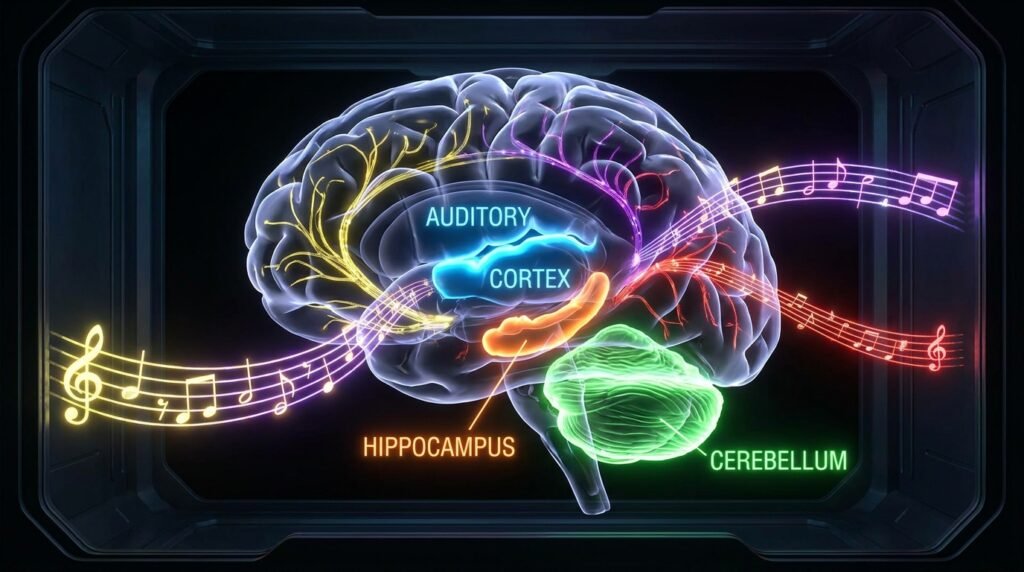
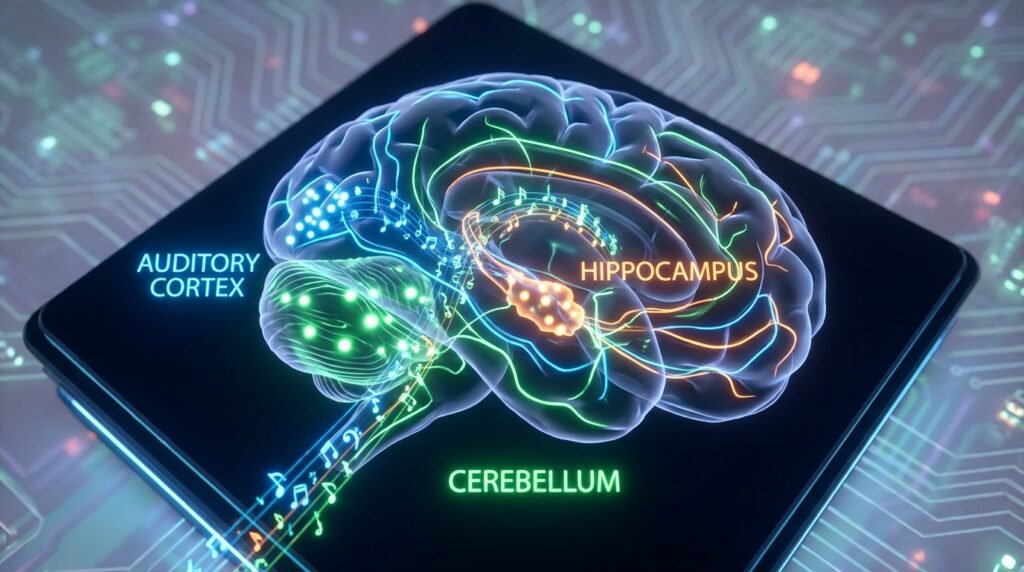
- The Auditory Cortex: Located in the temporal lobes, this is the primary processing center. It breaks down the basics: pitch, volume, and timbre.
- The Frontal Lobe: This is where you process the “meaning” of the music. It handles the structure and expectations—predicting when the beat will drop or how a melody will resolve.
- The Cerebellum: Often associated with physical movement, the cerebellum processes rhythm and timing. It’s the reason your foot starts tapping before you’ve even consciously realized you like the song.

2. The Chemistry of “The Chills”
Have you ever felt a shiver down your spine during a powerful bridge? This is known as frisson.
Research using PET scans has shown that when we listen to music that moves us, the brain releases dopamine—the same “feel-good” neurotransmitter associated with food, sex, and even certain addictive substances. Interestingly, dopamine is released both at the peak emotional moment and in the anticipation of that moment. Your brain is literally rewarding you for predicting a musical payoff.
3. Music and Memory: The “Flashbulb” Effect
The hippocampus, which handles long-term memory, is deeply integrated with the auditory system. This is why a single song can transport you back to a specific summer ten years ago or remind you of a loved one.
For patients with Alzheimer’s or dementia, music is often the last “key” that can unlock memories. Even when language centers fail, the musical memory remains remarkably resilient because it is stored across such a wide network of the brain.

4. The Benefits of Rhythm and Tempo
The speed of music can physically alter your body’s state:
| Genre/Tempo | Brain Effect | Physiological Response |
| High BPM (120+) | Increases Adrenaline | Higher Heart Rate, Increased Alertness |
| Binaural Beats | Brainwave Entrainment | Enhanced Focus or Deep Sleep |
| Classical (Adagio) | Lowers Cortisol | Reduced Blood Pressure, Lower Stress |
5. Neuroplasticity: The Musician’s Brain
Practicing music is essentially “full-body exercise” for the brain. Studies show that long-term musicians have a larger corpus callosum—the bridge of fibers connecting the left and right hemispheres. This allows for faster communication between the creative/emotional side and the logical/analytical side of the brain.
Summary: A Survival Mechanism?
Why did we evolve to love music? Some scientists suggest it helped our ancestors bond. By singing or drumming together, groups synchronized their brainwaves (a process called neural coupling), fostering social cohesion and trust.
Whether you’re using it to study, sweat, or sob, music is a sophisticated tool for emotional and cognitive regulation. It’s not just art; it’s a biological necessity.
Music and the brain, neuroscience of music, dopamine and music, how music affects mood, benefits of listening to music, auditory cortex functions.
Music is not merely a cultural byproduct or a pleasant pastime; it is a biological imperative. From the rhythmic beating of a mother’s heart in the womb to the complex polyphonies of a Mahler symphony, humans are “hard-wired” for sound. But what is actually happening behind the skull when the needle hits the record?
In this deep dive, we will explore the neuroanatomy, chemistry, and evolutionary psychology that make music one of the most powerful tools for human transformation.
I. The Neuroanatomy of Sound: A Full-Brain Workout
Unlike language, which is primarily processed in the left hemisphere for most people, music is one of the few activities that engages every major structure of the brain simultaneously.
1. The Auditory Cortex and Beyond
When sound waves hit your ear, they are converted into electrical signals by the cochlea. These signals travel to the Auditory Cortex in the temporal lobes. Here, the brain performs a feat of “reverse engineering.” It deconstructs the sound into:
- Pitch: The frequency of the vibrations.
- Timbre: The “color” or quality of the sound (why a piano sounds different from a trumpet).
- Volume: The intensity of the signal.
2. The Cerebellum: The Rhythm Center
While you might think rhythm is a high-level “thinking” task, it’s actually processed in the cerebellum, the oldest part of the brain responsible for motor control. This is why you don’t have to “think” about tapping your foot—your cerebellum has already synchronized your motor neurons to the beat before the signal even reaches your conscious mind.
3. The Hippocampus: The Memory Vault
Why does a specific song remind you of your high school prom? The hippocampus is responsible for long-term memory and emotional context. Music is an incredibly “sticky” stimulus for the hippocampus, which is why it is often used in therapy for patients with Alzheimer’s.
II. The Chemistry of Harmony: Neurotransmitters and Music
Music acts as a natural pharmacy. By changing what we listen to, we can literally alter the chemical makeup of our blood.
1. The Dopamine Rush

Research using fMRI technology has shown that listening to “pleasurable” music triggers a massive release of dopamine in the nucleus accumbens. This is the same reward pathway activated by eating chocolate or winning the lottery.
- The Chills (Frisson): That physical shiver you feel is a “dopamine spike” occurring at a moment of musical resolution or unexpected change.
2. Cortisol and Stress Reduction
Listening to slow, rhythmic music (around 60–80 BPM) has been shown to reduce levels of cortisol, the body’s primary stress hormone. In clinical settings, music therapy has been found to be more effective than some anti-anxiety medications in pre-operative patients.
3. Oxytocin: The Social Glue
When people sing together in a choir or dance at a concert, their brains release oxytocin, often called the “bonding hormone.” This creates a sense of shared identity and trust, explaining why music has been central to human rituals for tens of thousands of years.
III. The “Mozart Effect” vs. The “Vivaldi Effect”
For decades, the “Mozart Effect” claimed that listening to classical music made babies smarter. Modern science has refined this. While music doesn’t necessarily raise your IQ permanently, it does induce “Short-term Spatiotemporal Enhancement.”
Basically, listening to complex music warms up the neural pathways used for spatial reasoning and math. However, the “Vivaldi Effect” (based on upbeat, fast-tempo music) shows that any music that improves your mood will also improve your cognitive performance.
IV. Music as Medicine: Neuroplasticity and Healing

The brain’s ability to reorganize itself—neuroplasticity—is highly sensitive to music.
- Stroke Recovery: Patients who have lost the ability to speak (aphasia) can often still sing their thoughts. Through Melodic Intonation Therapy, they can bypass damaged language centers and use the musical centers of the right brain to “re-learn” speech.
- Parkinson’s Disease: Rhythmic Auditory Stimulation (RAS) helps Parkinson’s patients walk more fluidly. The external “beat” acts as a prosthetic for the brain’s internal timing mechanisms that have been damaged by the disease.
Neuroscience of music
How music affects mood
Music therapy for anxiety
Dopamine and auditory stimuli
Brain benefits of playing an instrument
The Verdict
The science is clear: we are musical beings. Every time you put on your favorite playlist, you aren’t just killing time—you are performing a complex neurological tune-up. You are flooding your system with dopamine, lowering your cortisol, and strengthening the bridges between your brain’s hemispheres.
Does your brain have a “theme song” that instantly changes your mood or helps you focus?
What specific genre of music do you find most effective for boosting your productivity or mood?
https://www.teepublic.com/t-shirt/50508298-yoga-cuty?store_id=2851997
trance music dubstep music The Rise of Jazz Music The Ultimate Guide to Music, Subgenres, and Detroit Origins EDM:The Complete Guide to Electronic Dance Music, Genres