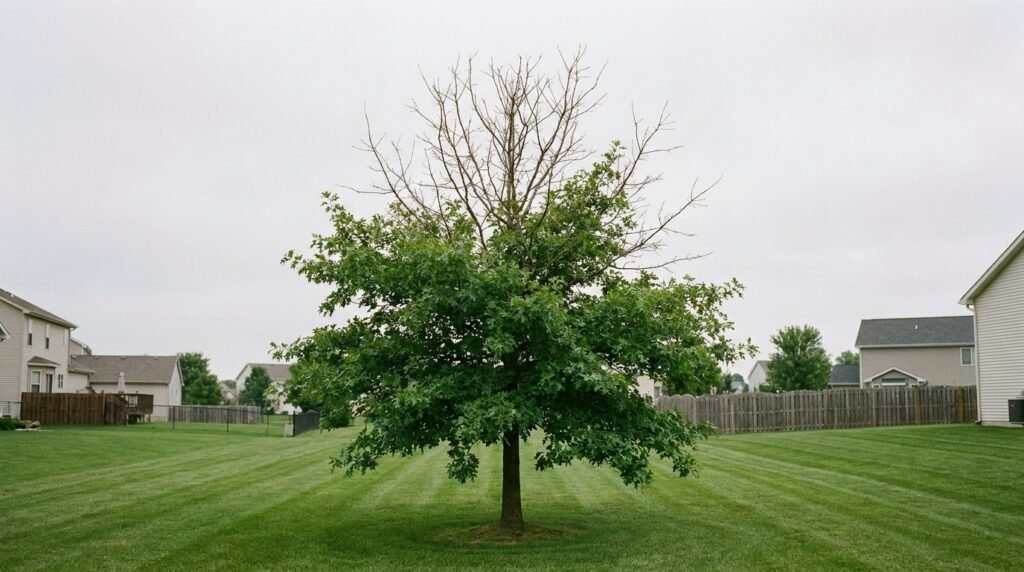
The lower branches are lush and green — but the crown is completely bare. Should you panic? Probably not. Here’s what transplant shock looks like and how to help your tree recover.
pin oak transplant shocktree bare top after transplanttransplanted tree not leafing outpin oak caretree recovery after transplant
SEO Meta Description
Is your Pin Oak bare at the top a year after transplanting while the lower branches look healthy? Learn why this happens, what it means, and how to help your tree fully recover.
Focus Keyword
pin oak transplant shock
Suggested URL Slug
/pin-oak-bare-top-after-transplant
You had four Pin Oaks transplanted at the same time. Three of them are thriving — full, lush, leafing out beautifully from top to bottom. But the fourth? The bottom half looks great. The top is completely bare. No leaves, just bare branches reaching into the sky.
Is it dying? Did something go wrong? And will it sort itself out?
The short answer: this is almost certainly transplant shock — and while it warrants attention, it doesn’t necessarily mean the tree is doomed.
What is transplant shock?
When a tree is dug up and moved, it loses a large portion of its root system in the process. Those roots are responsible for drawing water and nutrients up through the tree. With fewer roots working, the tree simply can’t support everything it was able to before — so it starts making trade-offs.
The top of the tree — the crown — is the farthest point from the roots and requires the most energy to sustain. It’s typically the first area to show signs of stress. The lower branches, being closer to the root zone, get first access to whatever resources the weakened root system can deliver.
This is exactly why a tree can look perfectly healthy at the bottom while appearing dead at the top. It’s not a coincidence — it’s the tree doing triage.
Good sign: Healthy, leafy lower branches mean the tree is alive and actively growing. The root system is just not yet strong enough to push energy all the way to the crown.
https://www.teepublic.com/t-shirt/50159849-hot-dog?store_id=2851997
Why did this one struggle when the others didn’t?
When multiple trees are transplanted together but only one shows stress, a few factors could be at play. The affected tree may have had a smaller or more damaged root ball during digging. It might have landed in a slightly different soil condition — a drier pocket, a clay-heavy zone, or an area with less drainage. It could also have been planted at a slightly different depth, which makes a significant
Is it dying? Did something go wrong? And will it sort itself out?
The short answer: this is almost certainly transplant shock — and while it warrants attention, it doesn’t necessarily mean the tree is doomed.
What is transplant shock?
When a tree is dug up and moved, it loses a large portion of its root system in the process. Those roots are responsible for drawing water and nutrients up through the tree. With fewer roots working, the tree simply can’t support everything it was able to before — so it starts making trade-offs.
The top of the tree — the crown — is the farthest point from the roots and requires the most energy to sustain. It’s typically the first area to show signs of stress. The lower branches, being closer to the root zone, get first access to whatever resources the weakened root system can deliver.
This is exactly why a tree can look perfectly healthy at the bottom while appearing dead at the top. It’s not a coincidence — it’s the tree doing triage.
Good sign: Healthy, leafy lower branches mean the tree is alive and actively growing. The root system is just not yet strong enough to push energy all the way to the crown.
Why did this one struggle when the others didn’t?
When multiple trees are transplanted together but only one shows stress, a few factors could be at play. The affected tree may have had a smaller or more damaged root ball during digging. It might have landed in a slightly different soil condition — a drier pocket, a clay-heavy zone, or an area with less drainage. It could also have been planted at a slightly different depth, which makes a significant
difference in how well roots establish.
None of these are necessarily a fatal problem. They just mean this particular tree is working harder to get established and needs more support.
How to tell if the bare branches are dead or just dormant
This is the most important question. Bare branches can mean two things: the tree hasn’t pushed growth up there yet, or those branches have actually died.
The scratch test is your best tool. Using a fingernail or a small knife, gently scratch the bark on one of the bare upper branches. If the tissue underneath is green or white and moist — the branch is alive. If it’s dry, brown, and brittle — it’s dead.
Do this on several upper branches. A mix of results is common after transplant stress.
Watch for this: If by midsummer the bare upper branches show zero signs of budding or green tissue under the bark, those specific branches are gone and should be pruned out. Leaving dead wood invites disease and pests.
What you should do right now
Hold off on fertilizer. It’s tempting to feed a struggling tree, but heavy fertilization pushes top growth the root system can’t yet support. Wait until the tree shows clear signs of strong recovery.
Mulch the base. A 3–4 inch ring of mulch (kept away from the trunk itself) retains soil moisture, moderates temperature, and reduces competition from grass roots.
Water deeply and consistently. This is the single most important thing. Transplanted trees need slow, deep watering — not frequent shallow sprinkles. Aim for the equivalent of about 10 gallons per inch of trunk diameter, once or twice a week during dry periods.
- Hold off on fertilizer. It’s tempting to feed a struggling tree, but heavy fertilization pushes top growth the root system can’t yet support. Wait until the tree shows clear signs of strong recovery.
- Be patient through this growing season. Pin Oaks can take 2–3 years to fully re-establish after transplanting. Year one bare crowns that fill in by year two are not unusual at all.
- Prune dead wood carefully. Once you’ve confirmed which branches are dead via the scratch test, remove them cleanly. This redirects the tree’s energy toward viable growth.
When should you actually worry?
Escalate your concern if the dieback continues to spread downward into branches that were healthy this season. If next spring the leafed-out lower branches are also struggling, the root system may be in more serious trouble. At that point, consulting a certified arborist is the right call — they can assess root health, check for soil compaction or fungal issues, and advise on whether intervention can save the tree.
Understanding Your Pet’s Behavior: Common SignsYoga for Flexibility: Tips and Tricks The Benefits of Adopting a Shelter Pet scandinavia interior design trance music Cannes Travel Guide: Top Attractions and Best Time to Visit


Also keep an eye out for signs of pests moving into the stressed tissue. Borers in particular target weakened oaks and can turn a recoverable situation into a fatal one quickly.
The bottom line
A Pin Oak with a bare crown a year after transplanting — while the lower canopy is full and green — is showing classic transplant shock, not necessarily a death spiral. The tree is alive. It’s just rebuilding from the bottom up. With consistent deep watering, mulching, and patience through one more growing season, there’s a real chance the crown fills back in and the tree catches up to its siblings.
Give it the support it needs, monitor it through summer, and resist the urge to intervene aggressively. Trees are slow, resilient, and often more capable of recovery than they initially appear.

Zoo_Doku
My Puzzle
CrystalCollector
Combat Protocol
WASD – Move
Mouse – Look around
Left Click – Fire Weapon
R – Reload
Eliminate all hostile units in the sector!
(Works better on computer)