
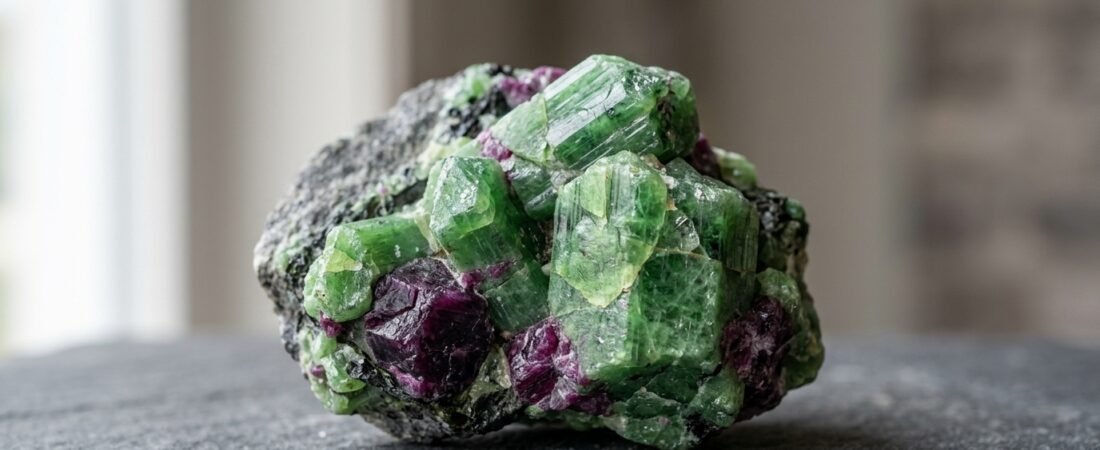
Few minerals captivate collectors, healers, and gemologists quite like zoisite. With its extraordinary range of colors, its remarkable geological diversity, and its deep resonance in metaphysical traditions, zoisite occupies a singular place in the world of crystals. From the vivid green and ruby-red masses found in Tanzania to the celebrated blue tanzanite variety that graces fine jewelry collections worldwide, zoisite is far more than an ornamental stone. It carries layered meaning, demonstrable energetic qualities, and practical applications that make it genuinely worth understanding. Whether you are drawn to it for its aesthetic beauty, its healing properties, or its spiritual significance, this guide offers a thorough and grounded exploration of everything zoisite has to offer.
What Is Zoisite and Where Does It Come From?
Geological Origins and Formation of Zoisite
Zoisite is a calcium aluminum silicate hydroxide mineral belonging to the epidote group. It forms primarily through regional metamorphism and hydrothermal processes, developing within metamorphic rocks such as schists, gneisses, and amphibolites, as well as in hydrothermally altered igneous rocks. The mineral was first identified in 1805 by the Slovenian naturalist Sigmund Zois, after whom it was named, following its discovery in the Saualpe mountains of Carinthia, Austria.
Chemically, zoisite is composed of calcium, aluminum, silicate, and hydroxyl groups arranged in an orthorhombic crystal system. This structure gives it a prismatic habit, and crystals often exhibit striated faces along the length of the prism. The mineral’s hardness ranges between 6 and 7 on the Mohs scale, making it durable enough for use in jewelry yet still susceptible to mechanical shock. Its coloration varies widely depending on trace element inclusions — manganese produces pink to red tones in thulite, vanadium is responsible for the coveted blue-violet hue of tanzanite, and chromium lends a rich green to certain massive varieties.
The diversity of zoisite’s appearance across its varieties is not merely cosmetic. Each variety forms under distinct geological conditions, and that uniqueness is reflected in how each is used, valued, and understood in both scientific and metaphysical contexts.
Major Sources and Varieties of Zoisite Around the World
Zoisite occurs on multiple continents, though certain localities have achieved particular renown for the quality and character of their specimens. Tanzania remains the most celebrated source, producing both the iconic ruby in zoisite combination stones and the blue-violet tanzanite, which was discovered only in 1967 near Mount Kilimanjaro and has since become one of the most sought-after gemstones in the world. Tanzanite is found exclusively in a small mining area in the Mererani Hills, making it geologically rare and commercially precious.
Norway is the primary source of thulite, a pink to rose-red variety of zoisite colored by manganese, which serves as the national stone of Norway. India, Pakistan, Austria, and the United States — particularly Montana, Wyoming, and Washington — also yield quality zoisite specimens. Kenya and other parts of East Africa contribute additional green and multicolored varieties.
Among the most visually striking forms is ruby zoisite, also known as anyolite, a combination of green zoisite, red corundum (ruby), and black hornblende. Found primarily in Tanzania, this stone has become iconic in the crystal healing community due to its bold coloration and its association with balancing opposing energies. Each variety of zoisite carries its own aesthetic character and its own set of metaphysical associations, giving collectors and practitioners ample choice depending on their intentions.
Zoisite Meaning and Spiritual Significance
Symbolic Meaning and Metaphysical Properties of Zoisite
Zoisite carries a meaning deeply rooted in transformation, vitality, and the actualization of one’s authentic self. In metaphysical traditions, it is regarded as a stone of return — one that brings the soul back to its original nature after periods of grief, stagnation, or external pressure have caused a departure from inner truth. It encourages individuality without ego, supporting the emergence of a self that is grounded, genuine, and purposeful.
The spiritual meaning of zoisite is often described in terms of transmutation. Just as the mineral forms through the metamorphic transformation of existing rock, it is believed to help individuals transform negative patterns, suppressed emotions, and unhealthy dependencies into constructive energy. It does not simply dissolve difficulty — it converts it. This quality makes zoisite particularly resonant for those undergoing major life transitions, recovering from loss, or seeking to break free from cycles that no longer serve them.
Ruby zoisite, in particular, carries an amplified version of this meaning. The union of the fiery red ruby with the grounding green zoisite is symbolically rich: it represents the integration of passion and practicality, heart and mind, vitality and calm. Many practitioners describe it as a stone of wholeness — one that bridges polarities rather than favoring one over the other. Its metaphysical properties are considered especially potent for those who feel divided within themselves or who struggle to reconcile ambition with emotional well-being.
Thulite, with its soft pink coloration, is associated with compassion, extroversion, and the capacity for joy. Tanzanite carries a more elevated spiritual frequency, often linked to visionary states, higher consciousness, and the expansion of perception beyond ordinary waking awareness. Together, the zoisite family spans a wide spectrum of spiritual significance, from the earthly and emotional to the transcendent.
Zoisite and Its Connection to Chakras and Energy Work
In energy healing and chakra-based traditions, zoisite is primarily associated with the heart chakra, the energy center located at the center of the chest and governing love, empathy, relationship, and emotional resilience. Green zoisite resonates most strongly with this chakra, encouraging the free flow of loving energy and helping to dissolve emotional blockages that prevent genuine connection — both with others and with oneself.
Ruby zoisite engages both the heart chakra and the root chakra simultaneously, which accounts for much of its appeal in grounding practices. The ruby component stimulates life force energy and courage at the root level, while the zoisite channels that energy upward toward the heart, promoting a sense of courageous love and embodied compassion. This dual activation makes it a particularly useful stone in work involving trauma, where both safety and emotional openness are necessary.
Tanzanite, by contrast, is aligned with the throat chakra, the third eye chakra, and the crown chakra, facilitating clear communication, intuitive insight, and spiritual connection. It is frequently used in meditation to deepen states of receptivity and to support access to higher guidance. For those who work with energy intuitively, tanzanite is considered one of the more powerful tools for expanding psychic sensitivity and refining the quality of inner listening.
Thulite activates the sacral and heart chakras, supporting emotional expression, interpersonal warmth, and the kind of open-hearted presence that makes meaningful relationships possible. In a complete energy practice, different varieties of zoisite can be used in sequence or combination to address multiple chakra centers, creating a holistic and nuanced approach to energetic alignment.
Zoisite Healing Properties and Benefits
Physical and Emotional Healing Benefits of Zoisite
From a holistic healing perspective, zoisite is credited with a broad range of physical and emotional benefits that complement conventional wellness practices. On the physical level, crystal healers associate it with support for the immune system, the heart, and the reproductive organs. It is believed to assist with cellular regeneration and recovery, making it a common choice for those healing from illness or surgery. Some traditions also link it to fertility and the healthy functioning of the endocrine system.
Ruby zoisite, with its deeply energizing quality, is thought to stimulate vitality, support cardiovascular function, and enhance overall physical endurance. Its ruby component has long been associated with blood, circulation, and the life force itself, and when combined with zoisite’s grounding energy, the stone is considered particularly restorative for those experiencing chronic fatigue or depletion.
On the emotional level, zoisite’s healing properties are perhaps most significant. The stone is widely regarded as a powerful antidote to apathy, grief, and the kind of deep emotional numbness that can follow prolonged suffering or loss. Rather than simply lifting the spirit superficially, it is said to reconnect individuals with the core of their own vitality — reminding them, at an experiential level, why life is worth engaging with fully. This quality makes it valuable for those navigating depression, bereavement, or the aftermath of trauma.
Zoisite also supports the release of suppressed emotions. It encourages individuals to acknowledge what they have buried — not to dwell in it, but to process it and let it move. In doing so, it facilitates a kind of emotional honesty that is both healing and liberating. Many who work with this stone regularly report an increased sense of authenticity in how they express themselves, as though an internal filter has been gently lifted.
How Zoisite Supports Mental Clarity and Personal Growth
Beyond its emotional resonance, zoisite is associated with qualities that support intellectual life and personal development. It is regarded as a stone that promotes independent thinking and the courage to form one’s own opinions, particularly in the face of social pressure or external expectation. For this reason, it is sometimes recommended for individuals who habitually defer to others at the expense of their own judgment — students, emerging professionals, or anyone in the process of developing a stronger sense of self.
Mentally, zoisite is thought to enhance concentration, reduce mental scatter, and support the kind of focused awareness required for sustained creative or intellectual work. It may be particularly useful during periods of study or complex problem-solving, where mental clarity and the ability to hold multiple considerations simultaneously are essential.
On the path of personal growth, zoisite functions as a stone of becoming. It does not simply affirm what one already is — it actively supports the process of evolving into who one is capable of being. This makes it a meaningful companion for those engaged in therapy, spiritual practice, or any serious process of self-examination. Its energy is patient, steady, and encouraging without being passive. It meets the practitioner where they are, and gently propels them forward.
The gemstone benefits of zoisite also include a strengthening of trust — trust in one’s own perceptions, in the unfolding of circumstances, and in the intelligence of the natural world. This quality of trust is foundational to any meaningful growth process, and zoisite’s ability to cultivate it makes it an unusually well-rounded crystal for long-term personal work.
How to Use and Care for Your Zoisite Crystal
Best Ways to Use Zoisite for Meditation and Daily Life
Zoisite is a versatile stone that lends itself to a variety of practical applications, both in dedicated spiritual practice and in everyday life. Its uses are numerous, and choosing the right approach depends largely on your intention and the variety of zoisite you are working with.
For meditation, holding a piece of zoisite — particularly ruby zoisite or tanzanite — in the hands or placing it on the corresponding chakra point can significantly deepen the quality of the sitting. Begin by setting a clear intention: whether that is emotional release, heart opening, mental clarity, or spiritual expansion. Allow the weight and texture of the stone to anchor your attention, and breathe slowly as you invite its energy into your field. Even a brief daily practice of ten to fifteen minutes can yield noticeable shifts over time.
In daily life, wearing zoisite as jewelry is one of the most effective ways to maintain a continuous energetic connection with the stone. Pendants placed near the heart center are ideal for green zoisite and ruby zoisite. Tanzanite is particularly powerful when worn near the throat or as earrings close to the ears and temples, supporting clear communication and intuitive receptivity throughout the day.
Placing zoisite crystals in your living or working environment is another practical approach. A piece of ruby zoisite on a work desk can help sustain motivation and grounded focus. Green zoisite in a bedroom or living room promotes emotional warmth and a sense of sanctuary. Many practitioners also incorporate zoisite into crystal grids, pairing it with stones such as clear quartz for amplification, rose quartz for additional heart energy, or black tourmaline for protective grounding.
Zoisite can also be used during journaling, breathwork, or somatic healing practices. Holding the stone during reflective writing, for instance, may help surface insights that would otherwise remain just below awareness. Its energy supports honesty and clarity — two qualities that are indispensable in any genuine self-inquiry process.
How to Cleanse, Charge, and Store Zoisite Properly
Like all crystals used in healing and energetic work, zoisite benefits from regular cleansing to clear accumulated energies and restore its natural vitality. Several effective methods are available, and the best choice depends on the specific variety you own and your personal preferences.
Smudging with sage, palo santo, or cedar is a gentle and widely used cleansing method that suits all varieties of zoisite without any risk of physical damage. Pass the stone slowly through the smoke while holding a clear intention for purification. Sound cleansing — using a singing bowl, tuning fork, or bells — is equally effective and carries no risk to the stone’s surface.
Water cleansing is generally safe for zoisite given its hardness, though it should be used with care and avoided for prolonged periods with porous or treated specimens. A brief rinse under cool running water, followed by gentle drying, is sufficient. Avoid saltwater immersion, which can be abrasive over time. Burying zoisite briefly in dry earth is a deeply grounding cleansing method that is particularly well-suited to ruby zoisite, given its strong earth energy.
To charge zoisite, placing it in natural sunlight for a few hours is effective, though extended sun exposure may gradually fade the color of certain varieties, particularly tanzanite. Moonlight — especially during a full moon — is an excellent alternative that carries no risk to the stone and is considered particularly appropriate for varieties associated with intuition and higher consciousness. Placing zoisite on a selenite charging plate or alongside a cluster of clear quartz is another reliable method that can be used continuously.
For storage, keep zoisite in a soft cloth pouch or a lined box to protect it from scratches, as harder minerals in proximity can damage its surface. Store tanzanite away from direct sunlight and away from extreme temperature fluctuations. Keep ruby zoisite separate from other stones when possible, or wrap it individually, as its corundum inclusions may scratch softer minerals. Handled with reasonable care, zoisite will remain vibrant and energetically potent for many years.
Conclusion
Zoisite is a mineral of remarkable depth — geologically complex, visually stunning, and rich with meaning across multiple dimensions of experience. Whether encountered as the grounding, passion-infused ruby zoisite, the serene pink thulite, or the visionary tanzanite, each variety offers something distinct and valuable. Its healing properties address the full spectrum of human experience, from physical vitality and emotional resilience to mental clarity and spiritual growth. Its uses are practical, its care straightforward, and its benefits — for those willing to engage with it sincerely — genuinely far-reaching. For anyone drawn to the world of crystals, or simply seeking a stone that meets them at a meaningful level of depth, zoisite is a choice that consistently rewards.
Discover More from Didier Lancelot
Amazon Author page: amazon.com/author/didierlancelot
Narmer Store: narmerstore.org
AI and Technology Ebooks
- Creative AI: Animated Drawings, Manga & Illustrations
- Build a Game with AI: The No-Code Guide
- AI Image Generation Made Easy
- Build a Website with AI: The No-Code Guide
- How to Connect AI to Your Blog: The Ultimate Automation Guide
- AI Productivity Habits: Get More Done in Less Time
- AI Avatars Made Easy
- The Book of AI Prompts: 100+ Proven Prompts
- Make Music with AI: Suno, Udio and AI Music Generators
- Click to Cash
- The Automated Edge: Outwork, Outpace, and Outperform with AI
- AI Side Hustle: How to Make Money with ChatGPT and AI Tools
- Work Smarter with AI
Health, Lifestyle and Home Ebooks
- Hidden Superfoods: The World’s Most Powerful Healing Foods
- Spanish Food: The Complete Cookbook for Authentic Home Cooking
- The Science of Happiness Explained
- The Psychology of Success
- The Secret Sauce of Consistency: What the Experts Don’t Tell You About Fitness
- The Complete Home Bartender’s Guide: Link 1 | Link 2
- Natural Beauty, Made Simple: Easy DIY Organic Skincare Recipes
- Garden Made Simple: Easy, Beginner-Friendly Techniques
- The Dog Training Bible