
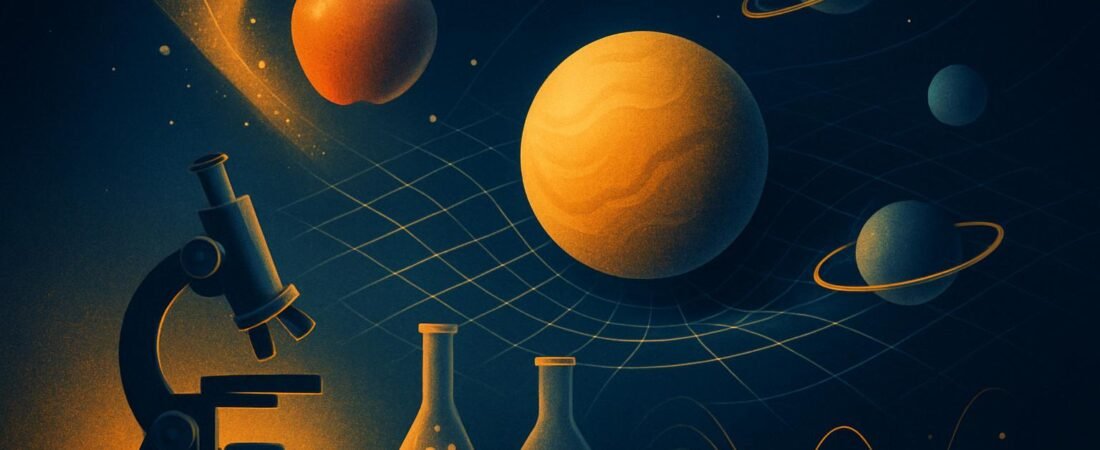
Why does an apple fall to the ground, but the Moon never crashes into Earth? This simple question led to one of the greatest journeys in science: from Isaac Newton’s idea of gravity as an invisible pull, to Albert Einstein’s vision of gravity as the bending of space and time. Understanding gravity is not just about planets and stars; it shapes GPS navigation, satellite TV, and even how your phone’s clock keeps time.
From Falling Apples to Universal Law: Newton’s Big Idea
In the late 1600s, English scientist Isaac Newton began thinking deeply about motion and forces. According to later accounts, he wondered if the same force that makes apples fall also keeps the Moon in orbit around Earth. Whether or not an actual apple struck his head is uncertain, but the story captures the heart of his insight: one universal rule might explain both everyday falls and cosmic motions.
Newton had already laid out his famous laws of motion, which describe how objects speed up, slow down, and change direction. But he still needed a law for the mysterious pull between masses. In 1687, in his book Philosophiæ Naturalis Principia Mathematica, Newton proposed the law of universal gravitation.
In simple terms, Newton’s law says:
- Every object with mass (anything that takes up space and has weight) attracts every other object with mass.
- The strength of this attraction increases with the masses of the two objects.
- The strength decreases as the distance between them increases.
A helpful comparison is magnets. Two magnets pull on each other more strongly when they are close and weaker when they are far apart. Gravity behaves in a similar way, but it works between anything with mass, and it is always attractive: it pulls, never pushes.
This idea was revolutionary. For the first time, the same law explained:
- Why an apple falls straight down.
- Why the Moon orbits Earth instead of flying off into space.
- Why planets move in neat, predictable paths around the Sun.
Newton’s gravity turned the universe into a predictable machine. If you knew where something was, how fast it was moving, and how massive it was, you could calculate where it would be in the future. That was an astonishing level of power for human minds and pencils.
Gravity in Everyday Life: From Bridges to Spaceflight
Newton’s view of gravity became the foundation of classical physics, the branch of science that describes most everyday motions. Engineers, architects, sailors, and later aerospace designers all relied on it. Even today, Newton’s equations are accurate enough for almost everything we build or launch.
Practical uses you encounter every day
- Buildings and bridges: When engineers design a bridge, they calculate how gravity pulls down on cars, people, and the structure itself. The shape and materials must be strong enough to resist that pull without collapsing.
- Sports and ballistics: The arc of a thrown ball or a kicked football is a direct result of gravity. Coaches and players may not write equations, but they rely on accurate instincts about how gravity bends a ball’s path.
- Scales and weight: The number you see on a bathroom scale is how strongly Earth’s gravity pulls on your mass. Your mass is how much “stuff” your body contains; your weight changes if you go somewhere with weaker or stronger gravity, like the Moon.
- Spaceflight and satellites: The paths of rockets, satellites, and space probes are still planned mostly with Newton’s law of gravitation. Mission designers calculate how Earth’s gravity and the gravity of other planets will tug on a spacecraft across millions of kilometers.
Thanks to Newton, humanity could send spacecraft to the Moon, land probes on Mars, and sling robotic explorers past Jupiter and Saturn. Yet by the late 1800s, small cracks began to appear in this elegant picture.
Where Newton’s Gravity Struggled
Newton’s law worked beautifully for most things, but precise measurements sometimes disagreed with his predictions. Two key puzzles stood out.
The orbit of Mercury
Mercury, the planet closest to the Sun, has an orbit that slowly rotates, like a spinning oval. Most of this motion could be explained by Newton’s gravity and the tugs of other planets. But there was a small leftover twist, known as the “anomalous precession of Mercury’s perihelion,” that Newton’s equations could not fully account for.
Astronomers tried to explain it by imagining an unseen planet, “Vulcan,” closer to the Sun. No such planet was ever found.
The speed limit of light
Another issue came from the study of light and electricity. By the early 1900s, experiments strongly suggested that the speed of light in a vacuum is constant and is the maximum speed at which anything can travel. But Newtonian gravity assumed that changes in gravity were felt instantly across space, with no speed limit.
These problems hinted that gravity might be deeper and stranger than a simple invisible pull. Enter Albert Einstein.
Einstein’s Leap: Gravity as Curved Space-Time
Albert Einstein, working in the early 20th century, first developed special relativity in 1905. This theory showed that time and space are linked and that measurements of time depend on motion. But special relativity did not include gravity.
Einstein spent about a decade wrestling with this problem. The breakthrough came when he considered a thought experiment: what would it feel like to be in a falling elevator?
- Inside a falling elevator, you and everything else would drop at the same rate. If you tossed an object, it would float beside you, as if gravity had vanished.
- This led Einstein to the “equivalence principle”: locally, free fall feels identical to weightlessness.
From this simple idea, Einstein developed general relativity, published in 1915. Here is the key shift:
- Newton: Gravity is a force that masses exert on each other across empty space.
- Einstein: Mass and energy bend or curve space-time (the combined “fabric” of space and time), and objects follow the straightest possible paths in this curved geometry.
Space-time is a way of treating time as a fourth dimension, along with the three dimensions of space (length, width, height). To picture curved space-time, imagine a stretched rubber sheet. Place a heavy ball on it: the sheet dips around the ball. If you roll a smaller marble nearby, it will spiral inward, not because the big ball “pulls” it directly, but because the surface itself is curved.
In Einstein’s picture, Earth curves space-time around it. The Moon is like the marble, moving along the curves of this distorted space-time. What we feel as the “force” of gravity is really our experience of moving through a curved geometry.
This new theory made several testable predictions. One striking example came in 1919, when astronomers observed a solar eclipse to see if starlight passing near the Sun was bent by gravity. The amount of bending matched Einstein’s predictions, not Newton’s. Overnight, Einstein became an international scientific celebrity.
Living in a Curved Universe: Modern Technology and Cosmic Mysteries
You might think general relativity is only relevant for black holes and distant galaxies, but it shapes technologies we rely on every day.
GPS and the flow of time
The Global Positioning System (GPS) uses satellites orbiting Earth to determine your location. Each satellite contains a highly accurate clock. To calculate your position, your receiver compares signals from several satellites and measures how long each signal took to arrive.
According to Einstein’s theories:
- Special relativity: Moving clocks run slightly slower than clocks at rest.
- General relativity: Clocks closer to a massive object (like Earth) run slightly slower than clocks farther away, because time itself flows differently in stronger gravity.
GPS satellites are moving fast and are farther from Earth’s surface, so both effects matter. Engineers must correct the satellite clocks using Einstein’s equations. Without these corrections, GPS positions would drift by kilometers each day, making navigation unreliable.
Black holes and gravitational waves
General relativity also predicts black holes, regions where gravity is so intense that not even light can escape, and gravitational waves, ripples in space-time created by massive objects accelerating, like two colliding black holes.
For decades, these were theoretical. Today, there is strong evidence for black holes at the centers of galaxies, including our own Milky Way. In 2015, the LIGO observatory directly detected gravitational waves from merging black holes, matching Einstein’s predictions with remarkable precision.
Yet gravity is still not fully understood. Scientists have not yet found a way to merge general relativity (which describes the very large) with quantum mechanics (which describes the very small) into a single, complete theory. Ideas like “quantum gravity” and “string theory” are active areas of research, but they are not yet settled science.
Conclusion: One Mystery, Two Great Visions
From Newton’s apple to Einstein’s curved space-time, our understanding of gravity has grown from a simple universal pull to a rich geometry of space and time. Newton gave us the tools to predict the motion of planets and build the foundations of modern engineering. Einstein revealed that gravity shapes the entire structure of the universe and even the flow of time itself.
The key takeaway is that science evolves. Newton’s and Einstein’s ideas are not rival stories where one erases the other. Instead, Newton’s gravity remains an excellent approximation for most everyday situations, while Einstein’s general relativity takes over when gravity is very strong, speeds are very high, or when we demand extreme precision. Together, they show how a falling apple can lead, step by step, to a deeper understanding of the cosmos we live in.
About the Author
Didier Lancelot is an independent author and creator of the Everyday AI Series, with books that explain technology, science and personal growth in plain language. Explore all his books on his Amazon Author page or visit Narmer Store.