
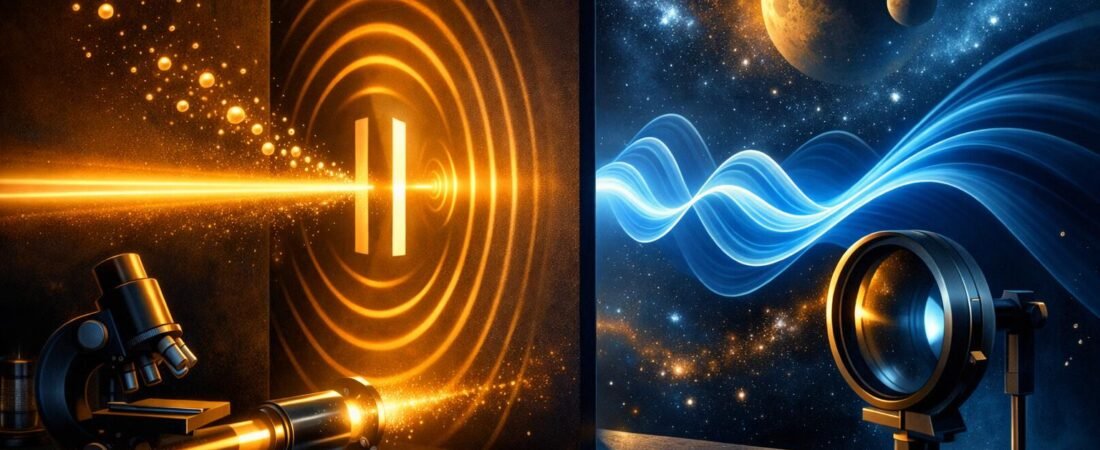
Imagine throwing pebbles into a pond and watching the ripples spread and overlap. Now imagine throwing tiny marbles at a wall with two slits cut into it. You would expect waves (the water) and particles (the marbles) to behave very differently. Yet when scientists tried a similar test with light, nature refused to choose a side. The result is the famous double-slit experiment, one of the strangest and most important experiments in physics.
It asks a deceptively simple question with a mind-bending answer: Is light a wave or a particle?
Waves vs. particles: a quick refresher
In everyday life, we are used to two very different kinds of stuff:
- Particles: tiny “bits” of matter, like grains of sand, bullets, or droplets of paint. They travel along definite paths and hit in one place at a time.
- Waves: spread-out disturbances that move through something, like ripples on water, sound in air, or light as we usually picture it. Waves can overlap and interfere with each other.
When two waves meet, they can do something called interference:
- If their peaks line up, they add together to make a bigger wave (constructive interference).
- If a peak meets a trough, they cancel out (destructive interference).
This interference creates patterns of bright and dark or loud and quiet that are unique to waves. Particles, by contrast, just pile up where they land. They do not create interference patterns by passing through each other.
For a long time, many scientists thought light was a wave only, similar to ripples or radio signals. Others insisted it was made of particles, like tiny bullets. The double-slit experiment became the ultimate test.
Thomas Young’s original double-slit experiment
The story begins in the early 1800s with an English scientist named Thomas Young. In 1801, he performed a simple but brilliant experiment to understand the nature of light.
How the experiment works
Picture this setup:
- A source of light (originally sunlight, later lasers).
- A barrier with two very narrow, side-by-side slits cut into it.
- A screen behind the barrier to catch the light and show where it lands.
Young did the following:
- He let light pass through one slit and hit the screen. The result was a single bright band where the light landed, just as you might expect.
- He then opened the second slit as well, letting light pass through both at the same time.
What should you see if light is made of particles, like a spray of tiny bullets? You would expect two bright bands on the screen, one behind each slit, where the particles hit.
But that is not what appeared. Instead, Young saw a pattern of many bright and dark stripes spread out across the screen. This is an interference pattern, the kind that waves make when they overlap.
The only way to explain this pattern was to say that light behaves like a wave. Waves spreading out from each slit meet, combine, and either add up or cancel. Where they add up, you get bright stripes. Where they cancel, you get dark gaps.
Young’s experiment strongly supported the idea that light is a wave. For the 19th century, that seemed to settle the debate. The wave theory of light became the standard view.
Then came photons: light as particles
In the early 1900s, a new problem appeared. Scientists were studying how light knocks electrons out of metal, a phenomenon called the photoelectric effect. Experiments showed that light behaved as if it came in little packets of energy instead of a continuous wave.
Albert Einstein explained this by proposing that light is made of tiny packets, or “quanta,” of energy now called photons. You can read more about that in our guide to the photoelectric effect and Einstein’s Nobel Prize.
Einstein’s idea meant light is not just a wave. It also behaves like a particle, depending on how you look at it. This was the beginning of quantum physics, the science of the very small, which you can explore further in our article on the birth of quantum physics.
But there was a puzzle: if light is made of individual photons, what happens in the double-slit experiment if you send those photons one at a time?
The updated double-slit: one photon at a time
Later in the 20th century, scientists repeated Young’s experiment using very dim light sources that emitted single photons. Photons were sent so far apart in time that they could not possibly interact with each other as waves.
You might expect this:
- Each photon is a tiny particle going through one slit or the other.
- Over time, they should build up two bright bands on the screen, one behind each slit.
But that is not what happened.
What actually appears on the screen
At first, the screen shows isolated dots, each marking where a single photon landed—just like particles. But as more and more dots appear, a familiar pattern emerges: the same interference pattern of bright and dark stripes that Young saw with bright light.
This suggests something astonishing: each photon, sent one at a time, somehow behaves like a wave that goes through both slits at once, interferes with itself, and then lands as a single dot.
In other words, nature seems to say: light is not simply a wave or a particle. It shows wave–particle duality—it can behave like either, depending on how you ask the question.
Watching the slits: when measurement changes reality
Physicists naturally tried to answer a burning question: through which slit does each photon actually go? To find out, they added detectors at the slits to “watch” the photons.
When they did this, another surprise appeared:
- When no one measures which slit the photons go through, you get the interference pattern: light behaves like a wave.
- When detectors are used to find out which slit each photon passes through, the interference pattern disappears. Instead, photons land in two clumps, just like ordinary particles.
Simply trying to observe which path a photon takes changes the outcome. The act of measurement itself affects how nature behaves.
This is closely related to the ideas behind Schrödinger’s cat, a thought experiment in which a system seems to exist in several states at once until it is observed. It also touches on the Heisenberg uncertainty principle, which says there are limits to how precisely we can know certain pairs of properties, like position and momentum, at the same time.
In modern quantum theory, we describe a particle like a photon with a wavefunction—a mathematical function that gives the probability of finding the particle in different places. Before we measure it, the photon is not simply “here” or “there” in the classical sense. The wavefunction spreads out, passes through both slits, and interferes with itself. When we measure it at the screen, the wavefunction “collapses” and we see a single, definite result: one dot in one place.
Why the double-slit experiment matters today
The double-slit experiment is not just a curiosity for physics textbooks. Its ideas are woven into technologies we rely on every day.
- Lasers and optics: Understanding light as both waves and particles is essential for designing lasers, fiber-optic cables, cameras, and microscopes. Interference is used to build extremely precise measuring devices, such as interferometers for detecting tiny distances.
- Electronics and computing: Quantum effects guide the design of transistors and microchips. Without quantum physics, the devices powering the internet, smartphones, and modern computers could not be engineered.
- Quantum information and encryption: Experiments using single photons passing through beam splitters and slits are the building blocks of emerging technologies like quantum communication and quantum cryptography, which promise new ways to secure information.
- Fundamental physics: Variations of the double-slit experiment have been done with electrons, atoms, and even large molecules. All show similar wave–particle duality. This pushes us to rethink what “particle” and “wave” even mean, and how reality behaves at its most basic level.
The double-slit experiment also connects conceptually with other surprising quantum phenomena, such as quantum entanglement (“spooky action at a distance”), where particles appear deeply linked no matter how far apart they are.
So, is light a wave or a particle?
After more than a century of experiments and theory, the most careful answer is:
Light is neither a classical wave nor a classical particle. It is a quantum object that behaves like a wave in some situations and like a particle in others.
“Wave” and “particle” are concepts drawn from everyday experience. In the quantum world, something like a photon, or even an electron, does not fit neatly into either category. Instead, it shows properties of both, depending on how we interact with it.
The double-slit experiment forces us to drop simple, intuitive pictures and accept a more subtle view of reality: one where probabilities, interference, and measurement play central roles.
Key takeaway
Thomas Young’s double-slit experiment began as a clever way to test whether light is a wave. Over 200 years later, refined versions of that experiment still shape our deepest understanding of nature. When light (and matter) consistently refuse to be just waves or just particles, they reveal something profound: at the smallest scales, the universe does not behave like the everyday world we see. Instead, it follows the strange but remarkably accurate rules of quantum physics, rules that now power much of our modern technology and continue to challenge our ideas about what is real.
About the Author
Didier Lancelot is an independent author and creator of the Everyday AI Series, with books that explain technology, science and personal growth in plain language. Explore all his books on his Amazon Author page or visit Narmer Store.