Top 10 Exercises for Core Strength
A resilient core is more than a set of visible abdominals. It is the anatomical “center” that stabilizes your spine, transfers force between the upper and lower body, and supports efficient movement patterns in sport and everyday life. When your midsection is strong and coordinated, posture improves, lifting mechanics become safer, and the risk of common aches—especially in the lower back—often decreases.
This guide breaks down what core strength actually means, how to train it intelligently, and the best core workouts to build real-world stability. You will also find a practical home core workout and clear progression strategies so your results continue long after the first week.
Understanding Core Strength and Why It Matters
Core strength is the capacity of your trunk to resist unwanted motion while producing and transmitting force. In practice, that means controlling extension (arching), flexion (rounding), rotation, and side-bending under load. This is why functional core training emphasizes stability as much as “burn.” A well-trained core helps you brace during heavy lifts, maintain alignment while running, and move with less compensation during daily tasks such as carrying groceries or lifting a child.
Key Muscles Targeted in Core Strength Training
Effective core stability exercises recruit more than the rectus abdominis. The primary contributors include:
- Transverse abdominis (deep stabilizer that supports bracing and intra-abdominal pressure)
- Obliques (internal and external; resist and create rotation, support lateral stability)
- Rectus abdominis (trunk flexion and anti-extension control)
- Erector spinae (spinal support and extension strength)
- Quadratus lumborum (lateral stability and pelvic control)
- Glutes and hip musculature (pelvic stability, critical for protecting the lumbar spine)
- Diaphragm and pelvic floor (often overlooked, but essential for effective bracing)
How to Safely Train Your Core for Maximum Results
Core Training Frequency, Sets, and Reps for All Levels
A productive core training routine is consistent, progressive, and respectful of recovery. Because the core contributes to almost every compound movement, you can train it frequently—provided the volume and intensity are appropriate.
- Beginners: 2–3 sessions per week, 2–3 exercises per session, 2–3 sets. Use timed holds (15–30 seconds) and controlled reps (6–10) with strict form.
- Intermediate: 3–4 sessions per week, 3–5 exercises per session, 3–4 sets. Holds of 30–45 seconds and reps in the 8–15 range.
- Advanced: 3–5 sessions per week, 4–6 exercises per session, 3–5 sets. Longer lever positions, added load, and advanced anti-rotation or rollout variations.
For many people, the fastest route to improvement is not more volume—it is cleaner bracing, better alignment, and a gradual increase in difficulty.
Common Core Workout Mistakes to Avoid
- Chasing fatigue over control: If form deteriorates, the target shifts from the trunk to the hips and lower back. End sets before technique fails.
- Overemphasizing crunches: Ab workouts built solely on spinal flexion can neglect anti-rotation and anti-extension strength, which are crucial for athletic performance and injury prevention.
- Allowing rib flare and lumbar arching: Poor rib-to-pelvis alignment reduces true core engagement. Aim for a neutral spine with a subtle brace.
- Rushing repetitions: Momentum disguises weakness. Slow eccentrics and deliberate pauses build durable strength.
- Ignoring breathing mechanics: Exhale to “stack” ribs over pelvis, then inhale into the abdomen and sides while maintaining tension.
Top 10 Core Strength Exercises (With Form Tips)
Beginner-Friendly Core Exercises
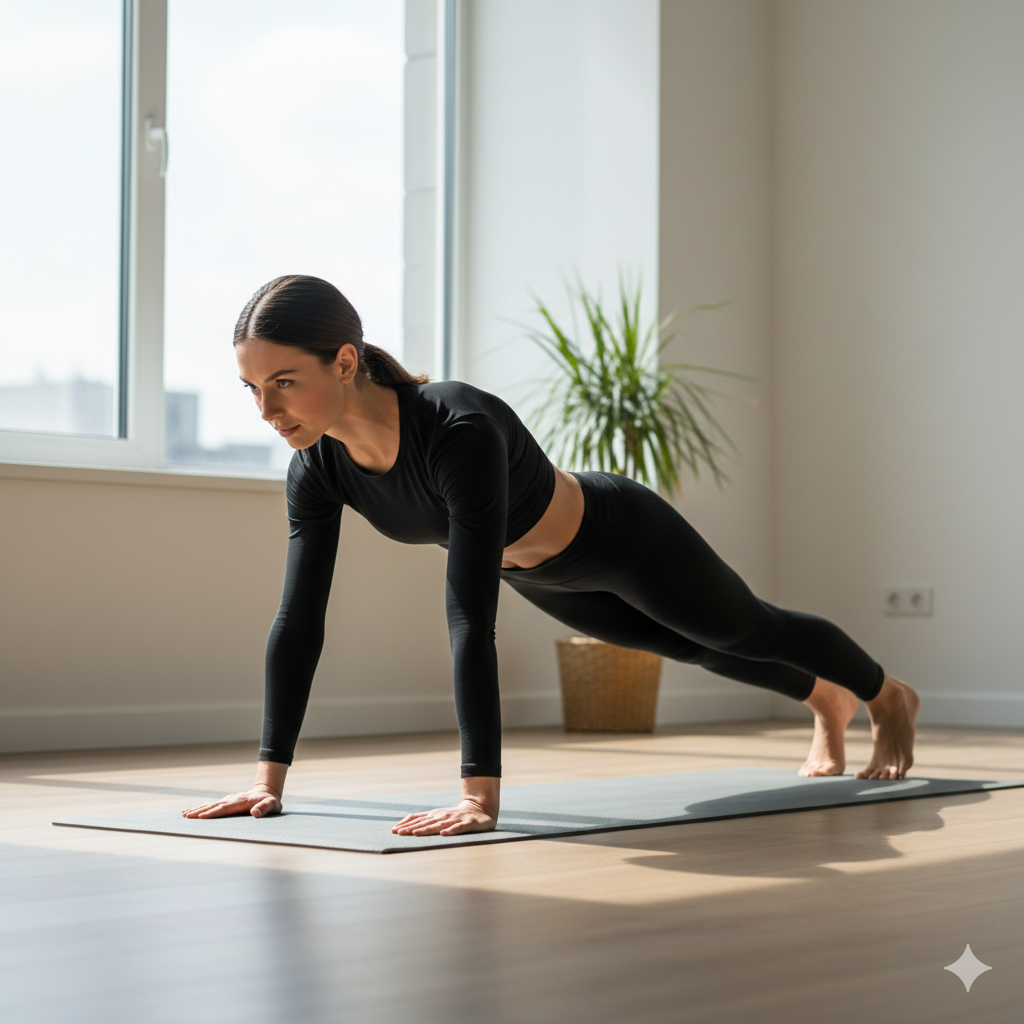
Plank (Forearm Plank)
The plank exercise is a foundational anti-extension drill that teaches full-body tension and spinal alignment.
- Setup: Forearms on the floor, elbows under shoulders, legs extended. Gently tuck the pelvis to avoid arching.
- Form cue: Press the floor away, squeeze glutes, and keep ribs “down” as if tightening a corset.
- Common error: Hips drifting high or sagging low. Maintain a straight line from head to heels.
Dead Bug
Dead bugs develop core stability while the limbs move—excellent for reinforcing rib-to-pelvis control.
- Setup: Lie on your back, hips and knees at 90 degrees, arms extended toward the ceiling.
- Form cue: Exhale fully to flatten the lower back gently into the floor, then extend opposite arm and leg without losing contact.
- Common error: Lower back popping up as the leg extends. Shorten the range until control is solid.
Glute Bridge
While often classified as a glute drill, the glute bridge strengthens the posterior chain and improves pelvic stability—critical to strengthen your core safely.
- Setup: Lie on your back, knees bent, feet hip-width apart.
- Form cue: Drive through heels, squeeze glutes at the top, and avoid excessive rib flare.
- Common error: Hyperextending the lower back to “reach” height. Aim for a controlled, neutral finish.
Bird Dog
Bird dogs train anti-rotation and spinal stability, teaching you to resist twisting as the limbs extend.
- Setup: Quadruped position—hands under shoulders, knees under hips.
- Form cue: Extend opposite arm and leg while keeping hips square and ribcage stable.
- Common error: Rotating the pelvis or overreaching. Keep the movement long and controlled.
Intermediate to Advanced Core Exercises
Side Plank
The side plank builds lateral core strength and reinforces hip-to-rib alignment, making it a high-value addition to any core training routine.
- Setup: Elbow under shoulder, legs stacked or staggered.
- Form cue: Lift hips and maintain a straight line from head to feet; keep the top hip slightly forward to prevent drifting backward.
- Progression: Raise the top leg or add a reach-through rotation with strict control.
Russian Twists
Russian twists develop rotational endurance and coordination when performed with disciplined range and posture.
- Setup: Sit with knees bent, torso tall, chest open. Hold a weight close to the sternum.
- Form cue: Rotate through the ribcage while keeping the spine long; move deliberately, not violently.
- Common error: Collapsing the chest and rounding the lower back. Reduce load and reclaim posture.
Mountain Climbers
Mountain climbers blend core stability with metabolic demand, challenging anti-extension under speed.
- Setup: High plank position with shoulders over wrists.
- Form cue: Pull knees forward while keeping hips steady and shoulder blades active.
- Common error: Bouncing hips. Slow down until the trunk remains quiet.
Leg Raises
Leg raises emphasize anti-extension strength and hip flexor control. Done well, they are a potent alternative to excessive crunching ab workouts.
- Setup: Lie on your back, hands under hips if needed for support.
- Form cue: Exhale as the legs lower; stop before the lower back arches off the floor.
- Progression: Start with bent knees, then extend legs as control improves.
Bicycle Crunches
Bicycle crunches integrate rotation and trunk flexion, stimulating obliques and rectus abdominis when performed with precision.
- Setup: Hands lightly behind the head, elbows wide, legs elevated.
- Form cue: Rotate the ribcage toward the opposite knee while extending the other leg long; keep the neck relaxed.
- Common error: Pulling on the head. Let the torso rotate; the hands simply support.
Ab Wheel Rollout
The ab wheel rollout is a premier anti-extension drill that demands full-body tension and excellent bracing. It is highly effective—but only if you own the range.
- Setup: Start on knees with the wheel under shoulders. Brace as if preparing for a gentle impact.
- Form cue: Roll forward slowly while maintaining a neutral spine and “stacked” ribs; pull back using the lats and core, not momentum.
- Common error: Collapsing into lumbar extension at the farthest point. Shorten the rollout distance until alignment is consistent.
Sample Core Workout Routines and Progression
10–15 Minute Core Workout You Can Do at Home
This home core workout requires no equipment (optional: light weight for Russian twists). Move steadily, prioritizing posture and control.
Warm-up (1–2 minutes): 4–6 deep breaths in a dead bug setup (knees up), focusing on rib-to-pelvis alignment.
Circuit (2–3 rounds):
- Forearm Plank: 20–40 seconds
- Dead Bug: 6–10 reps per side
- Glute Bridge: 10–15 reps (2-second squeeze at the top)
- Side Plank: 15–30 seconds per side
- Mountain Climbers: 20–40 seconds (controlled pace)
Optional finisher (1 round): Bicycle crunches, 10–15 reps per side, slow and deliberate.
How to Progress Your Core Strength Over Time
Progression is most effective when it is systematic. Instead of adding random difficulty, choose one variable to advance every 1–2 weeks:
- Increase time under tension: Add 5–10 seconds to planks and side planks while maintaining strict alignment.
- Improve leverage: Move from bent-knee leg lowers to straight-leg raises; from short ab wheel rollouts to longer ranges.
- Add load thoughtfully: Hold a dumbbell or plate for Russian twists, or add a weight plate to glute bridges once form is stable.
- Enhance complexity: Transition from bird dog holds to slow reps with pauses, or add controlled reach-throughs to side planks.
- Protect quality: If you cannot breathe steadily and maintain rib-to-pelvis control, the variation is too advanced for that day.
For long-term success, integrate these movements into a broader strength plan. A few high-quality sets after your main lifts often outperform marathon sessions that leave your lower back overworked.
Conclusion
Developing a strong midsection is not about collecting endless ab workouts; it is about building a trunk that stabilizes, transfers force, and withstands real-life demands. By combining foundational drills such as the plank exercise and dead bug with more challenging options like leg raises and the ab wheel rollout, you can create best core workouts that improve performance, posture, and resilience.
Choose two to five exercises, train them consistently, and progress with intention. When your core becomes stronger and more stable, nearly every other movement—lifting, running, carrying, and even sitting—benefits from that upgraded foundation.