
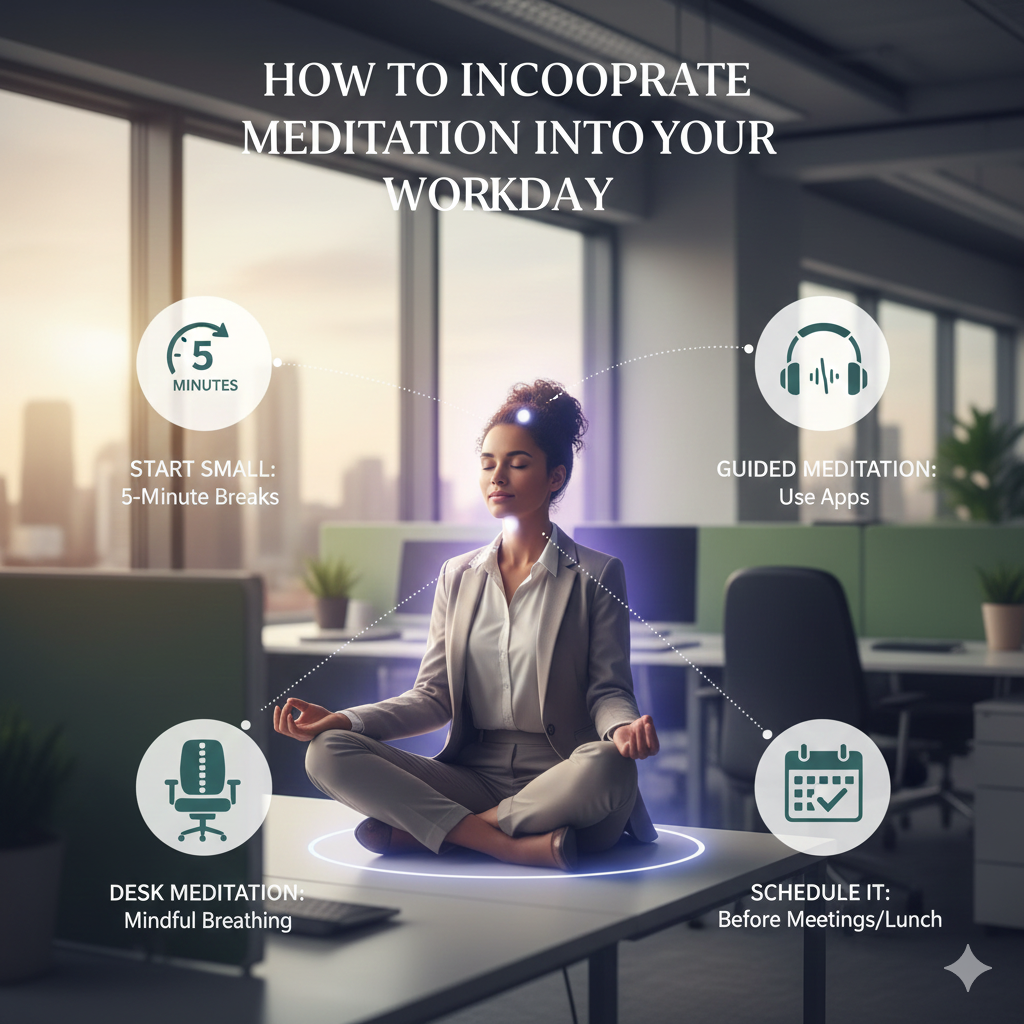
Modern work rarely leaves space for quiet. Deadlines compress, notifications accumulate, and the mind is expected to stay sharp for hours at a time. Yet the very environment that demands peak performance often undermines it through stress and constant cognitive switching. Workday meditation offers a practical counterweight: brief, intentional pauses that restore attention, steady emotions, and support clearer decision-making—without requiring you to leave the office or overhaul your calendar.
Understanding the Benefits of Meditation in Your Workday
Why Meditation Matters for Busy Professionals
For many professionals, the challenge is not a lack of ambition but a shortage of mental bandwidth. Meetings run back-to-back, tasks overlap, and complex problems require sustained concentration. Introducing meditation at work helps interrupt the cycle of reactivity that builds throughout the day. Instead of pushing through fatigue and distraction, you create deliberate moments to reset your nervous system and return to your priorities with renewed composure.
Equally important, meditation is not an indulgence or a retreat from productivity. When applied strategically, it becomes a performance skill—much like time management or communication—supporting steadier focus and more measured responses under pressure. This is the essence of workplace mindfulness: maintaining awareness of your attention, mood, and habits while navigating demanding professional responsibilities.
Science-Backed Benefits of Workplace Meditation
Research consistently associates mindfulness practices with improvements in attention regulation, emotional resilience, and stress reduction. In practical terms, short sessions can help lower perceived stress, reduce rumination after difficult interactions, and improve the ability to return to a task after interruptions. Professionals who practice mindfulness also report stronger awareness of cognitive overload—an early warning system that prevents small stressors from compounding into burnout.
Even brief exercises can be meaningful. “Micro-meditations” support physiological downshifts—slowing the breath and easing muscle tension—while reinforcing a mental habit of observing thoughts rather than being driven by them. Over time, this translates into a calmer baseline, fewer impulsive reactions, and a more stable capacity to reduce stress at work.
Preparing to Meditate at Work
Creating a Calm Space in a Busy Office
A suitable meditation space does not need to be silent or private, although both can help. The goal is consistency and minimal friction. If you have an office, close the door and dim the screen. If you work in an open-plan environment, consider a conference room between meetings, a quiet stairwell landing, an unused phone booth, or even your car during a break. When privacy is limited, noise-canceling headphones can create a psychological boundary that signals, “This is my pause.”
Keep your setup simple. Sit upright with both feet grounded, shoulders relaxed, and hands resting naturally. If you prefer, soften your gaze toward a neutral point rather than closing your eyes. This posture communicates alertness, making office meditation feel appropriate and professional rather than drowsy or disengaged.
Choosing the Right Type of Meditation for Your Workday
The most effective practice is the one you will actually use when pressure rises. Different work contexts call for different approaches, so it helps to keep a small repertoire of office meditation techniques:
- Breath awareness: Ideal for fast resets between tasks, presentations, or difficult conversations.
- Body scan: Useful when stress manifests physically through jaw tension, shallow breathing, or headaches.
- Open monitoring: Helpful for creative work, allowing ideas and concerns to arise without immediate judgment.
- Loving-kindness or compassion practice: Particularly effective after conflict, supporting emotional recovery and constructive communication.
If you are new to meditation, start with breath-based attention. It is accessible, discreet, and easy to repeat throughout the day. Over time, you can layer in other methods to match the demands of your role.
Practical Ways to Incorporate Meditation into Your Schedule
Short Meditation Practices You Can Do at Your Desk
You do not need a long session to benefit. The following short meditations for work are designed to be completed at your desk without drawing attention or disrupting your workflow.
1) The 60-Second Reset (breath and posture)
Sit upright and let your shoulders drop. Inhale through the nose for a slow count of four, then exhale for a count of six. Repeat for five to seven cycles. Keep your attention on the sensation of breathing rather than on solving problems. This simple ratio tends to encourage a calmer physiological state while sharpening attention.
2) The “Arrival” Practice (before starting a task)
Before opening a document or joining a call, pause for three breaths. On the first breath, notice where your attention is pulling you. On the second, relax your face and jaw. On the third, name your next action in a single sentence: “I will draft the outline,” or “I will review the report for accuracy.” This takes less than a minute and strengthens task clarity.
3) The Two-Minute Body Scan (tension audit)
Bring attention to the contact of your feet with the floor. Then scan upward: calves, thighs, abdomen, chest, shoulders, hands, and face. Wherever you find tension, soften it on the exhale. This is a pragmatic way to interrupt stress accumulation and maintain composure during long stretches of desk work.
4) The Sound Anchor (for noisy environments)
When the office is loud, fighting the noise often increases irritation. Instead, let sound become the anchor. Listen neutrally to the nearest sounds, then the farthest. Notice how the mind labels them as “annoying” or “distracting,” and gently return to simple hearing. This transforms environmental noise into a training tool for steadier attention.
5) The Three-Question Check-In (for emotional regulation)
Silently ask: “What am I feeling right now?” “Where do I sense it in the body?” “What is the next wise step?” This practice is particularly effective after criticism, an urgent email, or an unexpected change in priorities. It creates a brief gap between stimulus and response—often the difference between reactive and strategic communication.
These options make how to meditate at your desk straightforward: you are simply training attention, calming the body, and clarifying intent—quickly and quietly.
How to Build a Daily Work Meditation Routine
Consistency matters more than duration. A workable meditation routine for professionals fits naturally into existing transitions rather than competing with them. Use the structure of your day—starting work, switching tasks, eating lunch, ending meetings—as the scaffolding.
Consider a simple routine that combines predictability with flexibility:
- Morning (2–5 minutes): Before opening email, do breath awareness to establish a calm baseline and set an intention for the day.
- Mid-morning (1–2 minutes): After your first deep-work block, take a brief reset to prevent cognitive fatigue.
- Pre-meeting (30–60 seconds): Three slow breaths to arrive, listen better, and speak more deliberately.
- Lunch (3–5 minutes): A short body scan or mindful eating for one portion of the meal to support recovery.
- Afternoon (1–3 minutes): A sound anchor or breath practice to counteract the typical focus dip.
- End of day (2–4 minutes): A closing check-in to release lingering tension and reduce after-hours rumination.
This approach turns meditation into a series of mindfulness breaks during workday rather than a single event that is easy to skip. If your schedule is unpredictable, anchor the practice to non-negotiables—such as logging in, sitting down after lunch, or closing your laptop—so it remains stable even when meetings shift.
Overcoming Common Challenges and Staying Consistent
Managing Distractions and Office Stress
Distractions are not a sign of failure; they are the training environment. When attention wanders—toward a notification, a worry, or a colleague’s conversation—label it gently (“thinking,” “planning,” “hearing”) and return to your anchor. This is the core repetition that strengthens focus over time.
For high-stress periods, keep the practice especially brief. A 45-second pause done consistently is more valuable than a 15-minute session you attempt once and abandon. If you anticipate an intense call or a difficult negotiation, practice immediately beforehand. Meditation is most useful when applied close to the stressor, not only after you are already overwhelmed.
Also consider adjusting your environment to reduce unnecessary friction. Silence nonessential notifications, batch email checks, and create short intervals of uninterrupted work. These changes support meditation indirectly by lowering the baseline level of cognitive noise.
Tracking Progress and Making Meditation a Work Habit
Meditation benefits accumulate subtly. Tracking helps you notice improvements that might otherwise be overlooked—such as fewer tension headaches, faster recovery after conflict, or smoother transitions between tasks. Use a simple method:
- One metric: Record how many days per week you practiced, even if it was only one minute.
- One observation: Note a brief outcome such as “more patient in meeting” or “less reactive to email.”
- One adjustment: Decide what to change next week—timing, duration, or technique.
To make the habit resilient, reduce decision fatigue. Choose one default practice—such as a two-minute breath meditation—and treat other techniques as optional additions. If you miss a day, resume without compensating or self-criticism. The aim is continuity, not perfection.
Finally, connect the practice to professional outcomes. When you see meditation supporting clearer writing, better listening, or steadier leadership, it stops feeling like an extra task and becomes a strategic tool for performance and wellbeing.
Conclusion
Incorporating meditation into a busy schedule is less about finding large blocks of time and more about using transitions intelligently. With a few discreet practices, a supportive environment, and a routine built around the natural rhythm of your day, workday meditation becomes both realistic and effective. Over time, these brief pauses improve attention, strengthen emotional control, and help reduce stress at work—not by removing pressure, but by changing how you meet it.
Start small, stay consistent, and let the practice earn its place through results. A calmer, more focused workday is often one minute away.