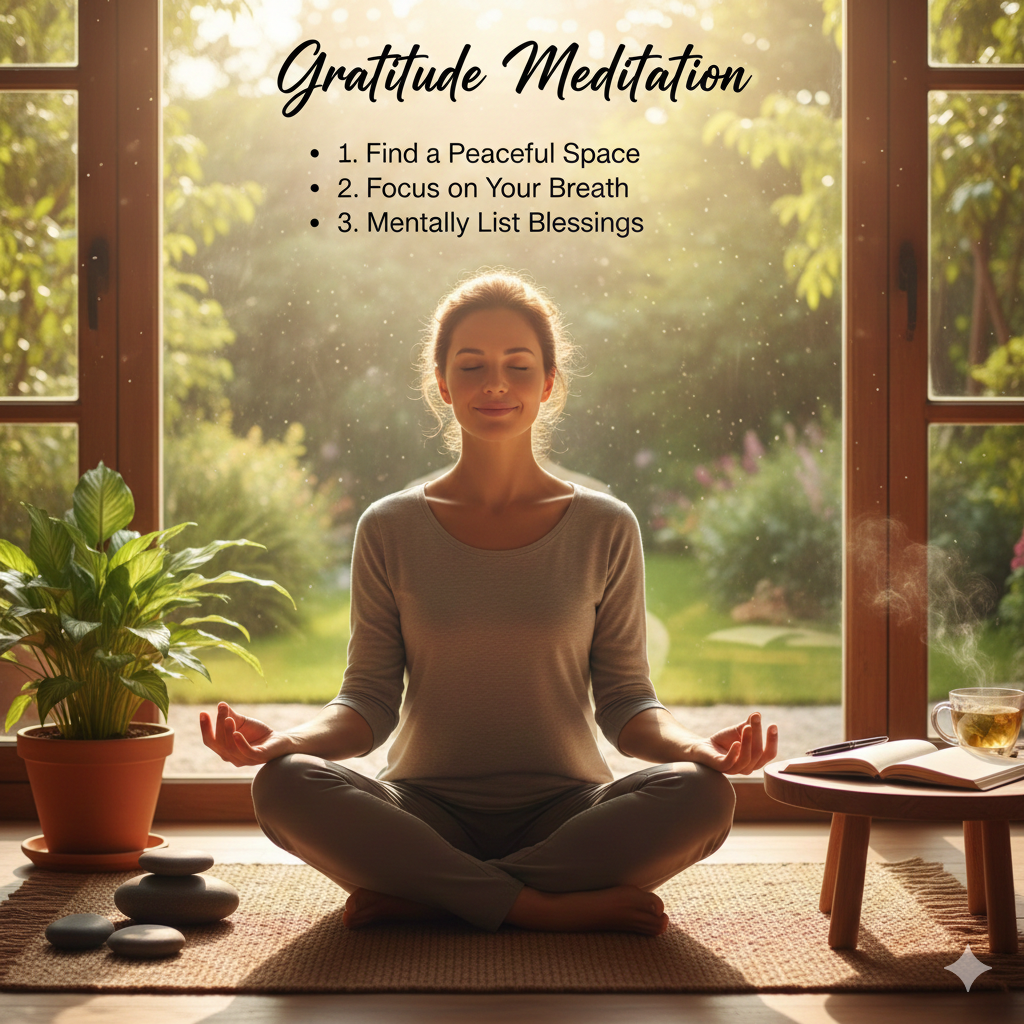
Gratitude meditation is a disciplined way to train attention toward what is supportive, meaningful, and life-giving—without denying what is difficult. When practiced consistently, it can soften habitual negativity, strengthen emotional balance, and cultivate a steadier sense of contentment. This guide explains what gratitude meditation is, the benefits of gratitude meditation, how to prepare effectively, and exactly how to practice gratitude meditation using simple scripts and guided techniques you can return to each day.
Understanding Gratitude Meditation
What Is Gratitude Meditation?
Gratitude meditation is a form of mindfulness and gratitude practice in which you intentionally bring to mind people, experiences, capacities, or simple comforts that you appreciate, then rest your awareness in the feelings they evoke. Unlike positive thinking, it does not require you to “make everything good.” Instead, it invites an honest inventory: acknowledging challenges while recognizing what still deserves care and respect.
In practical terms, gratitude meditation typically involves three elements:
- Attention: choosing a specific object of gratitude (a person, lesson, opportunity, body function, or moment).
- Presence: sensing the emotional tone—warmth, relief, tenderness—without forcing it.
- Integration: letting gratitude inform your next actions, speech, or decisions.
Benefits of Practicing Gratitude Meditation
The benefits of gratitude meditation arise from a simple mechanism: what you repeatedly attend to becomes more psychologically available. Over time, a daily gratitude practice can make supportive experiences easier to notice and more soothing to recall.
- Improved emotional regulation: Gratitude can help counter rumination by redirecting attention toward stabilizing perspectives.
- Reduced stress reactivity: A trained appreciation response often lowers the intensity of everyday irritations.
- Greater resilience: Recognizing resources—relationships, skills, inner strengths—supports steadier coping during uncertainty.
- Better relationships: Gratitude expressed inwardly often becomes gratitude expressed outwardly, strengthening connection and goodwill.
- Enhanced mindfulness: Guided gratitude meditation anchors awareness in the present while widening attention beyond problems.
These outcomes are rarely instant. They are cumulative, built through small, repeated moments of deliberate attention.
How to Prepare for Gratitude Meditation
Creating the Right Environment and Mindset
You do not need a special room or elaborate ritual. You do need conditions that reduce friction, especially at the beginning. Choose a setting that signals simplicity and calm: a chair with good support, a cushion, or the edge of your bed. Silence is helpful, but not mandatory; a consistent location matters more than perfect quiet.
Prepare your mindset with three intentions:
- Gentleness: You are not performing gratitude; you are practicing it. Some days will feel neutral.
- Specificity: Precise details evoke authentic appreciation more reliably than vague statements.
- Honesty: If gratitude feels inaccessible, begin with what is merely “not worse”—a stable floor, clean water, one supportive text message.
If you wish, set a simple structure: a timer, a notebook nearby for reflection afterward, and a phrase that marks the start, such as “For the next few minutes, I will practice noticing what supports my life.”
When and How Often to Practice Gratitude Meditation
Consistency is more important than duration. For most people, 5–10 minutes daily is sufficient to establish momentum. Choose a time aligned with your natural rhythm:
- Morning: establishes a tone of steadiness before demands accumulate.
- Midday: resets attention and reduces stress buildup.
- Evening: integrates the day and can ease the transition into rest.
If you are new to beginner gratitude meditation, start with three sessions per week and increase gradually. A sustainable schedule outperforms ambitious plans that collapse under pressure.
Step-by-Step Guide: How to Practice Gratitude Meditation
Simple Gratitude Meditation Script for Beginners
This beginner gratitude meditation script is designed to be direct, practical, and adaptable. Read it slowly, or record it in your own voice and replay it as a guided gratitude meditation.
- Settle (30–60 seconds): Sit upright yet relaxed. Place your hands comfortably. Soften your gaze or close your eyes. Feel the support beneath you.
- Arrive with the breath (60 seconds): Notice your inhale and exhale. Do not change them at first; simply observe the rhythm.
- Name three anchors of gratitude (2–4 minutes): Bring to mind three specific things you appreciate. Keep them concrete.
- Example: “The colleague who helped me yesterday.”
- Example: “My legs carrying me up the stairs.”
- Example: “A warm meal and the people who made it possible.”
- Choose one and deepen (2–3 minutes): Select the one that feels most vivid. Ask:
- What exactly happened?
- What did it make possible for me?
- Where do I feel appreciation in the body—chest, throat, face, belly?
Rest with the felt sense. If emotion appears, let it be present without analysis.
- Offer a simple phrase (30–60 seconds): Silently repeat one line, timed with the breath:
- “Thank you for this support.”
- “May I recognize what sustains me.”
- “May I respond with care.”
- Close and integrate (30 seconds): Feel your surroundings again. Before standing, choose one small action that expresses gratitude—send a message, take a mindful breath before a meeting, or handle your next task with deliberate care.
This gratitude meditation script emphasizes specificity and embodiment, two elements that make gratitude more than a mental list.
Guided Techniques: Breath, Body, and Gratitude Focus
If you want more structure—or if your attention tends to wander—use one of these guided techniques. Each integrates mindfulness and gratitude, building stability before expanding into appreciation.
1) Breath-Led Gratitude
On the inhale, silently note “receiving.” On the exhale, note “appreciating.” After a minute, add a focus:
- Inhale: “Receiving support.”
- Exhale: “Appreciating support.”
This approach is particularly effective when you feel rushed, because the breath provides immediate rhythm and containment.
2) Body-Based Gratitude Scan
Move attention slowly through the body—feet, calves, knees, thighs, abdomen, chest, shoulders, arms, hands, neck, face. At each region, acknowledge one function you can appreciate, even if it is imperfect:
- “Feet that balance me.”
- “Hands that hold and create.”
- “Eyes that help me navigate the day.”
This is a powerful gratitude exercise when your mind is abstract or emotionally flat, because sensation provides a concrete entry point.
3) Relationship-Focused Gratitude
Bring to mind a person who has contributed to your life in a meaningful way—through generosity, patience, teaching, or simple presence. Picture a specific moment. Then reflect:
- What quality did they express?
- How did it shape my choices or opportunities?
- What would I like to offer in return—respect, honesty, a sincere message?
Let gratitude be both felt and ethical: not only an emotion, but also a commitment to respond well.
Deepening and Sustaining Your Gratitude Meditation Practice
Common Challenges and How to Overcome Them
Even a well-designed daily gratitude practice will encounter resistance. Anticipating it prevents discouragement.
- “I feel nothing.” Emotional numbness is common under stress. Shift from emotion to recognition: identify what is objectively supportive (shelter, a reliable friend, a skill you can use). Appreciation often follows consistency.
- “My mind keeps drifting.” Treat distraction as part of training. Return to one sensory detail—breath at the nostrils, contact points with the chair—then resume the gratitude focus.
- “It feels forced or artificial.” Replace grand statements with modest truths. Gratitude is credible when it is specific: one helpful email, one quiet moment, one decision you made that protected your well-being.
- “I feel guilty because others have it worse.” Guilt can block genuine appreciation. Let gratitude become motivation rather than self-judgment: acknowledge what you have, then commit to using it responsibly.
- “Life is objectively hard right now.” Gratitude meditation is not denial. Begin with “what is still here that helps me endure,” even if the list is small. The practice is a refuge, not a verdict on your circumstances.
Everyday Practices to Reinforce Gratitude Meditation
Formal meditation becomes more potent when paired with informal reinforcement. These gratitude exercises take minutes and support continuity.
- One-sentence journaling: Each day, write one precise line: “Today I appreciate ____ because ____.” The “because” prevents vagueness.
- Gratitude cues: Attach a brief pause to an existing habit—boiling water, opening your laptop, washing your hands. Take one breath and name one supportive element in your life.
- Micro-messages: Once per week, send a concise note of appreciation to someone. Specificity matters more than length.
- Reframing practice: When irritation arises, ask: “What is this moment asking for?” Then identify one resource you have—time, choice, knowledge, help—and acknowledge it.
- Evening review: Before sleep, recall three moments from the day that were “quietly good”: a task completed, a pleasant interaction, a brief rest, a problem avoided.
These small reinforcements turn gratitude meditation from an isolated session into a stable orientation—one that gradually shapes perception and behavior.
Conclusion
Learning how to practice gratitude meditation is less about dramatic emotion and more about disciplined noticing. With a supportive environment, a realistic schedule, and a clear gratitude meditation script, you can develop a practice that is steady, humane, and resilient under pressure. Begin small, stay specific, and let gratitude mature from a momentary feeling into a reliable way of meeting your life—one breath, one recognition, and one deliberate action at a time.