
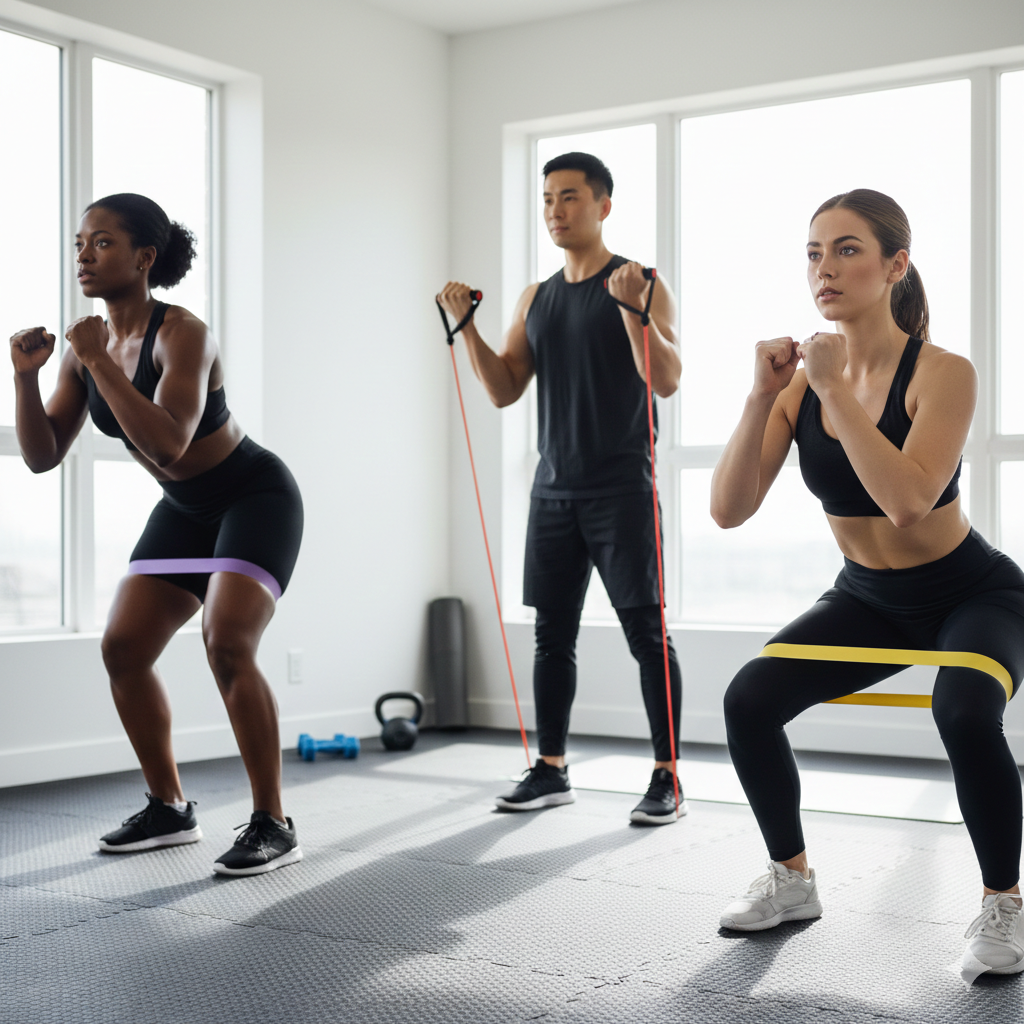
Resistance bands have evolved from rehabilitation staples into mainstream training tools used by athletes, personal trainers, and everyday lifters alike. Their appeal is simple: they deliver meaningful resistance without bulky equipment, making them ideal for strength training at home, travel, and busy schedules. More importantly, bands can challenge muscles through a unique resistance curve that complements traditional lifting, helping you build strength while often being kinder to joints. This guide explains what bands are, the benefits of resistance bands, and exactly how to use them with smart exercise selection and programming.
What Are Resistance Bands? Understanding This Versatile Strength Tool
Resistance bands are elastic training implements designed to provide load through tension. Unlike dumbbells or barbells—where the weight is constant—bands increase resistance as they stretch. This “accommodating resistance” can be leveraged to make movements more challenging where you are strongest, while reducing stress where joints are most vulnerable. For anyone exploring resistance bands for strength training, that variable tension is a defining advantage.
Types of Resistance Bands (Loop, Tube, Figure-8, Therapy Bands)
Not all bands are made for the same purpose. Choosing the right format affects comfort, exercise options, and progression.
- Loop bands: Continuous circles typically used for lower-body work (glute activation, lateral walks), assisted pull-ups, and banded squats or deadlifts. They are highly versatile and often the best resistance bands for beginners because they are straightforward and durable.
- Tube bands with handles: Tubes connect to handles or anchors, making them convenient for presses, rows, curls, and other movements that mimic cable-machine training.
- Figure-8 bands: Compact bands shaped like an “8,” offering built-in grip points. They are useful for accessory work, posture training, and quick sessions.
- Therapy bands (flat bands): Long, thin strips commonly used in physical therapy for shoulder health, mobility drills, and light resistance patterns. They are excellent for joint-friendly activation and rehabilitation-focused strength work.
How Resistance Bands Work for Strength Training
Strength training depends on progressive overload—gradually increasing the challenge placed on your muscles. Bands support this by increasing tension with stretch, allowing you to progress by:
- Using thicker or stiffer bands
- Shortening the band length (standing wider, choking up on the band)
- Increasing reps, sets, or time under tension
- Slowing the eccentric (lowering phase) and adding pauses
- Combining bands with free weights for additional load at key points in the range of motion
Done correctly, it is entirely possible to build muscle with resistance bands—especially when training close to muscular fatigue with solid technique and consistent progression.
Key Benefits of Resistance Bands for Strength Training
Building Strength, Muscle, and Endurance with Bands
The primary reason people adopt resistance band exercises is effectiveness. Bands can generate significant tension, and their resistance profile can enhance training quality in several ways:
- High-quality resistance across the range: Many exercises are easiest at the start and hardest near the end. Bands naturally load the end range, which can improve lockout strength in presses, squats, and hip hinges.
- Metabolic stress for hypertrophy: Band training pairs well with higher-rep sets, short rest periods, and continuous tension—conditions associated with muscle growth.
- Scalable intensity for strength endurance: Bands make it easy to adjust resistance between sets, perform drop sets, or sequence exercises for conditioning without switching heavy equipment.
- Excellent for accessory work: Bands are ideal for targeting smaller muscle groups—rear delts, rotator cuff, glutes, and triceps—supporting balanced development and better performance in compound lifts.
A well-structured resistance band workout can develop strength and muscle while also improving work capacity, particularly when you train with intention rather than simply “going through the motions.”
Improving Stability, Balance, and Joint Health
Beyond muscle building, bands shine as a tool for movement quality. Their elastic pull introduces subtle instability, requiring you to control alignment and tempo. This can translate to better joint mechanics and athletic resilience.
- Joint-friendly loading: Bands reduce peak stress at vulnerable positions by offering lower resistance at the start of many movements, which can be helpful for shoulders, elbows, and knees.
- Improved proprioception: The constant demand to manage tension can enhance body awareness, supporting better balance and coordination.
- Strength in stabilizers: Band presses, rows, and anti-rotation holds challenge the trunk, scapular stabilizers, and hips—often neglected areas in machine-heavy routines.
- Warm-ups and prehab: Therapy and light loop bands are outstanding for activation drills that prepare joints for heavier work, whether you train with bands or weights.
These advantages explain why many coaches treat bands not as a substitute, but as a strategic complement—especially when managing training longevity.
How to Use Resistance Bands Effectively in Your Workouts
Beginner, Intermediate, and Advanced Resistance Band Exercises
Effective band training depends on selecting movements that match your current strength and coordination. Below are progressions that work well for most people.
Beginner
- Band squat to chair: Stand on the band, hold the ends at shoulder height, and squat to a box or chair to standardize depth.
- Seated band row: Loop the band around your feet; row with a tall spine and controlled shoulder blades.
- Glute bridge with loop band: Place a loop above the knees; press knees outward as you lift hips to train glutes and hip stability.
- Standing band chest press (anchored): Anchor behind you; press forward with ribcage stacked over hips.
- Pallof press: Anti-rotation core drill that builds trunk stability without spinal strain.
Intermediate
- Band Romanian deadlift: Stand on the band; hinge with a neutral spine to develop posterior chain strength.
- Overhead press (standing on band): Press with strict control; avoid leaning back by engaging the core.
- Single-leg hinge (banded): Improves balance, hamstring strength, and hip control.
- Lat pulldown (anchored high): Mimics a cable pulldown when anchored in a doorway or sturdy rack.
- Band face pulls: Enhances posture and shoulder health, particularly for desk-bound lifters.
Advanced
- Banded push-ups: Loop a band across the upper back and under hands to increase lockout tension.
- Assisted pull-ups or band-resisted pull-ups: Use a band for assistance, then progress to lighter assistance or add resistance for advanced strength.
- Banded front squat: Band under feet and over shoulders; forces upright posture and challenges the quads and trunk.
- Band-resisted deadlift or hip thrust: Add bands to increase tension near lockout, a common sticking point.
- Complexes and timed sets: String multiple movements together to build strength endurance under fatigue.
Tips for Choosing the Right Band Resistance and Safety Guidelines
Bands are simple, but not careless. Use these principles to train safely and progress reliably.
- Start lighter than you think: For the best resistance bands for beginners, choose a set with multiple tensions. The goal is clean reps with consistent band tension throughout the set.
- Match resistance to the exercise: You will need a heavier band for squats and hinges than for curls or lateral raises. One band rarely fits all movements.
- Anchor intelligently: Use door anchors rated for training, or wrap bands around sturdy posts. Avoid sharp edges and unstable furniture.
- Inspect before each session: Look for micro-tears, thinning, or cracked latex. Replace compromised bands immediately.
- Control the return: Never let the band snap back. Maintain tension and move deliberately, particularly near the end range.
- Use a clear line of pull: Ensure the band will not recoil toward your face if grip slips. Position yourself slightly off the direct path when possible.
- Progress with purpose: If you increase resistance, keep form constant. If form degrades, reduce tension and regain control.
Integrating Resistance Bands into Your Fitness Routine
Combining Resistance Bands with Free Weights and Bodyweight Training
The debate of resistance bands vs weights misses a practical truth: the strongest programs often use both. Bands excel at portability and joint-friendly tension; weights excel at precise loading and high absolute resistance. Together, they create a versatile toolkit.
- Add bands to barbell or dumbbell lifts: Banded squats, presses, or deadlifts increase end-range challenge and can improve lockout strength.
- Use bands for warm-ups and activation: Pair band pull-aparts, face pulls, and glute work with your main lifts to reinforce mechanics.
- Replace cable-machine patterns at home: Rows, presses, pulldowns, and anti-rotation drills translate well to bands, making them ideal for strength training at home.
- Enhance bodyweight training: Bands can assist (pull-ups, dips) or add resistance (push-ups, squats), giving bodyweight work a broader progression path.
Sample Full-Body Resistance Band Workout Plan
This full body resistance band workout is designed for 2–4 sessions per week. Choose a band that brings you within 1–3 reps of technical failure on the final set. Rest 45–90 seconds between sets, longer for demanding lower-body movements.
Warm-Up (5–8 minutes)
- Band pull-aparts: 2 sets × 12–20 reps
- Glute bridge with loop band: 2 sets × 12–20 reps
- Pallof press (light): 1–2 sets × 8–12 reps per side
Workout
- 1) Squat pattern: Band squat (stand on band) — 3–4 sets × 8–15 reps
- 2) Hinge pattern: Band Romanian deadlift — 3 sets × 8–15 reps
- 3) Upper-body push: Anchored chest press or banded push-up — 3–4 sets × 8–15 reps
- 4) Upper-body pull: Seated band row or anchored row — 3–4 sets × 10–20 reps
- 5) Shoulder health/accessory: Band face pull — 2–3 sets × 12–25 reps
- 6) Core stability: Pallof press — 2–3 sets × 10–15 reps per side
Progression Options (Choose One Each Week)
- Add 1–2 reps per set until you reach the top of the rep range, then move to a heavier band.
- Slow the eccentric to 3–4 seconds per rep while keeping the same reps.
- Add one additional set to the first two exercises if recovery is good.
This approach keeps the plan simple while ensuring progressive overload—an essential requirement for anyone using resistance bands for strength training to pursue measurable improvement.
Conclusion
Resistance bands are not merely a convenient alternative; they are a legitimate strength modality with distinct advantages. The most compelling benefits of resistance bands include scalable tension, joint-friendly loading, improved stability demands, and the ability to train effectively in small spaces. Whether you want a reliable resistance band workout at home, a travel-ready option, or a smart complement to free weights, bands can deliver serious results when paired with sound technique and consistent progression. Choose the right band, train close to fatigue with control, and let the simplicity work in your favor.
Celestial Stackmaster
Core Loop: Vertical block stacking with slicing physics.
Precision Rewards: “Perfect” drops snap into place with a glow effect.
Dynamic Difficulty: Block speed increases as you climb higher.
Atmospheric Visuals: A cosmic “Zenith” background with color-shifting fog that evolves with your score.
Responsive Controls: Fully playable on desktop (click) and mobile (tap).
Camera System: Dynamic camera that tracks your progress toward the stars.
How to Play
Objective: Stack blocks as high as possible without missing the tower.
Controls: Click or Tap anywhere to drop the moving block onto the stack.
Pro Tip: Align the block perfectly with the one below to keep its full size; otherwise, the overhanging part will be sliced off!