
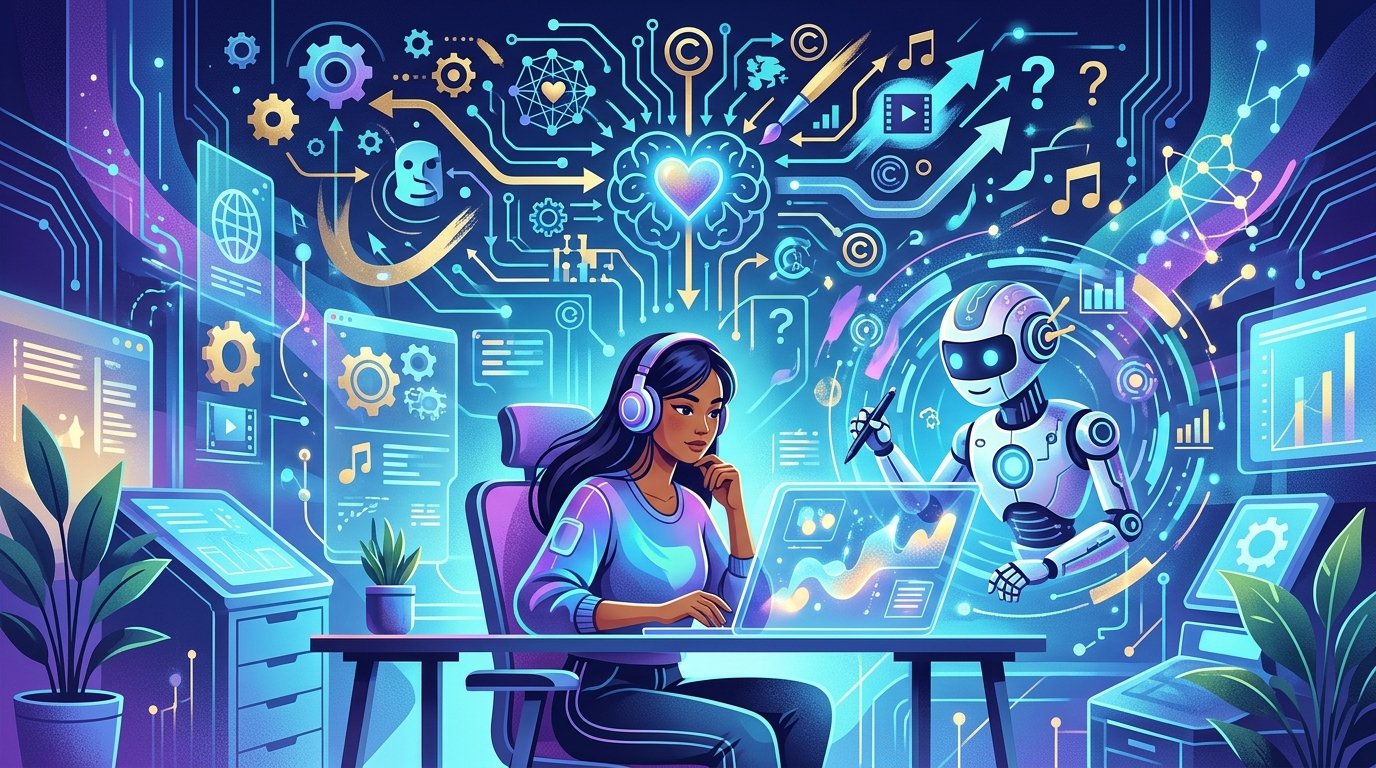
If you create anything — writing, art, music, videos, code — artificial intelligence has probably already entered your world, whether you invited it or not. Maybe you’ve used an AI tool to brainstorm ideas, generate images, or polish a draft. Or maybe you’ve worried that an AI somewhere has been trained on your work without your permission. Either way, copyright law and AI are on a collision course, and the rules are still being written in real time. Understanding the basics now can protect your work, sharpen your business decisions, and keep you out of legal trouble. Let’s break it all down in plain English.
What Is Copyright, and Why Does AI Complicate It?
Copyright is a legal protection that automatically applies to original creative work the moment you create it. Write a poem, paint a picture, record a song — it’s yours. No registration required in most countries, though registering can give you extra legal options. Copyright gives you the exclusive right to reproduce, distribute, and build on your work.
AI complicates this in two big ways:
- Training data: AI models learn by processing enormous amounts of existing content from the internet and other sources. That content often includes copyrighted work — yours, mine, and millions of others’.
- AI-generated output: When an AI produces text, images, or music, the question becomes: who, if anyone, owns it?
These two issues sit at the center of nearly every AI copyright debate happening right now, from courtrooms to government offices around the world.
Can You Copyright Something Made with AI?
This is the question most creators ask first, and the honest answer is: it depends — and the rules vary by country.
In the United States, the Copyright Office has taken the position that copyright protects human authorship. If a piece of work was generated entirely by an AI with no meaningful human creative input, it generally cannot be copyrighted. Think of it like a photograph taken by a camera attached to a tree — no human made the creative choices, so there’s nothing to protect.
However, if a human makes substantial creative decisions — choosing what prompts to use, selecting and arranging AI outputs, editing and combining them into something new — copyright protection may apply to those human contributions. The line is blurry and courts are still figuring it out.
Practical tip: If you use AI as a tool (the way a photographer uses a camera), document your creative process. Keep notes on the choices you made. This kind of record can help you argue that the final work reflects meaningful human authorship.
Was Your Work Used to Train an AI?
This is the question creators are understandably angry about. Many leading AI systems were trained on vast amounts of content scraped from the web. If your blog posts, artwork, or music were publicly available online, there’s a real chance some AI model has “seen” your work during its training.
Is that legal? This is actively contested. AI companies generally argue that training on publicly available data is covered by fair use — a legal concept that allows limited use of copyrighted material without permission under certain conditions. Critics, including many artists and writers, argue that using someone’s work to build a commercial product without compensation crosses a line.
Several lawsuits are working their way through courts on exactly this issue, and the outcomes will shape the future of AI development significantly. Until there’s clearer legal guidance, the situation remains genuinely uncertain.
What you can do right now:
- Add a robots.txt file to your website that signals AI crawlers to stay away. Some companies honor these requests; not all do.
- Look for opt-out tools offered by specific AI platforms for their training datasets.
- Support advocacy organizations that represent creators’ rights in tech policy discussions.
Using AI-Generated Content in Your Business
If you use AI to create content for commercial purposes — blog posts, marketing copy, product images — you need to think carefully about a few risks.
Originality and plagiarism concerns: AI doesn’t truly invent; it generates based on patterns learned from existing work. There’s a real (if unpredictable) chance that AI output closely resembles something already out there. Always run AI-generated text through a plagiarism checker and visually verify images before publishing commercially.
No guaranteed exclusivity: If you prompt an AI to generate an image and someone else types a very similar prompt, they may get a very similar image. You may not be the only person “owning” that visual.
Platform terms of service matter: Read the terms of the AI tools you use. Some grant you full commercial rights to outputs; others retain certain rights or place restrictions on commercial use. This varies significantly between platforms and subscription tiers.
How to Protect Your Creative Work in the AI Era
The landscape is uncertain, but you’re not powerless. Here are practical steps every creator should consider:
- Register important works with your national copyright office. In the US, registration is inexpensive and gives you the right to sue for statutory damages if someone infringes your work.
- Watermark and timestamp your creative work to establish a clear record of when you made it.
- Use licensing tools like Creative Commons to clearly communicate what others can and cannot do with your content.
- Stay informed. Copyright law around AI is evolving fast. Follow reputable legal and tech news sources so you’re not caught off guard by changes that affect your work.
- Consult a lawyer if you’re building a business around AI-generated content or if you believe your work has been used without permission.
The Bottom Line
AI copyright is messy, evolving, and genuinely unresolved — but that doesn’t mean you should ignore it. The creators who come out ahead will be the ones who understand the rules as they stand today, keep good records of their creative process, protect their existing work proactively, and stay alert as the legal landscape shifts. Your creativity has value, and learning how copyright applies to AI is one of the smartest investments you can make as a modern creator.
Discover More from Didier Lancelot
Amazon Author page: amazon.com/author/didierlancelot
Narmer Store: narmerstore.org
AI and Technology Ebooks
- Creative AI: Animated Drawings, Manga & Illustrations
- Build a Game with AI: The No-Code Guide
- AI Image Generation Made Easy
- Build a Website with AI: The No-Code Guide
- How to Connect AI to Your Blog: The Ultimate Automation Guide
- AI Productivity Habits: Get More Done in Less Time
- AI Avatars Made Easy
- The Book of AI Prompts: 100+ Proven Prompts
- Make Music with AI: Suno, Udio and AI Music Generators
- Click to Cash
- The Automated Edge: Outwork, Outpace, and Outperform with AI
- AI Side Hustle: How to Make Money with ChatGPT and AI Tools
- Work Smarter with AI
Health, Lifestyle and Home Ebooks
- Hidden Superfoods: The World’s Most Powerful Healing Foods
- Spanish Food: The Complete Cookbook for Authentic Home Cooking
- The Science of Happiness Explained
- The Psychology of Success
- The Secret Sauce of Consistency: What the Experts Don’t Tell You About Fitness
- The Complete Home Bartender’s Guide: Link 1 | Link 2
- Natural Beauty, Made Simple: Easy DIY Organic Skincare Recipes
- Garden Made Simple: Easy, Beginner-Friendly Techniques
- The Dog Training Bible