
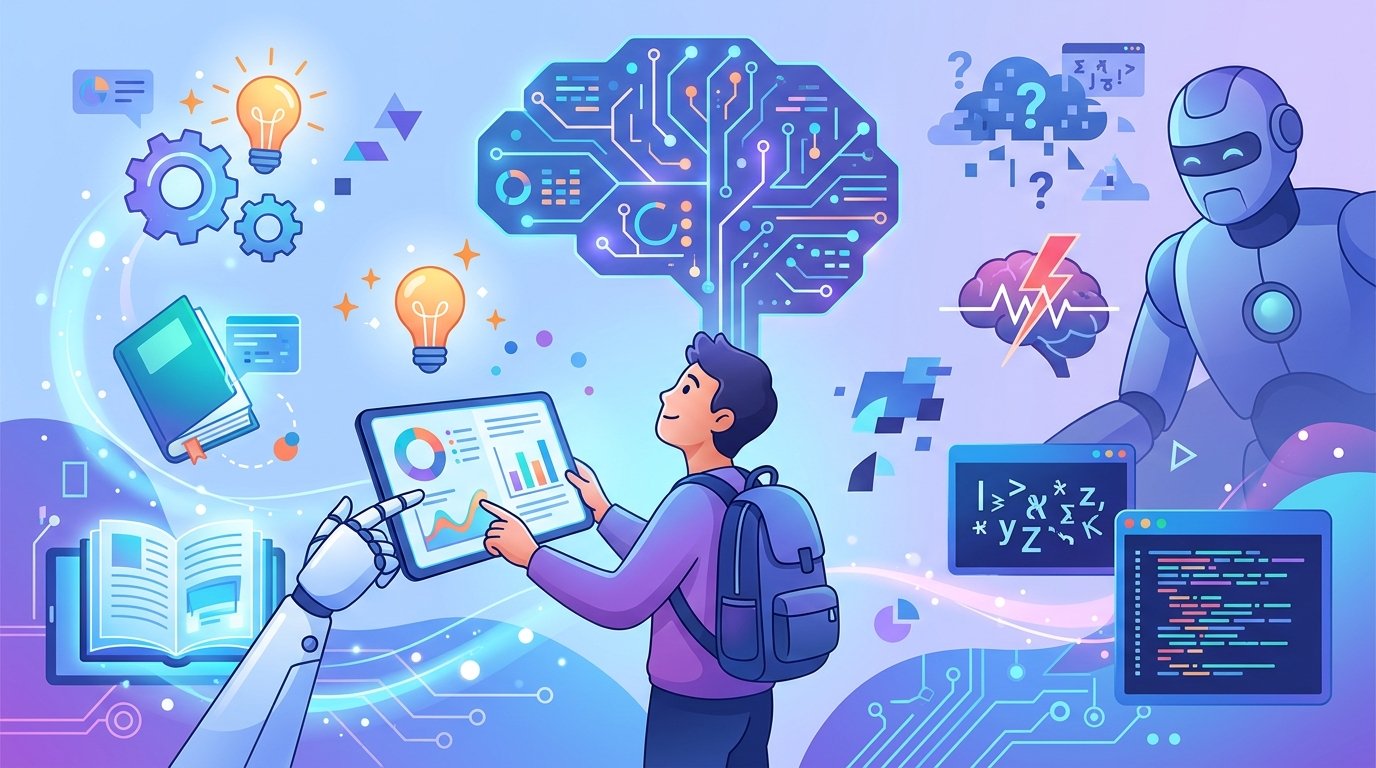
Artificial intelligence has quietly walked into classrooms, study halls, and dorm rooms around the world — and it is not leaving any time soon. Students are using AI-powered tools to brainstorm essays, solve math problems, study for exams, and even learn new languages. Teachers, parents, and researchers are asking the same urgent question: is this a breakthrough for learning, or are we accidentally building a generation that cannot think for itself? The honest answer is that AI in education is neither a villain nor a miracle cure. It all depends on how students use it.
What AI in Education Actually Looks Like
When most people hear “AI in education,” they picture a student typing a question into ChatGPT and copy-pasting the answer into their homework. That happens, but it is only a small slice of what is going on. AI in education covers a surprisingly wide range of tools and experiences.
- Intelligent tutoring systems — software that adapts to a student’s pace and skill level, giving harder questions when they are doing well and simpler ones when they struggle.
- Writing assistants — tools that suggest grammar fixes, flag unclear sentences, or help students develop an argument step by step.
- Language learning apps — platforms that use AI to mimic real conversation and personalise vocabulary practice based on what you already know.
- Accessibility tools — features that read text aloud, generate captions, or simplify complex language for students with learning differences.
- Automated feedback — systems that review a student’s draft or quiz answer and point out what is working and what needs improvement, without the student having to wait days for a teacher to respond.
Each of these tools can be enormously helpful or quietly harmful, depending on the situation and the student’s mindset.
The Real Benefits: Where AI Genuinely Helps
Let’s be fair to the technology first. Used thoughtfully, AI offers some genuine advantages that even the most traditional educators are starting to acknowledge.
Personalised Learning at Scale
One teacher in a classroom of thirty students cannot possibly tailor every lesson to every individual. AI can. An intelligent tutoring system can identify that one student understands fractions but struggles with percentages, then automatically serve up targeted practice. This kind of personalised attention was once available only to students whose families could afford private tutors. AI is beginning to level that playing field.
Instant, Low-Stakes Feedback
One of the most powerful things for learning is getting feedback quickly. When a student has to wait a week to find out their essay had a weak thesis, the lesson is much harder to absorb. AI writing tools can flag problems in real time, letting students revise and improve while the ideas are still fresh. The key word here is feedback, not replacement — the student still does the thinking.
Support for Students Who Are Often Left Behind
Students who are learning a new language, have dyslexia, or are returning to education after a long break often feel invisible in traditional classrooms. AI tools designed for accessibility — text-to-speech, simplified summaries, conversation practice bots — can give these learners the extra scaffolding they need without stigma or extra cost.
The Real Risks: Where AI Gets in the Way of Learning
Now for the harder conversation. AI can also undermine learning in ways that are subtle and worth taking seriously.
- Skipping the struggle. Productive struggle — working through a problem you find genuinely difficult — is one of the most important parts of building real understanding. When a student reaches for an AI tool the moment something feels hard, they bypass that struggle and miss the learning that comes with it.
- False confidence. An AI-generated essay can look polished and well-structured while containing factual errors or shallow reasoning. A student who submits it without reading critically may not realise what they do not actually understand.
- Weakening core skills. If students always use a calculator, their mental arithmetic gets rusty. The same logic applies to writing, research, and critical thinking. If AI does those things constantly, those muscles weaken.
- Academic dishonesty. Using AI to produce work that is submitted as entirely your own is, in most schools and universities, a form of cheating. Beyond the ethics, it also means the student learns nothing.
Practical Tips for Students: How to Use AI the Right Way
AI tools are not going away, so the smarter move is to learn how to use them well. Here is a practical framework any student can follow.
- Try it yourself first. Before opening any AI tool, attempt the problem or draft on your own. Even a rough attempt activates your brain in ways that reading an AI response never will.
- Use AI as a coach, not a ghostwriter. Ask it to explain a concept, suggest how you might improve a paragraph, or give you practice questions — not to write your work for you.
- Always verify what it tells you. AI tools can state incorrect information with complete confidence. Cross-check important facts using reliable sources like textbooks, official websites, or your teacher.
- Reflect after using it. Ask yourself: do I actually understand this now, or do I just have an answer? If you cannot explain the answer in your own words, go back and dig deeper.
What Schools and Teachers Can Do
The responsibility does not rest entirely on students. Schools play a crucial role in shaping how AI is introduced and used in learning environments. Rather than banning AI outright — an approach that is both impractical and counterproductive — educators can design assignments that are genuinely difficult to outsource. Projects that require personal reflection, local research, oral presentations, or iterative drafts reviewed in class all push students to engage rather than delegate. Teachers can also bring AI use into the open, asking students to show their process and explain the choices they made, which naturally discourages passive copy-pasting.
Conclusion: The Tool Is Neutral — The Habit Is Not
AI in education is not inherently good or bad. It is a powerful tool, and like all powerful tools — from calculators to the internet — what matters most is the habit of mind you bring to it. Used as a thinking partner, a personalised coach, or an accessibility aid, AI can genuinely expand what students are capable of. Used as a shortcut to avoid effort, it quietly chips away at the skills that education is meant to build. The key takeaway: before you ask AI for an answer, ask yourself what you are actually trying to learn — and make sure the tool serves that goal, not the other way around.
Discover More from Didier Lancelot
Amazon Author page: amazon.com/author/didierlancelot
Narmer Store: narmerstore.org
AI and Technology Ebooks
- Creative AI: Animated Drawings, Manga & Illustrations
- Build a Game with AI: The No-Code Guide
- AI Image Generation Made Easy
- Build a Website with AI: The No-Code Guide
- How to Connect AI to Your Blog: The Ultimate Automation Guide
- AI Productivity Habits: Get More Done in Less Time
- AI Avatars Made Easy
- The Book of AI Prompts: 100+ Proven Prompts
- Make Music with AI: Suno, Udio and AI Music Generators
- Click to Cash
- The Automated Edge: Outwork, Outpace, and Outperform with AI
- AI Side Hustle: How to Make Money with ChatGPT and AI Tools
- Work Smarter with AI
Health, Lifestyle and Home Ebooks
- Hidden Superfoods: The World’s Most Powerful Healing Foods
- Spanish Food: The Complete Cookbook for Authentic Home Cooking
- The Science of Happiness Explained
- The Psychology of Success
- The Secret Sauce of Consistency: What the Experts Don’t Tell You About Fitness
- The Complete Home Bartender’s Guide: Link 1 | Link 2
- Natural Beauty, Made Simple: Easy DIY Organic Skincare Recipes
- Garden Made Simple: Easy, Beginner-Friendly Techniques
- The Dog Training Bible