
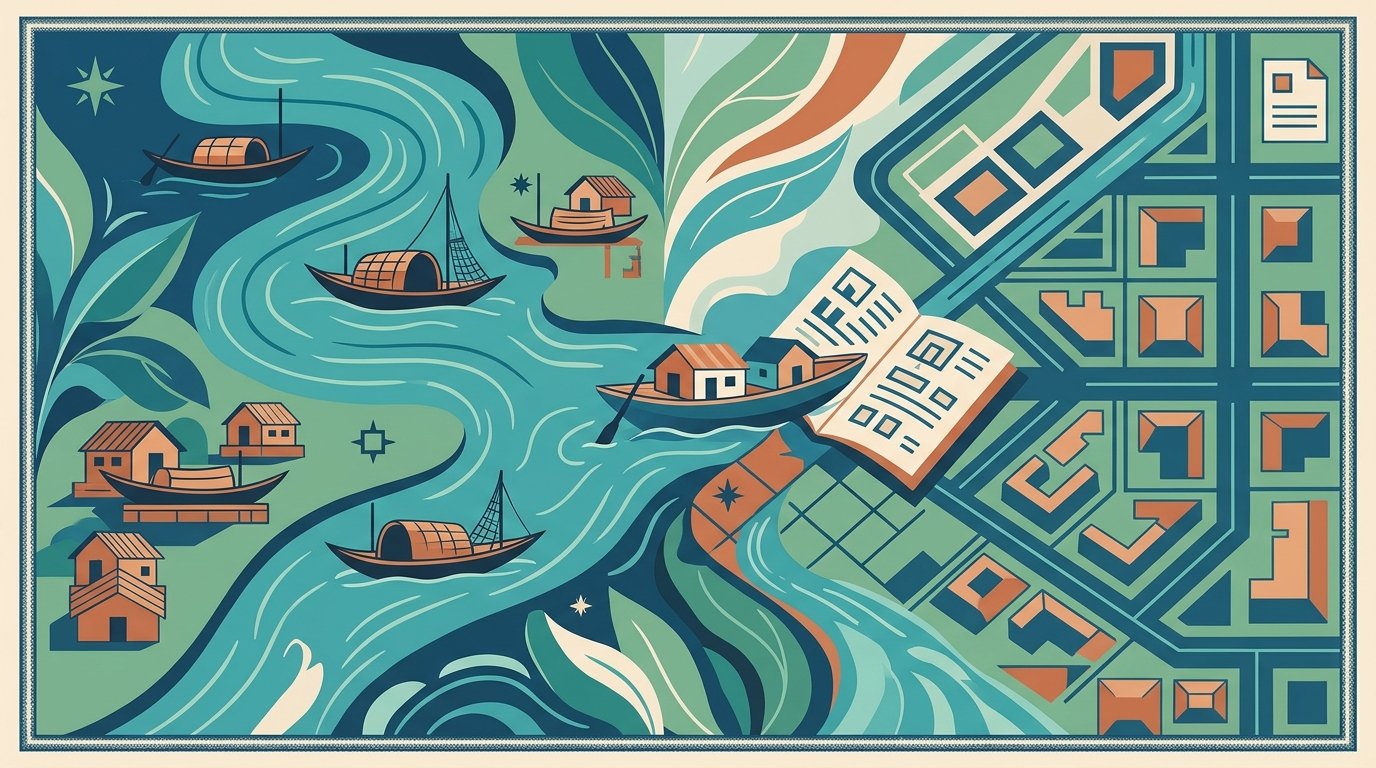
Bangladesh’s Bede people have lived and worked on the country’s rivers for generations, traveling by boat and earning livelihoods as healers, performers, and traders. Two studies published in 2026 shed new light on the pressures now pushing this traditionally mobile community onto land, and on the institutional barriers that make that transition exceptionally difficult.
A way of life under pressure
Research conducted in Tangail district during Bangladesh’s 2025 monsoon season found that Bede families in three riverside settlements move several times a year, following seasonal patterns and seeking audiences for their traditional work. Climate change has made this rhythm harder to sustain. Worsening floods, erosion, and the drying of some waterways are making life on the river untenable in certain areas. A separate study focused on Bede settlements in Munshiganj found that demand for traditional trades is also declining, and that a ban on snake-catching has removed another source of income. Around 88 percent of respondents in that study said they did not want their children to continue the traditional occupations. The Bede community has long faced social stigma, and community members told researchers that this, alongside environmental and economic factors, is driving a generational shift in outlook. An NGO called the Uttaran Foundation has trained around 200 young Bede women to work in garment factories as part of broader efforts to expand employment options.
A system built around fixed addresses
Moving onto land has not resolved the community’s difficulties. Bangladesh’s administrative and welfare systems are built around the assumption that residents have a permanent address, which most Bede families do not. This creates cascading problems:
- Many lack national identity documents, limiting access to government relief and disaster programmes.
- Children without birth certificates cannot be enrolled in schools or health initiatives through standard procedures.
- Bede people were not able to register as voters until 2008, which also delayed access to national identity cards issued through voter rolls.
Workarounds have emerged in some areas. A vaccinator in eastern Dhaka spent considerable time building trust with one Bede community before enrolling 24 girls in an HPV vaccination campaign by hand. Floating schools have also traveled with some Bede groups near Dhaka. Researchers recommend that support services be designed to be mobile and developed in consultation with community leaders, rather than relying solely on fixed facilities.
This article is adapted from “Built for boats, adrift on land: Bangladesh’s Bede community struggles with a fixed-address system” published by Global Voices, licensed under CC BY 3.0. Changes were made. Read the original story at the link above.
Discover More from Didier Lancelot
Amazon Author page: amazon.com/author/didierlancelot
Narmer Store: narmerstore.org
AI and Technology Ebooks
- Creative AI: Animated Drawings, Manga & Illustrations
- Build a Game with AI: The No-Code Guide
- AI Image Generation Made Easy
- Build a Website with AI: The No-Code Guide
- How to Connect AI to Your Blog: The Ultimate Automation Guide
- AI Productivity Habits: Get More Done in Less Time
- AI Avatars Made Easy
- The Book of AI Prompts: 100+ Proven Prompts
- Make Music with AI: Suno, Udio and AI Music Generators
- Click to Cash
- The Automated Edge: Outwork, Outpace, and Outperform with AI
- AI Side Hustle: How to Make Money with ChatGPT and AI Tools
- Work Smarter with AI
Health, Lifestyle and Home Ebooks
- Hidden Superfoods: The World’s Most Powerful Healing Foods
- Spanish Food: The Complete Cookbook for Authentic Home Cooking
- The Science of Happiness Explained
- The Psychology of Success
- The Secret Sauce of Consistency: What the Experts Don’t Tell You About Fitness
- The Complete Home Bartender’s Guide: Link 1 | Link 2
- Natural Beauty, Made Simple: Easy DIY Organic Skincare Recipes
- Garden Made Simple: Easy, Beginner-Friendly Techniques
- The Dog Training Bible