
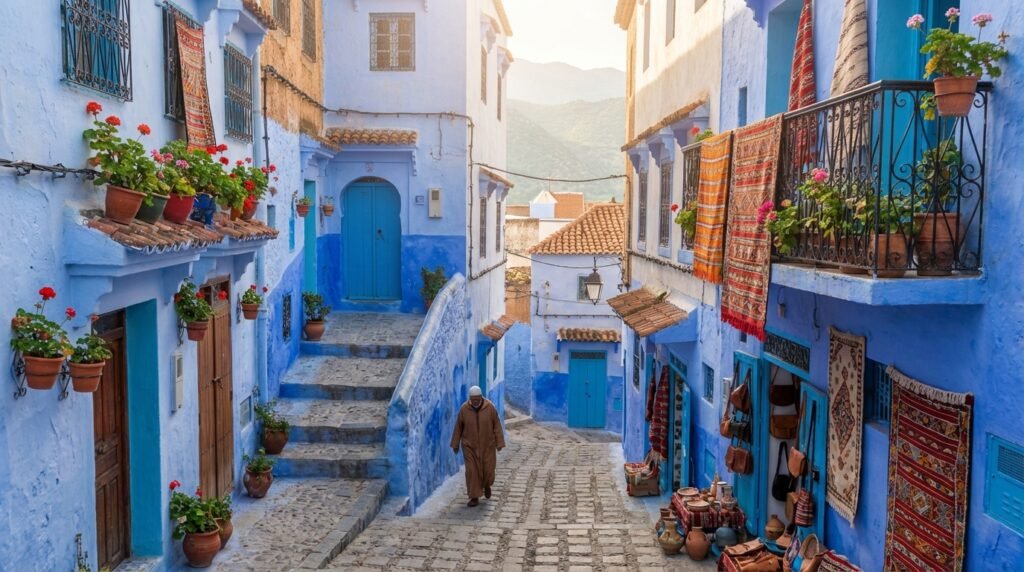
Chefchaouen, often called the “Blue Pearl” of Morocco, captivates visitors with its cobalt-washed alleyways, mountain backdrop, and serene atmosphere. Beyond its striking aesthetic, the city offers a refined blend of culture, nature, and history that rewards travelers who take time to wander slowly and look closely. This guide explores Chefchaouen’s origins, its iconic blue streets, rich traditions, and the outdoor adventures that make it one of northern Morocco’s most memorable destinations.
Overview of Chefchaouen
Geographic Location and Accessibility
Chefchaouen lies in the Rif Mountains of northern Morocco, set at an elevation that grants it clear air and sweeping views. The town is nestled between two peaks, Jebel Meggou and Jebel Tissouka, which frame its medina and contribute to its intimate, amphitheater-like setting. Despite its mountainous location, Chefchaouen is relatively easy to reach from major urban centers.
The most common gateways are Tangier, Tetouan, and Fez. From Tangier and Tetouan, travelers can reach Chefchaouen in approximately two to three hours by intercity bus or private transfer. From Fez, the journey typically takes around four hours, depending on traffic and road conditions. Public buses, such as those operated by CTM and other regional companies, provide reliable connections, while shared taxis are popular among locals for shorter segments. Although Chefchaouen has no airport or train station, its road network is well maintained, making it a practical addition to an itinerary through northern Morocco.
Once in town, Chefchaouen is best explored on foot. The medina’s narrow lanes and stepped pathways are not suited to vehicles, which enhances the sense of quiet and safety. Most accommodations, restaurants, and attractions are located within walking distance, allowing visitors to experience the town at a leisurely pace.
Brief History of Chefchaouen
Chefchaouen was founded in 1471 by Moulay Ali Ben Moussa Ben Rached El Alami as a small fortress to defend the region from Portuguese incursions. Its strategic position in the Rif Mountains allowed it to serve as both a military stronghold and a refuge. Over time, the settlement expanded as Muslim and Jewish refugees from Andalusia, fleeing the Reconquista and subsequent expulsions from Spain, sought safety in the town.
This Andalusian influence shaped Chefchaouen’s urban fabric and cultural identity. The whitewashed walls, internal courtyards, and tiled roofs echo architectural styles from southern Spain, while local craftsmanship and traditions developed at the crossroads of Berber, Arab, and Andalusian cultures. For centuries, Chefchaouen remained relatively isolated, which preserved its distinctive character and slowed the impact of external change.
During the early twentieth century, Chefchaouen fell under Spanish control as part of the Spanish Protectorate in northern Morocco, leaving a legacy that still appears in language, cuisine, and certain public buildings. After Moroccan independence in 1956, the town gradually opened to tourism. Today, Chefchaouen balances its historical roots with a growing reputation as a peaceful, visually arresting destination for travelers seeking authenticity and calm.
https://www.teepublic.com/t-shirt/50453000-puppy-and-kitten?store_id=2851997
The Blue Streets of Chefchaouen
Significance of the Blue Color
The blue color that coats Chefchaouen’s walls, doors, and staircases has become its defining hallmark. The exact origins of this tradition are debated, and several explanations coexist. One widely cited theory attributes the custom to Jewish refugees who settled in the town in the 15th and 16th centuries. For them, blue symbolized the sky and, by extension, the divine, serving as a visual reminder of spirituality in daily life.
Another interpretation links the blue to practical considerations. Some locals maintain that the pigments and limewash help repel insects, particularly mosquitoes, by creating a cooler, less inviting surface. Others suggest that the blue tones evoke water, an important symbol in a mountainous region where springs and rivers sustain agricultural life. Regardless of the origin, the practice of repainting walls several times a year has evolved into a communal ritual that preserves the medina’s luminous appearance.
Beyond symbolism, the blue hues have a tangible effect on the atmosphere. The narrow streets seem cooler, even on hot days, and the interplay of light and shadow across indigo, turquoise, and powder-blue surfaces creates a tranquil, almost dreamlike environment. For visitors, these tones invite slow exploration, photography, and quiet reflection, transforming an ordinary walk into an immersive visual experience.
Best Areas to Explore
Chefchaouen’s medina is compact yet intricate, filled with hidden corners and scenic viewpoints. While nearly every alley offers something picturesque, several areas stand out for their ambiance and architectural charm.
Outa el Hammam Square forms the heart of the old town. This broad, open plaza is lined with cafés and restaurants, making it an ideal starting point for orientation. From here, visitors can admire the terracotta-toned kasbah walls, watch daily life unfold, and then disappear into the surrounding blue lanes.
The Kasbah, a restored fortress and garden complex in the main square, offers a different perspective on Chefchaouen’s history and urban layout. Climbing the tower grants panoramic views over slate rooftops and the encircling mountains. The on-site ethnographic museum provides additional context about Rif culture and local traditions.
Wandering uphill from the square leads to some of the most photogenic residential streets. The Andalusian quarter features arched doorways, decorated steps, and ceramic details that evoke the city’s Iberian heritage. Small artisan workshops selling woven blankets, leather goods, and hand-painted ceramics line the lanes, providing insight into local craftsmanship.
For quieter exploration, head towards the upper medina near the Bab Souk and Bab el Ansar gates. These areas see fewer crowds, especially early in the morning or late in the afternoon, and reveal a more intimate side of daily life: children playing, neighbors chatting at doorsteps, and women painting fresh coats of blue on their homes. Each turn reveals a new composition of steps, flowerpots, and blue-washed walls that distinguishes Chefchaouen from other Moroccan cities.
Cultural Experiences in Chefchaouen
Local Cuisine to Try
Chefchaouen’s culinary scene blends Berber staples, Andalusian influences, and the freshness of mountain produce. The city’s smaller scale fosters a home-style approach to cooking, where many dishes resemble those served in local households rather than in large urban restaurants.
Tagine is fundamental to any gastronomic exploration. In Chefchaouen, chicken with preserved lemons and olives is particularly emblematic, combining fragrant spices with the sharpness of citrus. Lamb tagines with prunes or figs highlight the region’s affinity for balancing sweet and savory flavors. Slow cooking in earthenware vessels ensures tender meat and richly infused sauces.
Couscous, traditionally prepared on Fridays, is often served with seasonal vegetables and sometimes with lightly spiced broth. The grains are steamed rather than boiled, resulting in a delicate, airy texture. Many guesthouses and small restaurants offer couscous prepared according to family recipes, giving visitors an authentic taste of local domestic cuisine.
As a mountain town, Chefchaouen excels in simple yet flavorful vegetarian dishes. Bean stews, lentil soups, and zaalouk (a smoky eggplant and tomato salad) feature prominently, often accompanied by freshly baked khobz, the round Moroccan bread that appears on every table. Those inclined toward street food can sample msemen (layered flatbread) drizzled with honey or filled with herbs and cheese, perfect for breakfast or a mid-morning snack.
Tea culture is central to social life. Mint tea, sweetened and poured from a height to create a light foam, serves as a welcoming gesture in shops and riads. In winter, cafés may also serve achicha, a rustic barley soup, or warming spiced teas. While Chefchaouen is not a coastal city, some establishments offer fresh fish transported from nearby ports, providing variety for travelers spending several days in town.
Festivals and Traditions
Chefchaouen’s cultural calendar reflects both religious observances and local artistic expression. Many events are modest in scale compared with those in larger Moroccan cities, yet they provide an intimate window into the region’s social fabric.
Religious celebrations such as Ramadan and the major Islamic holidays shape the rhythm of life. During Ramadan, daily routines adjust to fasting hours, with evenings coming alive after sunset as families gather for the iftar meal and cafés fill with conversation. Visitors who respect these customs and plan meals accordingly can witness a deeply rooted sense of community and devotion.
Throughout the year, souk days remain important. On designated market days, traders and farmers from surrounding villages descend on Chefchaouen to sell produce, livestock, textiles, and household items. The weekly market offers insight into rural Rif life and the economic ties between the town and its hinterland.
On the artistic front, Chefchaouen occasionally hosts music and cultural festivals that highlight Andalusian, Sufi, and Amazigh traditions. These events may include live performances in public squares, poetry readings, and exhibitions of local crafts. While dates and programs vary, travelers who coincide with such gatherings often find that the combination of music and mountain scenery creates a particularly atmospheric experience.
Beyond organized festivals, many traditions manifest in everyday gestures: the way shopkeepers arrange their wares with aesthetic care, the hospitality of offering tea to strangers, and the quiet, rhythmic call to prayer echoing off the blue walls. Observing these patterns with sensitivity allows visitors to appreciate Chefchaouen not only as a visual spectacle but as a living community.
Marrakech Travel Guide: Discover the Magic of the Red City
Istanbul Travel Guide: A Journey Through History, Culture, and Modern Life
Ultimate Hvar Island Travel Guide: In Croatia
Outdoor Activities in Chefchaouen
Hiking Trails and Natural Attractions
Chefchaouen’s setting in the Rif Mountains makes it an excellent base for outdoor enthusiasts. The town lies close to several protected areas where hikers can experience forests, waterfalls, and highland plateaus, all within easy reach.
The most popular excursion leads to Akchour, a valley of rivers and cascades about 30 kilometers from Chefchaouen. Well-marked trails follow the river upstream, passing smaller pools and picnic spots before reaching the Petite Cascade and, for those who continue further, the Grande Cascade. Another path branches toward the “God’s Bridge,” a natural rock arch spanning the gorge. These hikes vary in difficulty and length, making it possible to tailor the day to different fitness levels.
Closer to town, the short walk up to the Spanish Mosque offers one of the best views over Chefchaouen. The trail begins near Ras El Ma, the riverside area on the eastern edge of the medina, where locals traditionally wash carpets and clothes. A gentle ascent along a clear path brings visitors to the whitewashed mosque overlooking the valley. Sunset is particularly spectacular, as the town’s blue tones deepen and the surrounding hills catch the last light.
For more demanding excursions, guided hikes into the Talassemtane National Park reveal cedar and fir forests, remote villages, and diverse birdlife. Multi-hour circuits allow hikers to experience the region’s biodiversity, including endemic plants and, with luck, sightings of Barbary macaques. Local guides not only ensure safety and navigation but also interpret the landscape, explaining traditional land use and conservation efforts.
Day Trips from Chefchaouen
While Chefchaouen itself can easily occupy several days, its location enables rewarding day trips to explore the broader Rif region. These outings offer contrast to the blue medina and provide a fuller sense of northern Morocco’s geography and culture.
In addition to Akchour and Talassemtane, travelers can visit nearby traditional villages where terraced fields and olive groves dominate the landscape. These small communities often maintain agricultural practices that have changed little over generations. With a knowledgeable guide, visitors may be able to tour local farms, learn about olive oil production, or share tea with families who host guests in their homes.
Another option is a journey toward Ouazzane, a town known for its religious significance and olive cultivation. Though less frequented by international tourists, it provides insight into spiritual life in the Rif and offers a more urban contrast to Chefchaouen’s compact medina. The route between Chefchaouen and Ouazzane reveals rolling hills and expansive olive orchards, illustrating the agricultural backbone of the region.
For those with more time and an interest in coastal landscapes, extended day trips—best done with private transport—can reach Tangier or the Mediterranean coastline. These excursions are longer but feasible for travelers wishing to combine mountain and sea within a single stay. Returning to Chefchaouen in the evening often feels like reentering a calm sanctuary after the busier pace of larger cities or seaside resorts.
Whether walking through azure alleys, sharing a meal in a family-run restaurant, or hiking towards a cascading waterfall, visitors find that Chefchaouen rewards curiosity and contemplation. The interplay of architecture, history, and natural beauty creates an atmosphere that is both soothing and invigorating. For travelers seeking a destination that combines visual harmony, cultural depth, and accessible outdoor adventure, Chefchaouen stands out as one of Morocco’s most compelling mountain towns.
CrystalCollector
Combat Protocol
WASD – Move
Mouse – Look around
Left Click – Fire Weapon
R – Reload
Eliminate all hostile units in the sector!
(Works better on computer)