
The Invisible Hand:
Explore how AI is transforming everyday life in , from smart homes and personalized content to advanced healthcare and smarter transportation. Discover the profound impact of artificial intelligence on our world.”
Artificial Intelligence (AI) isn’t just a buzzword from sci-fi movies anymore; it’s the invisible architect silently rebuilding the infrastructure of our daily existence. From the moment our alarms chime in the morning to the curated recommendations that lull us to sleep, AI is no longer a futuristic concept but a pervasive, powerful force. Its integration into everyday life is so seamless that we often don’t even realize its presence, yet its impact is profound, transforming industries, streamlining tasks, and personalizing experiences in ways we never thought possible.
Let’s pull back the curtain and explore how AI is fundamentally changing the fabric of our everyday lives.
1. The Personalized Digital Companion: Smart Devices & Content Curation
Our day often begins with AI. Your smart alarm clock might adjust its wake-up time based on your sleep cycle data collected by a wearable device. Your smartphone’s AI assistant (Siri, Google Assistant, Alexa) is constantly learning your preferences, predicting your needs, and providing instant information.
The most noticeable impact is in content curation. Think about your streaming services (Netflix, Spotify, YouTube), social media feeds (Facebook, Instagram, TikTok), and even online shopping experiences (Amazon). These platforms use sophisticated AI algorithms to:
- Recommend: Suggest movies, songs, products, or news articles based on your past behavior and the collective data of millions of users.
- Personalize: Tailor your feed to show you more of what you engage with, creating a uniquely individual digital experience.
- Optimize: Determine the best time to send you notifications or suggest new connections.
This hyper-personalization, while convenient, also raises questions about echo chambers and the potential for manipulation, highlighting the dual nature of AI’s power.
2. Driving Smarter: Transportation & Navigation
AI is revolutionizing how we move.
- Navigation Apps (Google Maps, Waze): These aren’t just displaying maps; they’re AI powerhouses. They analyze real-time traffic data, accident reports, road closures, and even historical traffic patterns to predict the fastest routes, estimate arrival times, and suggest alternative paths.
- Ride-Sharing Services (Uber, Lyft): AI algorithms are at their core, optimizing driver routes, matching passengers efficiently, dynamically pricing fares based on demand, and ensuring safety through driver monitoring and anomaly detection.
- Autonomous Vehicles: While fully self-driving cars aren’t yet mainstream, AI-powered features like adaptive cruise control, lane-keeping assistance, automatic emergency braking, and self-parking are already making our vehicles safer and smarter.
3. Health & Wellness: From Diagnosis to Personal Coaching
The healthcare sector is being transformed by AI.
- Diagnostic Tools: AI can analyze medical images (X-rays, MRIs, CT scans) with incredible speed and accuracy, often detecting subtle anomalies that might be missed by the human eye, aiding in early diagnosis of diseases like cancer.
- Drug Discovery: AI algorithms sift through vast databases of chemical compounds and biological targets, accelerating the process of identifying potential new drugs and vaccines.
- Personalized Medicine: AI helps tailor treatment plans based on an individual’s genetic makeup, lifestyle, and medical history, moving towards more effective and less generalized care.
- Wearables: Fitness trackers and smartwatches use AI to monitor heart rate, sleep patterns, activity levels, and even detect irregular heart rhythms, providing personalized health insights and early warnings.
4. Work & Productivity: The Automated Office & Creative Tools
AI is changing the way we work, making many processes more efficient.
- Automated Customer Service: Chatbots and virtual assistants handle a significant portion of customer queries, providing instant responses and freeing up human agents for more complex issues.
- Data Analysis: AI can rapidly process and analyze massive datasets, identifying trends, patterns, and insights that would take humans weeks or months to uncover, informing business strategies.
- Creative Tools: AI is being integrated into design software, video editing suites, and even writing tools (like generative AI models), helping automate mundane tasks, suggest improvements, and even generate content. From background removal in photos to auto-generating captions, AI is boosting creative output.
- Cybersecurity: AI systems continuously monitor networks for unusual activity, identifying and neutralizing threats much faster than human teams could, protecting our digital assets.
5. Home Sweet Smart Home: Efficiency & Convenience
Our homes are becoming “smarter” thanks to AI.
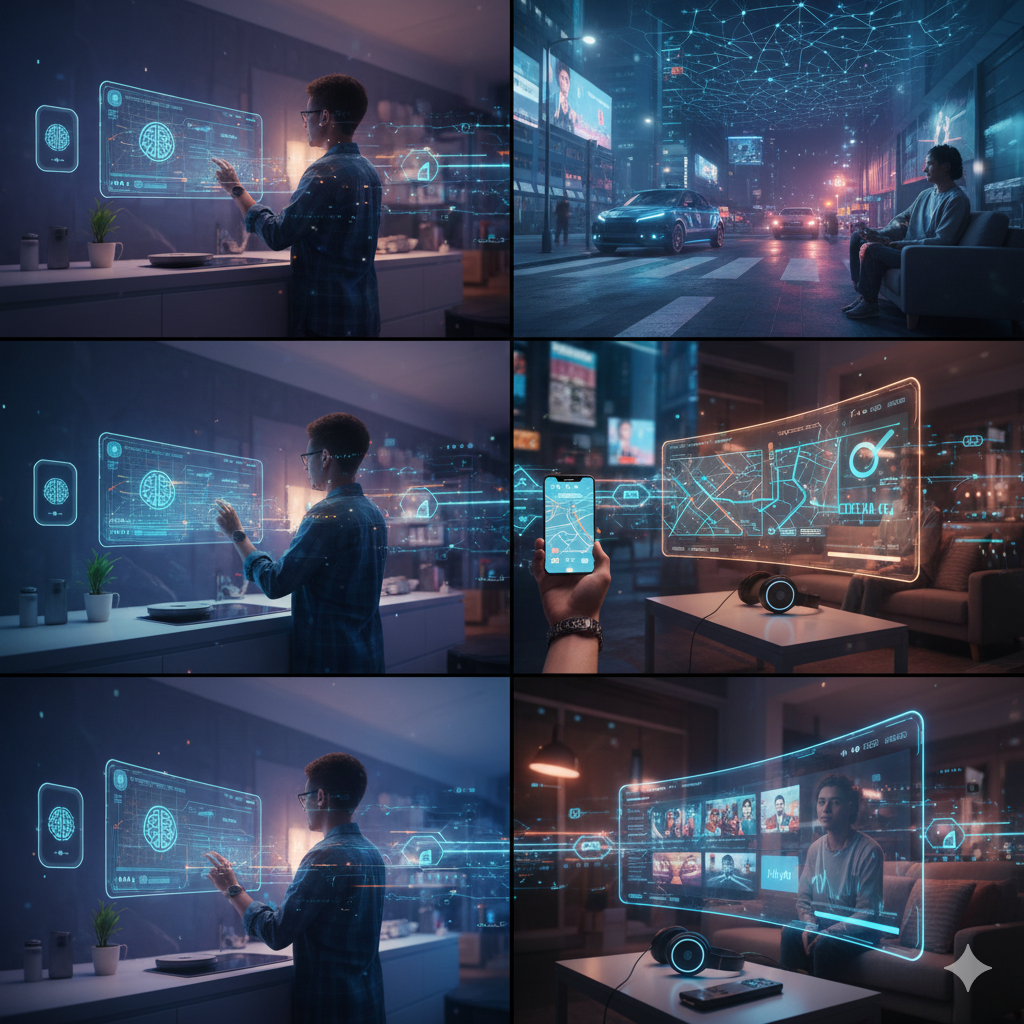
- Smart Thermostats (Nest): These devices learn your preferences and optimize heating and cooling schedules to save energy and enhance comfort.
- Robot Vacuums (Roomba): AI helps them map your home, navigate around obstacles, and clean efficiently.
- Smart Lighting: AI can adjust lighting based on time of day, occupancy, or even your mood.
- Security Systems: AI-powered cameras can differentiate between pets, people, and vehicles, reducing false alarms and enhancing home safety.
The Road Ahead: Navigating the AI Era
The rapid integration of AI into our daily lives brings immense opportunities for progress, efficiency, and personalization. However, it also presents significant challenges:
- Privacy Concerns: The more AI knows about us, the more questions arise about data security and how our personal information is used.
- Job Displacement: As AI automates more tasks, concerns about its impact on employment grow.
- Ethical Dilemmas: Who is responsible when an AI makes a mistake? How do we ensure fairness and prevent bias in algorithms?
- Digital Divide: Ensuring equitable access to AI’s benefits is crucial to prevent further societal inequalities.
today, AI is no longer a distant future; it’s a foundational element of our present. Understanding its pervasive influence, embracing its benefits responsibly, and critically engaging with its challenges will be key to shaping a future where AI truly serves humanity. The invisible hand of AI continues to mold our world, and our collective journey to adapt, innovate, and thrive within this new paradigm has only just begun.
- AI in everyday life
- how AI is changing daily life
- artificial intelligence impact
- AI personal assistants
- AI healthcare benefits
- AI in smart homes
- AI in transportation
- AI and productivity
- future of AI
- AI content recommendations
- AI ethics and challenges
- benefits of AI technology
- AI today
- AI and digital transformation
- smart technology AI