
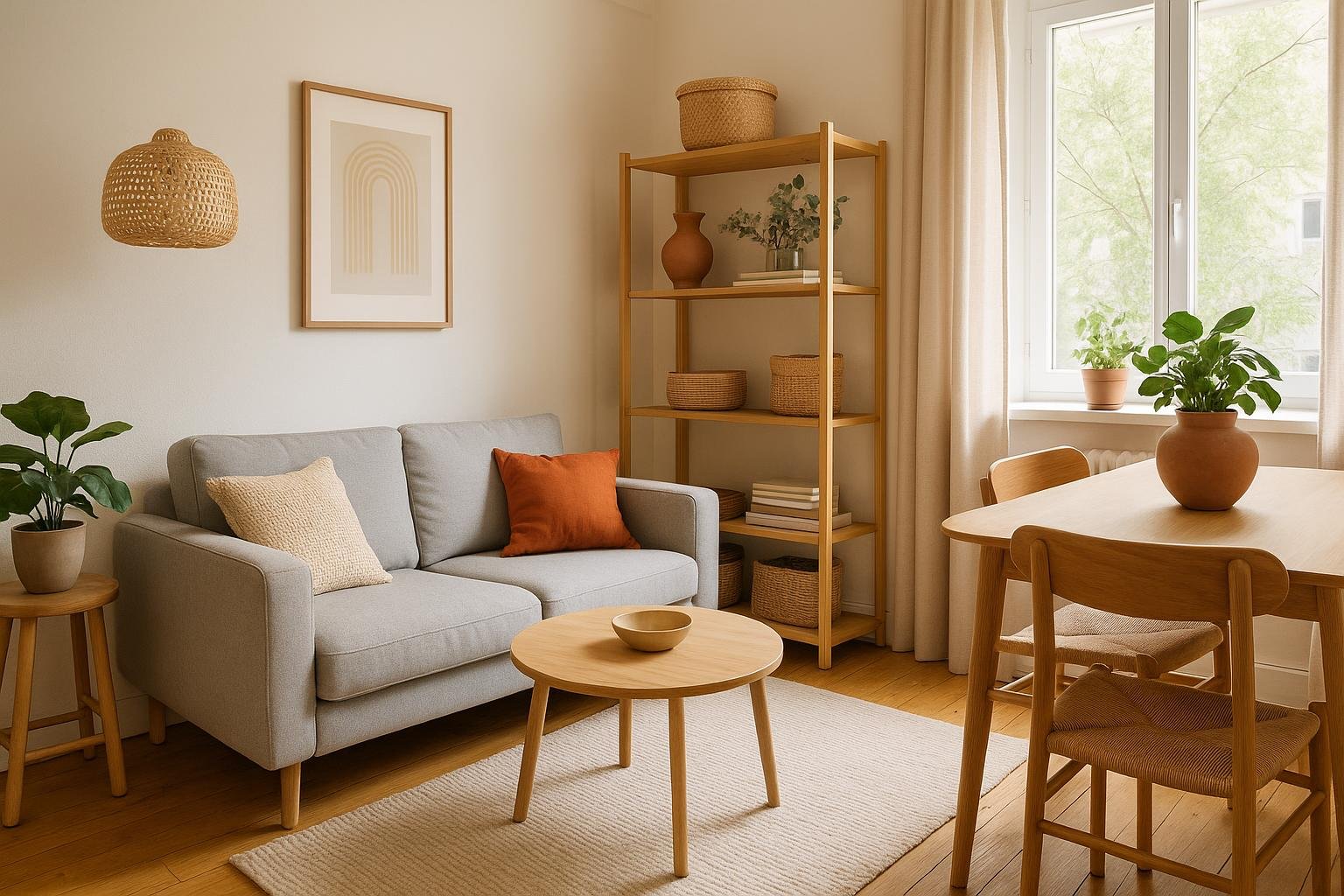
How to Design a Small Home That Feels Calm, Open, and Uncluttered
A small home doesn’t have to feel cramped or chaotic. The goal isn’t to own as little as possible—it’s to make every square foot work hard, look calm, and support the way you actually live.
When layout, storage, and decoration all pull in the same direction, a compact home can feel organized, spacious, and personal. The key is to design for visual calm and everyday function, not minimalism for its own sake.
This guide walks you through a practical three-step approach:
- Step 1: Map how you really use the space
- Step 2: Shape layout and storage around those activities
- Step 3: Edit what you see so every detail has a clear role
Step 1: Map How You Actually Live in Your Small Space
Notice your real routines, not your ideal ones
Before you move furniture or buy storage, start with observation. For a week or two, pay attention to how you naturally use your home:
- Where do bags, keys, and mail usually land?
- Which surfaces attract piles—kitchen counter, dining table, nightstand?
- Where do you work, relax, eat, or exercise most often?
- What paths do you walk over and over each day?
These patterns reveal the “pressure points” where clutter builds and where function is missing. Designing for a small home begins with accepting these habits and building systems around them, instead of constantly fighting them.
Define clear zones, even in one room
Visual clutter often comes from one space trying to be everything at once. Give each area a primary purpose—even if you’re working with a studio apartment or a combined living-dining room.
Ask yourself:
- Where is the main relaxation zone?
- Where do you eat or work at a table?
- Where do you get ready to leave the house?
- Where do clothes, linens, and cleaning supplies live?
In a small home, “zones” can be created with very simple cues:
- Rug placement to define a seating area.
- A narrow console plus hooks by the door for entry storage.
- A clamp-on lamp and a small side table to mark a reading or work nook.
Giving every activity a spot—even if tiny—helps prevent the entire home from turning into a catch-all.
Protect clear pathways
Nothing makes a small home feel tighter than blocked walkways. Your circulation paths should be obvious and unobstructed:
- Could you walk from the front door to the sofa, kitchen, or bed without sidestepping furniture?
- Do doors and cabinet fronts open fully, or hit something?
- Are there “stub your toe” spots you always bump into?
When in doubt, prioritize a clear path and slightly less furniture. A compact home feels bigger when you can move through it easily, even if the square footage is modest.
Step 2: Shape Layout and Storage Around Your Life
Choose furniture that matches the room’s scale
In a small home, the wrong furniture size creates instant visual clutter—no matter how tidy you are. Choose pieces that suit the room instead of defaulting to standard sizes.
- Avoid oversized, bulky silhouettes. Deep, overstuffed sofas or chunky armoires can swallow a room.
- Prefer slim, raised profiles. Sofas and chairs with visible legs, open bases, and slender arms look lighter and show more floor.
- Use wall-mounted options where possible. Floating shelves, wall desks, and wall-mounted nightstands keep the floor line open and easier to clean.
Adaptable furniture can be powerful in a small space—if it reflects your real habits:
- Storage ottomans that hold blankets or games, and double as extra seating.
- Extendable dining tables that stay compact for daily use but expand for guests.
- Fold-down desks if you truly need a workspace that disappears when you’re off the clock.
The test: if a multi-use piece adds complexity but you rarely use its features, it’s adding clutter, not flexibility.
Use storage to support daily actions, not just to hide things
Storage in a small home should make your routines easier. It’s not just about adding more bins—it’s about placing the right kind of storage where you need it.
Think in terms of frequency of use:
- Daily-use items: within easy reach, at arm or eye level.
- Weekly or monthly items: slightly higher or lower—top shelves, under-bed drawers.
- Rarely used extras: upper cabinets, high shelves, or tucked-away storage.
Smart small-home storage strategies include:
- Going vertical: full-height cabinets, tall bookcases, or a wall of shallow shelves to take advantage of height.
- Under-bed storage: drawers, rolling bins, or a bed with built-in storage for off-season clothing and linens.
- Built-in or integrated storage: media units with closed cabinets, benches with hidden compartments, headboards with shelves.
One caution: too many open shelves can create visual busyness. Reserve open storage for items that either look simple (neatly folded towels, matching dishes) or truly decorative pieces.
Create “landing zones” where clutter starts
Every home has spots where clutter appears first. Instead of trying to change these habits, build simple systems around them.
- Entryway: a hook rail for bags and coats, a small tray or bowl for keys, and a narrow shelf or console for mail.
- Kitchen: a defined mail sorting spot, a container for cooking utensils, and one “inbox” zone so paper doesn’t spread across every surface.
- Bedroom: a nightstand with a drawer and tray so glasses, books, and devices have a home, not just a pile.
When your storage matches where clutter naturally collects, your home stays clear with much less effort.
Step 3: Edit the Visual Details for Calm, Not Emptiness
Limit visual competition with a cohesive palette
Visual clutter isn’t just about quantity—it’s about how many different things your eye has to process at once. In a small home, cohesion is one of your strongest tools.
Across connected spaces, aim to:
- Repeat a simple color palette. Choose 2–3 main colors and a couple of accent tones, then echo them in textiles, decor, and smaller furniture pieces.
- Reuse materials. If your coffee table is light wood, consider light wood frames or shelves elsewhere to tie the room together.
- Keep big surfaces calm. Walls, large rugs, and big furniture pieces in quieter, neutral or muted tones can make a room feel more open.
This doesn’t mean your home has to be bland. It means you give a few meaningful things space to stand out instead of everything shouting at once.
Treat surfaces as intentional compositions
Flat surfaces are magnetically attractive to clutter. To prevent every table and countertop from feeling full, treat them like curated compositions, not storage zones.
Try this approach for each main surface:
- Decide its purpose. Is it for eating, working, prepping food, relaxing?
- Pick a few essentials. For example: a lamp + book + coaster on a side table; utensil crock + cutting board + small plant on a kitchen counter.
- Leave intentional empty space. Clear areas signal calm and give you room to actually use the surface.
If an object doesn’t support the surface’s purpose or add real joy, it probably belongs somewhere else—or not at all.
Choose fewer, larger focal points instead of many small ones
In a small space, many tiny decorative items easily become visual noise. A better strategy is:
- One appropriately scaled artwork over the sofa instead of a crowded grid of small frames.
- A single statement vase or sculpture on a console rather than a scattered collection of trinkets.
- One bold patterned pillow per seat instead of a jumble of mismatched cushions.
Fewer, more substantial pieces read as calm and intentional. Your favorite objects gain more presence when they’re not competing with dozens of others.
Layer lighting and protect natural light
Light is one of the simplest ways to make a compact home feel larger and more soothing.
Think about three types of lighting:
- Ambient: overall light from ceiling fixtures or large lamps.
- Task: targeted light for reading, cooking, desk work, or makeup.
- Accent: softer lighting to highlight art, plants, or architectural details.
In a small room, several smaller light sources often feel cozier and more flexible than one harsh overhead fixture. They also let you adjust the mood throughout the day.
To make the most of natural light:
- Avoid placing bulky furniture in front of windows. If you must, choose lower pieces that don’t block the glass.
- Use light, airy window coverings. Sheer curtains or blinds that stack tightly preserve the window’s full height and width.
- Add mirrors strategically. A mirror opposite or diagonal to a window can bounce light deeper into the room and create a sense of more space.
When a small home is well lit, both naturally and artificially, it feels more open and less cluttered—even if nothing else changes.
Build a simple daily “reset” routine
Even the best design can’t prevent clutter forever. What it can do is make tidying fast and almost automatic.
Design your storage and layout so that “resetting” the space is easy to do in 10–15 minutes:
- Keep donations bin or bag accessible so it’s simple to edit belongings regularly.
- Make sure every item has an obvious home, ideally close to where it’s used.
- Use containers (baskets, drawer dividers, bins) with clear categories: tech, mail, tools, skincare, cleaning supplies, etc.
A quick daily sweep—returning items to their spots, clearing surfaces, loading the dishwasher, emptying pockets—prevents slow buildup that makes a small space feel out of control.
Room-by-Room Tips for a Small, Uncluttered Home
Living room
- Choose a sofa that fits your wall, not the biggest one possible.
- Opt for a coffee table with shelves or drawers, or a pair of small nesting tables.
- Keep cords under control with cable management clips and boxes.
- Limit decor on the TV wall to avoid visual competition with the screen.
Kitchen
- Use drawer organizers so utensils and tools don’t become a jumble.
- Store visually busy items (mismatched containers, extra gadgets) behind closed doors.
- Reserve one or two open shelves for everyday dishes or attractive pieces only.
- Keep a clear prep zone on the counter by giving appliances a designated spot.
Bedroom
- Prioritize a bed with built-in storage or room for low bins underneath.
- Use matching or visually similar bedding and pillows for a calm look.
- Keep nightstands simple: a lamp, one or two essentials
Discover More from Didier Lancelot
Amazon Author page: amazon.com/author/didierlancelot
Narmer Store: narmerstore.orgAI and Technology Ebooks
- Creative AI: Animated Drawings, Manga & Illustrations
- Build a Game with AI: The No-Code Guide
- AI Image Generation Made Easy
- Build a Website with AI: The No-Code Guide
- How to Connect AI to Your Blog: The Ultimate Automation Guide
- AI Productivity Habits: Get More Done in Less Time
- AI Avatars Made Easy
- The Book of AI Prompts: 100+ Proven Prompts
- Make Music with AI: Suno, Udio and AI Music Generators
- Click to Cash
- The Automated Edge: Outwork, Outpace, and Outperform with AI
- AI Side Hustle: How to Make Money with ChatGPT and AI Tools
- Work Smarter with AI
Health, Lifestyle and Home Ebooks
- Hidden Superfoods: The World’s Most Powerful Healing Foods
- Spanish Food: The Complete Cookbook for Authentic Home Cooking
- The Science of Happiness Explained
- The Psychology of Success
- The Secret Sauce of Consistency: What the Experts Don’t Tell You About Fitness
- The Complete Home Bartender’s Guide: Link 1 | Link 2
- Natural Beauty, Made Simple: Easy DIY Organic Skincare Recipes
- Garden Made Simple: Easy, Beginner-Friendly Techniques
- The Dog Training Bible
Games and Music