
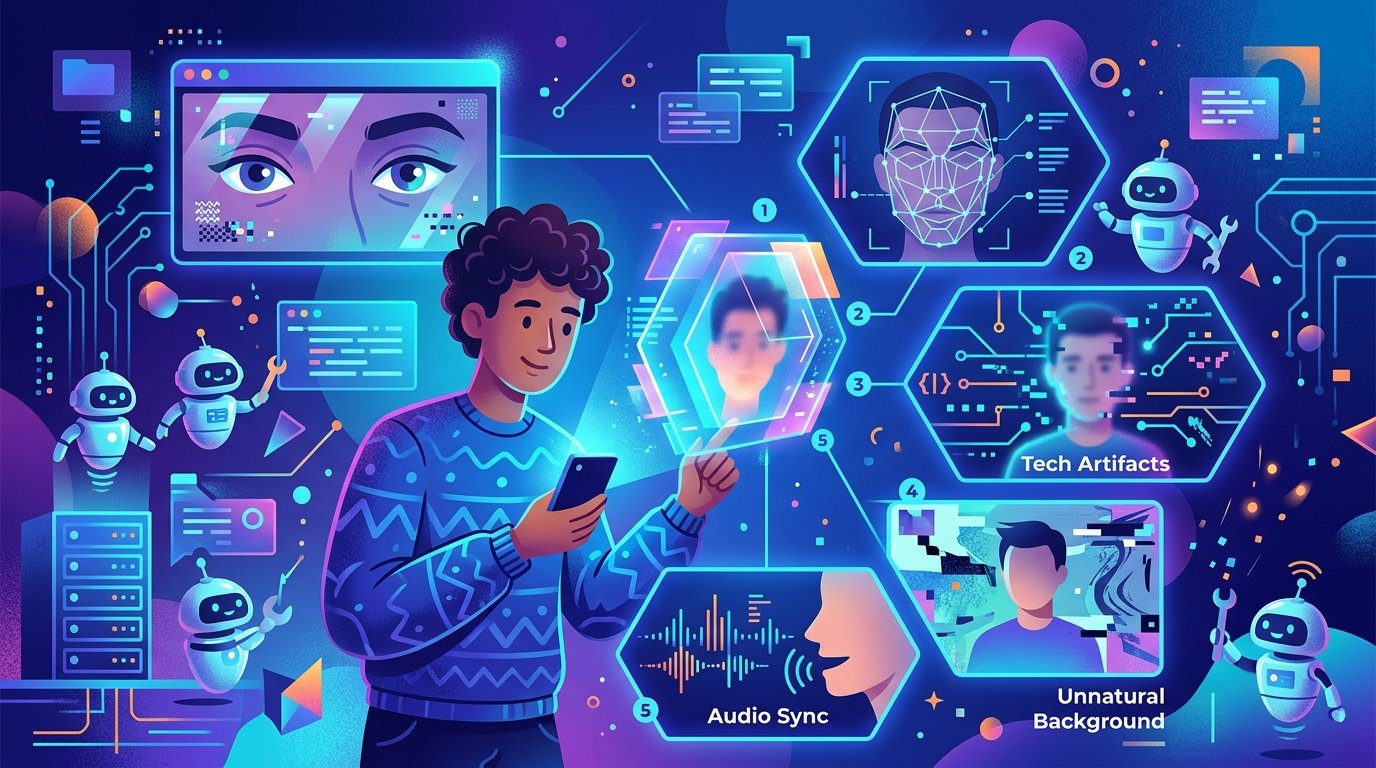
Scroll through your social media feed long enough and you’ll probably come across a video that makes you do a double-take. A celebrity saying something shocking. A politician making a statement you can’t believe. A friend’s face appearing in a clip you know they never filmed. Welcome to the age of deepfakes — AI-generated media that can make anyone appear to say or do almost anything. The good news? You don’t need to be a tech expert to spot them. With a little know-how and a sharp eye, you can learn to tell the real from the fake. Here are five simple steps to help you do exactly that.
Step 1: Look Closely at the Face — Especially the Edges
The most obvious place to start is the face itself. Deepfake technology works by swapping or generating a face using artificial intelligence, and even the most convincing fakes tend to leave clues around the edges of the face — the hairline, jawline, and the area where the neck meets the shoulders.
- Blurry or unnatural hairlines: Hair is notoriously difficult for AI to recreate convincingly. Look for patches that seem too smooth, too fuzzy, or oddly uniform.
- Skin that looks “plastic”: Deepfake faces sometimes have an almost airbrushed quality — pores disappear, wrinkles vanish unnaturally, and the skin can look waxy or overly smooth.
- Mismatched lighting: A genuine video has consistent light falling on every part of the scene. In a deepfake, the face lighting might not quite match the background or the neck, creating a subtle but telltale glow or shadow that doesn’t belong.
Try pausing the video and zooming in. Details that look fine at normal speed can become much more obvious when you slow things down.
Step 2: Watch the Eyes and Mouth Carefully
Our eyes and mouths are incredibly expressive, and they’re also two of the hardest things for AI to fake convincingly. Pay close attention to both.
The eyes are a great giveaway. Early deepfakes rarely blinked — or blinked in an oddly robotic way — because the AI was trained on images where people’s eyes were open. Newer models have improved, but eyes can still look glassy, fail to reflect light naturally, or move in ways that feel slightly “off.” Stare at the eyes for a few seconds and ask yourself: do they feel alive?
The mouth is equally revealing. Watch for:
- Teeth that look blurry or don’t move realistically with the lips
- Lip movements that don’t quite sync with the audio — a classic sign of a poorly made deepfake
- An interior of the mouth that looks flat or oddly coloured
If the words and lip movements feel even slightly out of sync — like a badly dubbed foreign film — treat that as a major red flag.
Step 3: Listen as Well as You Look
Deepfakes aren’t just visual. Voice cloning — where AI mimics a person’s voice — is increasingly common, and audio can be faked just as convincingly (or unconvincingly) as video.
Listen for these audio clues:
- Flat or robotic tone: Real human speech rises and falls naturally. Cloned voices can sound slightly monotone or emotionally flat, as though someone is reading a script without feeling it.
- Unusual pauses or pacing: AI-generated speech sometimes has odd rhythm — pauses in the wrong places, or words that run together unnaturally.
- Background audio that doesn’t match: If the background noise cuts out abruptly or doesn’t match the environment shown in the video, that’s suspicious.
Try watching the video with your eyes closed for a moment. Does the voice sound genuinely human? Does the emotion in the voice match what’s being said?
Step 4: Check the Source Before You Share
This step is less about spotting technical flaws and more about good digital habits — and it might be the most important one of all. Before you believe or share a surprising video, ask yourself a few basic questions:
- Where did this video originally come from? A clip shared on an anonymous social media account with no clear source is far more suspicious than footage from a verified news outlet.
- Has a credible news organisation reported on this? If a video supposedly shows something extraordinary but only one obscure website is talking about it, that’s a warning sign.
- Can you find the original context? Reverse image search tools (which let you search the web using an image or video frame rather than words) can help you trace where a piece of media first appeared and whether it’s been altered.
Deepfakes are often designed to provoke a strong emotional reaction — outrage, shock, or excitement — because emotional responses make people share without thinking. If a video makes you feel an immediate, intense emotion, take a breath before hitting that share button.
Step 5: Use Free Detection Tools as a Backup
You don’t have to rely on your eyes alone. A growing number of free and easy-to-use AI detection tools are available online. These tools analyse a video or image and flag signs of AI manipulation — things too subtle for the human eye to catch.
A few practical tips when using these tools:
- No tool is perfect. Use them as one part of your process, not the final word.
- Look for tools from reputable universities, research organisations, or established tech companies.
- Even if a tool says a video is “likely authentic,” still apply your own critical thinking.
Think of these tools the way you’d think of a spell-checker — helpful for catching things you miss, but not a replacement for your own judgement.
The Bottom Line
Deepfakes are getting better all the time, and that can feel unsettling. But so are the skills and tools we have for detecting them. The most powerful defence you have isn’t any piece of software — it’s a habit of healthy scepticism. Slow down, look closely, listen carefully, check your sources, and use the tools available to you. You won’t catch every fake, but you’ll be far less likely to be fooled — and far less likely to accidentally spread misinformation to the people you care about. In a world full of synthetic media, a curious and cautious mind is your best asset.
Discover More from Didier Lancelot
Amazon Author page: amazon.com/author/didierlancelot
Narmer Store: narmerstore.org
AI and Technology Ebooks
- Creative AI: Animated Drawings, Manga & Illustrations
- Build a Game with AI: The No-Code Guide
- AI Image Generation Made Easy
- Build a Website with AI: The No-Code Guide
- How to Connect AI to Your Blog: The Ultimate Automation Guide
- AI Productivity Habits: Get More Done in Less Time
- AI Avatars Made Easy
- The Book of AI Prompts: 100+ Proven Prompts
- Make Music with AI: Suno, Udio and AI Music Generators
- Click to Cash
- The Automated Edge: Outwork, Outpace, and Outperform with AI
- AI Side Hustle: How to Make Money with ChatGPT and AI Tools
- Work Smarter with AI
Health, Lifestyle and Home Ebooks
- Hidden Superfoods: The World’s Most Powerful Healing Foods
- Spanish Food: The Complete Cookbook for Authentic Home Cooking
- The Science of Happiness Explained
- The Psychology of Success
- The Secret Sauce of Consistency: What the Experts Don’t Tell You About Fitness
- The Complete Home Bartender’s Guide: Link 1 | Link 2
- Natural Beauty, Made Simple: Easy DIY Organic Skincare Recipes
- Garden Made Simple: Easy, Beginner-Friendly Techniques
- The Dog Training Bible