
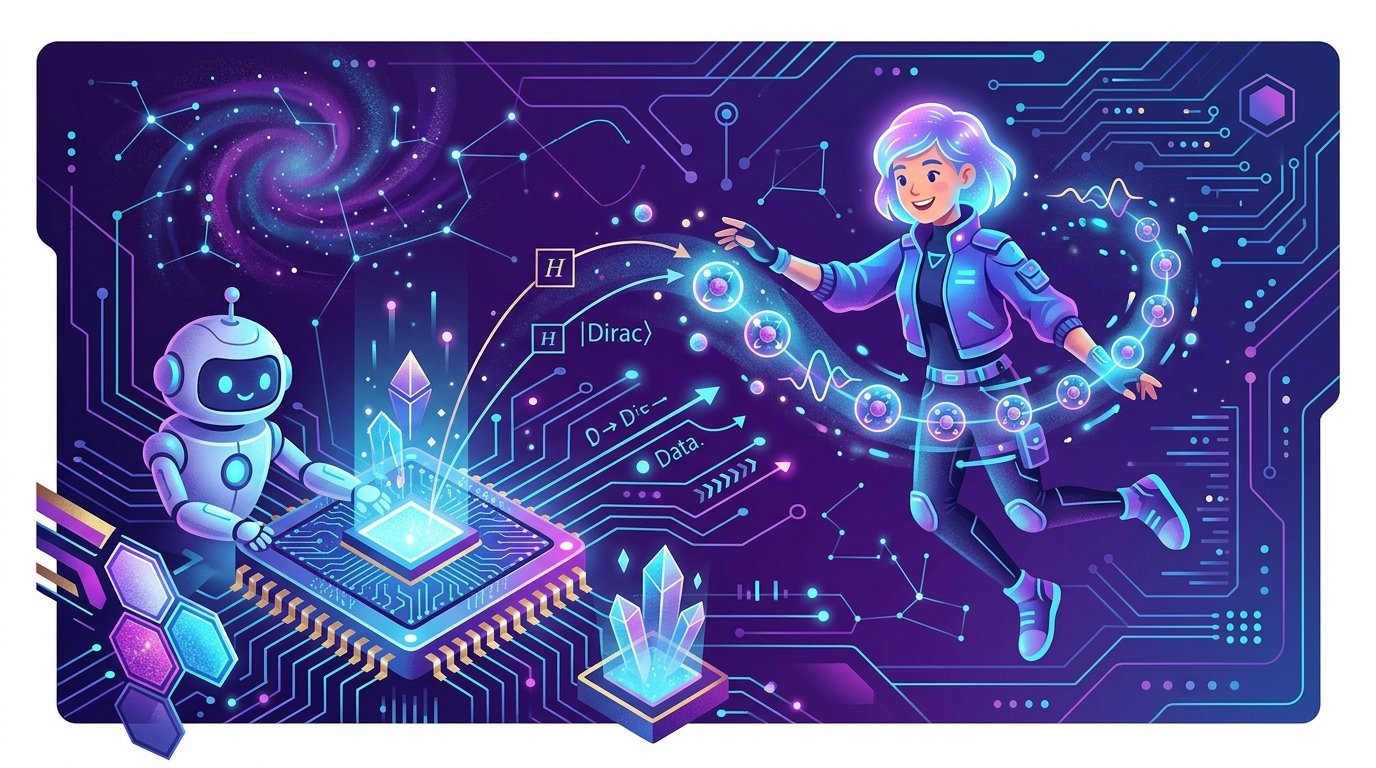
If you’ve been hearing the phrase “quantum computing” pop up more and more lately — in tech news, in conversations about artificial intelligence, even in sci-fi movies — you’re not alone. It sounds intimidatingly futuristic, like something out of a laboratory on another planet. But here’s the good news: the core ideas behind quantum computing are actually quite approachable once you strip away the jargon. In this post, we’ll walk through what quantum computers are, why they matter, and what they might mean for your everyday life — no physics degree required.
What Is a Quantum Computer, Anyway?
To understand quantum computers, you first need a quick refresher on how regular computers work. Your laptop, smartphone, and even the servers powering your favorite websites all run on bits. A bit is the most basic unit of information in computing, and it can only ever be one of two things: a 0 or a 1. Think of it like a light switch — it’s either off or on.
Quantum computers use a different kind of unit called a qubit (short for quantum bit). Here’s where things get interesting: a qubit can be a 0, a 1, or — thanks to a quantum physics phenomenon called superposition — both at the same time. Imagine a coin spinning in the air. While it’s spinning, it’s neither heads nor tails; it’s both. Only when it lands does it settle on one. A qubit behaves similarly while a quantum computer is running its calculations.
This ability to hold multiple states simultaneously allows quantum computers to explore many possible solutions to a problem all at once, rather than checking them one by one like traditional computers do.
Three Key Concepts (Without the Headache)
There are three big ideas that make quantum computing tick. You don’t need to master them — just getting a feel for each one is enough to understand why quantum computers are so powerful.
- Superposition: As mentioned above, this is the ability of a qubit to be in multiple states at once. More qubits in superposition means exponentially more information being processed at the same time.
- Entanglement: This is a quirky quantum physics phenomenon where two qubits become linked, so that the state of one instantly influences the state of the other — no matter how far apart they are. Einstein famously called this “spooky action at a distance.” For computing, it means qubits can work together in highly coordinated ways, making calculations faster and more efficient.
- Interference: Quantum computers use interference to steer calculations toward correct answers and away from wrong ones. Think of it like noise-canceling headphones — interference cancels out the “wrong” paths and amplifies the “right” ones.
How Is This Different From a Really Fast Normal Computer?
This is one of the most common questions people ask, and it’s a great one. Quantum computers aren’t just faster versions of the computers you use every day. They’re a completely different type of machine, built for a completely different type of problem.
A regular computer is brilliant at sequential tasks — sending emails, streaming video, running spreadsheets. A quantum computer, on the other hand, excels at problems that involve enormous numbers of variables and possibilities all interacting with each other. These include:
- Simulating complex molecules for drug discovery
- Optimizing huge logistics networks (like global shipping routes)
- Breaking — or building — advanced encryption systems
- Speeding up certain kinds of artificial intelligence training
For most everyday computing tasks, a quantum computer would actually be overkill — and not even particularly useful. But for certain hard, complex problems, it could be transformative.
Where Are We Right Now?
Quantum computing is still very much in its early stages. Current quantum computers are often described as being in the “noisy intermediate-scale quantum” (NISQ) era — a fancy way of saying they’re powerful enough to be interesting but still prone to errors and limited in scale. Qubits are extremely sensitive to their environment; even tiny vibrations or temperature changes can disrupt a calculation, which is why quantum computers typically need to be kept at temperatures colder than outer space.
Major technology companies, research universities, and governments around the world are all investing heavily in this field. Progress is real and ongoing, but practical, large-scale quantum computers that outperform classical computers on truly important tasks are still a work in progress. Think of where personal computers were in the 1970s — the potential was clear, but the technology wasn’t quite there yet for everyday use.
What Does This Mean for You?
You probably won’t buy a quantum computer anytime soon — and you won’t need to. But quantum computing may quietly shape your world in meaningful ways over the coming years and decades:
- Better medicines: Quantum simulations could help scientists design more effective drugs by modeling molecular behavior with unprecedented accuracy.
- Stronger security: Quantum computing will likely force a rethink of how we encrypt data online, leading to new, more robust security standards.
- Smarter AI: Quantum-enhanced machine learning could make AI systems faster and more capable at solving complex real-world problems.
- Climate solutions: Optimizing energy grids and modeling climate systems are exactly the kinds of massive, multi-variable problems where quantum computers could shine.
A Simple Takeaway
Quantum computing isn’t magic, and it isn’t going to replace your laptop tomorrow. It’s a genuinely new approach to solving problems that are simply too complex for today’s computers — problems in medicine, security, energy, and beyond. The technology is still maturing, but the direction it’s heading is exciting. The key thing to remember: quantum computers don’t just work faster — they work differently. And that difference could change quite a lot about the world we live in. Keep an eye on this space; it’s one of the most fascinating frontiers in modern technology.
Discover More from Didier Lancelot
Amazon Author page: amazon.com/author/didierlancelot
Narmer Store: narmerstore.org
AI and Technology Ebooks
- Creative AI: Animated Drawings, Manga & Illustrations
- Build a Game with AI: The No-Code Guide
- AI Image Generation Made Easy
- Build a Website with AI: The No-Code Guide
- How to Connect AI to Your Blog: The Ultimate Automation Guide
- AI Productivity Habits: Get More Done in Less Time
- AI Avatars Made Easy
- The Book of AI Prompts: 100+ Proven Prompts
- Make Music with AI: Suno, Udio and AI Music Generators
- Click to Cash
- The Automated Edge: Outwork, Outpace, and Outperform with AI
- AI Side Hustle: How to Make Money with ChatGPT and AI Tools
- Work Smarter with AI
Health, Lifestyle and Home Ebooks
- Hidden Superfoods: The World’s Most Powerful Healing Foods
- Spanish Food: The Complete Cookbook for Authentic Home Cooking
- The Science of Happiness Explained
- The Psychology of Success
- The Secret Sauce of Consistency: What the Experts Don’t Tell You About Fitness
- The Complete Home Bartender’s Guide: Link 1 | Link 2
- Natural Beauty, Made Simple: Easy DIY Organic Skincare Recipes
- Garden Made Simple: Easy, Beginner-Friendly Techniques
- The Dog Training Bible