The Anti-Routine Experiment: Why I Trashed My Schedule to Find My Soul 🌀✨
Is your daily routine killing your creativity? Discover the results of the 30-day Anti-Routine Experiment. Learn why trashing your schedule might be the best thing you every do for your productivity, mental health, and happiness
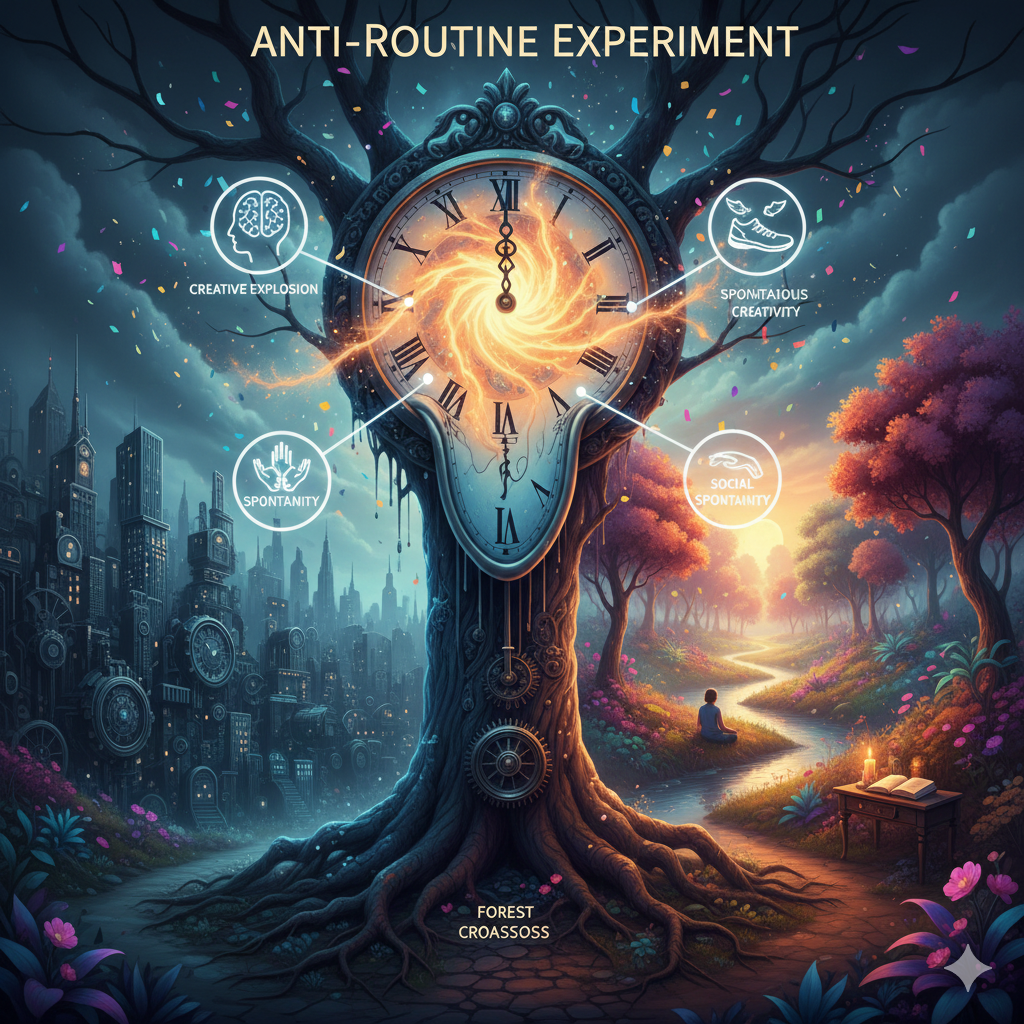
We are told from birth that “consistency is king.” From the rigid bell schedules of elementary school to the “5 AM Club” productivity gurus of YouTube, modern society is obsessed with the routine. We are coached to optimize every waking second, to time-block our creativity, and to “habit-stack” until our lives resemble a perfectly choreographed, yet soul-crushing, assembly line.
But what happens when the routine becomes a cage? What happens when the “perfect morning” starts to feel like a scripted performance?
For thirty days, I decided to find out. I conducted The Anti-Routine Experiment. I deleted my calendar, silenced my alarms, and committed to a life governed by intuition rather than intent. This is the 2,000-word chronicle of what I lost, what I found, and why a little bit of chaos might be the ultimate productivity hack.
I. The Philosophy of the Cage
Before we dive into the experiment, we have to look at why we love routines so much. Routines reduce “decision fatigue.” By deciding once that you will eat oatmeal at 8:00 AM, you save your brain from the energy cost of choosing breakfast every day.
However, there is a dark side. When life becomes a sequence of automated responses, we stop noticing. We drive to work on autopilot; we eat lunch while scrolling through emails; we “relax” by following a pre-set evening ritual. We are living, but we aren’t present. The Anti-Routine Experiment was designed to force presence through the sheer necessity of making choices.
II. The Rules of the Chaos
To ensure this wasn’t just a month of being “lazy,” I set strict “non-rules” for the 30-day experiment:
- No Alarms: I would wake up when my body was finished sleeping.
- No Time-Blocking: I would work on tasks based on “Energy Matching” (doing what I felt capable of in the moment) rather than a pre-set schedule.
- The “Yes, And” Rule: If an unexpected opportunity arose (a midday walk, a random phone call, a last-minute trip), I had to say yes, provided it didn’t violate a hard deadline.
- No Default Meals: No “meal prepping.” I had to ask myself, “What does my body actually need right now?” before every meal.
III. Week 1: The Withdrawal Phase
The first week was terrifying. Without the “railings” of my routine, I felt like I was floating in deep space.
The Wake-Up Crisis: On Tuesday, I woke up at 10:30 AM. My immediate internal reaction was shame. “You’ve wasted the morning! You’re behind!” But as the week progressed, a strange thing happened. Because I wasn’t forcing myself out of bed at 6:00 AM, the hours I was awake were twice as productive. I wasn’t fighting “brain fog” because I was actually rested.
Decision Fatigue is Real: I underestimated how much energy it takes to decide everything in real-time. By Thursday, I was exhausted just trying to figure out when to shower. This is the “friction” that routines are supposed to eliminate. But within that friction, I started noticing things—like how the light hits my kitchen at 11:00 AM, a sight I usually missed because I was always at my desk by 9:01 AM.
IV. Week 2: The Creative Explosion
By the second week, the “shame” of not being on a schedule began to evaporate, replaced by a surge of spontaneous creativity.
In a standard routine, I would “schedule” my writing for 2:00 PM. Usually, I’d sit there staring at a blank cursor because the clock told me to be creative, but my spirit wasn’t ready.
During the experiment, I found myself waking up at 2:00 AM with a feverish idea and writing for four hours straight. Because I didn’t have a 9:00 AM meeting to fear, I followed the muse. I produced more high-quality work in Week 2 than I had in the previous two months combined. I learned that creativity is a guest that doesn’t follow a calendar.
V. Week 3: Social Spontaneity and the “Random” Life
Routine is the enemy of social adventure. How many times have you turned down a coffee invite because “that’s my gym time”?
In Week 3, I leaned into the “Yes, And” rule.
- I took a two-hour lunch with an old friend on a Wednesday.
- I drove to the coast at 3:00 PM because the sky looked interesting.
- I started conversations with strangers in grocery stores because I wasn’t rushing to my next “time block.”
These “distractions” didn’t ruin my life. Instead, they provided the “input” my brain needed. We think we are saving time by being efficient, but we are often just starving our brains of the novelty they need to function.
VI. Week 4: The Integration
As the experiment closed, I looked at my data.
- Health: My resting heart rate dropped by 5 beats per minute.
- Output: I finished a project that had been “in progress” for six months.
- Happiness: I felt a sense of agency I hadn’t felt in years.
I realized that I didn’t hate routines; I hated enforced monotony. The Anti-Routine Experiment taught me that the goal shouldn’t be a “perfect schedule,” but a flexible framework.
VII. How to Run Your Own “Mini” Anti-Routine Experiment
You don’t have to quit your job to benefit from this. Try these “Micro-Chaos” tactics:
- The Reverse Commute: Take a completely different route to work tomorrow.
- The “Intuitive Lunch”: Don’t eat what you prepped. Go find the one thing you are truly craving.
- The Unscheduled Saturday: Delete all plans for one day. Do only what the “Next Version of You” wants to do in the moment.
VIII. Conclusion: The Managed Chaos
The Anti-Routine Experiment taught me that structure should support life, not replace it. We use routines to feel safe, but safety is often just a synonym for stagnation. By occasionally smashing the clock, we force ourselves to look at the world with fresh eyes.
I’ve gone back to having a calendar, but it looks different now. There are vast “White Spaces” labeled Do Whatever. I still have an alarm, but I don’t feel guilty if I hit snooze to finish a dream.
Life isn’t a problem to be solved with a spreadsheet. It’s an experience to be felt. Sometimes, the best thing you can do for your productivity—and your soul—is to get lost on purpose.
- anti-routine experiment
- how to break a routine
- benefits of spontaneity
- productivity hacks 2026
- decision fatigue solutions
- intuitive living guide
- why routines fail
- creative flow state
- time management vs energy management
- habit breaking for success