
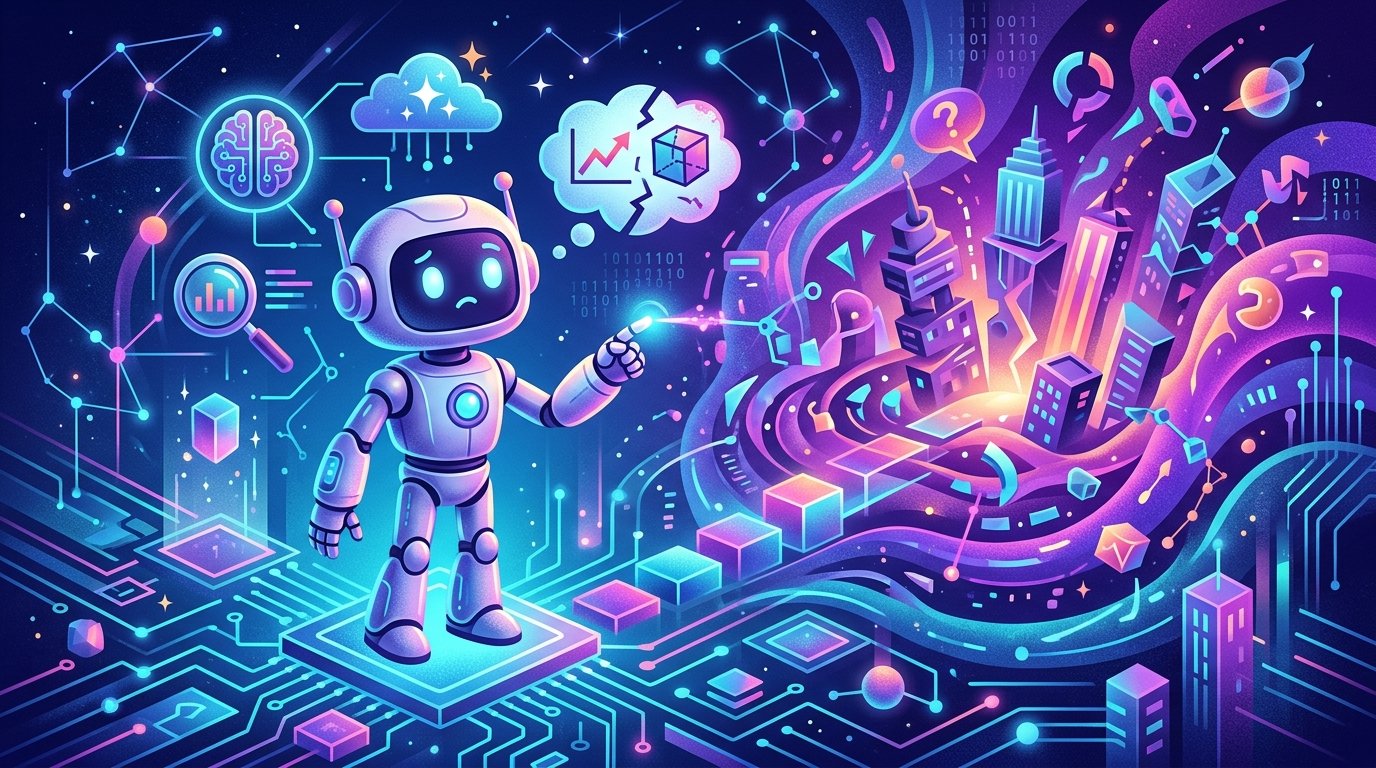
You ask an AI chatbot a simple question and it answers with total confidence — except the answer is completely wrong. It might cite a book that doesn’t exist, invent a historical date, or describe a law that was never passed. Welcome to the strange and surprisingly common world of AI hallucinations. Don’t worry — the AI isn’t having a psychedelic experience. But understanding why this happens, and what you can do about it, will make you a much smarter user of these powerful tools.
What Exactly Is an AI Hallucination?
In everyday language, a hallucination is seeing or believing something that isn’t real. For AI, the term means something similar: it’s when an AI system generates information that sounds plausible but is factually incorrect or completely made up.
AI chatbots like the popular large language models you may already use are built on something called a neural network — a system loosely inspired by the human brain. These models are trained on enormous amounts of text from the internet, books, and other sources. They learn patterns in language: which words tend to follow other words, how sentences are structured, and how ideas connect.
The catch? These models don’t actually “know” facts the way you know your own phone number. They’re predicting the most statistically likely next word or sentence based on patterns. Most of the time, that produces accurate and helpful results. But sometimes the pattern-matching goes wrong, and the AI confidently produces something that sounds right but simply isn’t true. That’s a hallucination.
Why Does This Happen?
There are a few key reasons why AI models hallucinate, and none of them are a sign that the technology is broken — they’re more like design limitations that engineers are actively working to reduce.
- Training data gaps: If the AI wasn’t trained on reliable information about a specific topic, it may “fill in the blanks” rather than admit it doesn’t know.
- No built-in fact-checker: The model generates text fluidly, without stopping to verify claims against a database of confirmed facts.
- Overconfidence by design: AI models are often optimised to give clear, helpful-sounding answers. This can make them sound certain even when they shouldn’t be.
- Ambiguous questions: When a question is vague or touches on niche subjects, the model is more likely to guess — and guess wrong.
- Rare or recent topics: Events that happened after the model’s training cut-off date, or topics that appeared rarely in training data, are high-risk zones for hallucinations.
Real-World Examples That Might Surprise You
Hallucinations aren’t just a theoretical problem. They show up in practical, everyday situations:
- Fake citations: Ask an AI to recommend academic papers or books on a topic, and it may invent titles, authors, and publication details that sound entirely real.
- Incorrect legal or medical information: An AI might describe a medication dosage or legal regulation with complete authority — and get it dangerously wrong.
- Made-up biographies: Ask about a minor public figure and the AI might blend real details with invented ones, creating a convincing but inaccurate profile.
- Coding errors: Developers who use AI to help write code sometimes find that the AI recommends software libraries or functions that don’t actually exist.
In each case, the AI didn’t “decide” to lie. It simply produced the most pattern-consistent response it could — and that response happened to be wrong.
How to Protect Yourself From AI Hallucinations
The good news is that you don’t have to stop using AI tools — you just need to use them more thoughtfully. Here are some practical habits to adopt:
- Treat AI as a starting point, not a final answer. Use it to brainstorm ideas, draft content, or summarise information, then verify the important details yourself.
- Always double-check high-stakes information. Anything related to health, law, finance, or safety should be confirmed with a qualified professional or authoritative source.
- Ask the AI to cite its sources. While the sources themselves may need verification, asking for them can reveal when the AI is uncertain — especially if it starts producing vague or unverifiable references.
- Be specific in your prompts. The more precise your question, the better the AI can draw on relevant training data rather than guessing.
- Watch for overconfident language. Phrases like “absolutely,” “it is well established that,” or “the definitive answer is” from an AI should prompt you to verify — not relax.
Are AI Companies Fixing This Problem?
Yes — and significant progress is being made, though hallucinations haven’t been fully solved yet. Developers are using several approaches to reduce how often they occur:
- Retrieval-Augmented Generation (RAG): This technique connects the AI to live, verified databases so it can look up real information rather than rely purely on patterns learned during training.
- Reinforcement learning from human feedback: Humans review AI outputs and flag inaccuracies, training the model to do better over time.
- Uncertainty signalling: Some newer AI systems are being designed to say “I’m not sure” more often, rather than guessing confidently.
These improvements are meaningful, but they don’t mean you should let your guard down. Even the most advanced AI systems still hallucinate occasionally, particularly on niche or very recent topics.
The Bottom Line
AI hallucinations are a real limitation of current technology — not a glitch, not a quirk, but a fundamental challenge rooted in how these systems learn and generate language. The more you understand this, the better equipped you are to use AI as the powerful assistant it is, rather than treating it as an infallible oracle. Stay curious, stay sceptical, and always verify what matters most. That’s not a reason to fear AI — it’s just smart digital literacy for the modern world.
Discover More from Didier Lancelot
Amazon Author page: amazon.com/author/didierlancelot
Narmer Store: narmerstore.org
AI and Technology Ebooks
- Creative AI: Animated Drawings, Manga & Illustrations
- Build a Game with AI: The No-Code Guide
- AI Image Generation Made Easy
- Build a Website with AI: The No-Code Guide
- How to Connect AI to Your Blog: The Ultimate Automation Guide
- AI Productivity Habits: Get More Done in Less Time
- AI Avatars Made Easy
- The Book of AI Prompts: 100+ Proven Prompts
- Make Music with AI: Suno, Udio and AI Music Generators
- Click to Cash
- The Automated Edge: Outwork, Outpace, and Outperform with AI
- AI Side Hustle: How to Make Money with ChatGPT and AI Tools
- Work Smarter with AI
Health, Lifestyle and Home Ebooks
- Hidden Superfoods: The World’s Most Powerful Healing Foods
- Spanish Food: The Complete Cookbook for Authentic Home Cooking
- The Science of Happiness Explained
- The Psychology of Success
- The Secret Sauce of Consistency: What the Experts Don’t Tell You About Fitness
- The Complete Home Bartender’s Guide: Link 1 | Link 2
- Natural Beauty, Made Simple: Easy DIY Organic Skincare Recipes
- Garden Made Simple: Easy, Beginner-Friendly Techniques
- The Dog Training Bible