
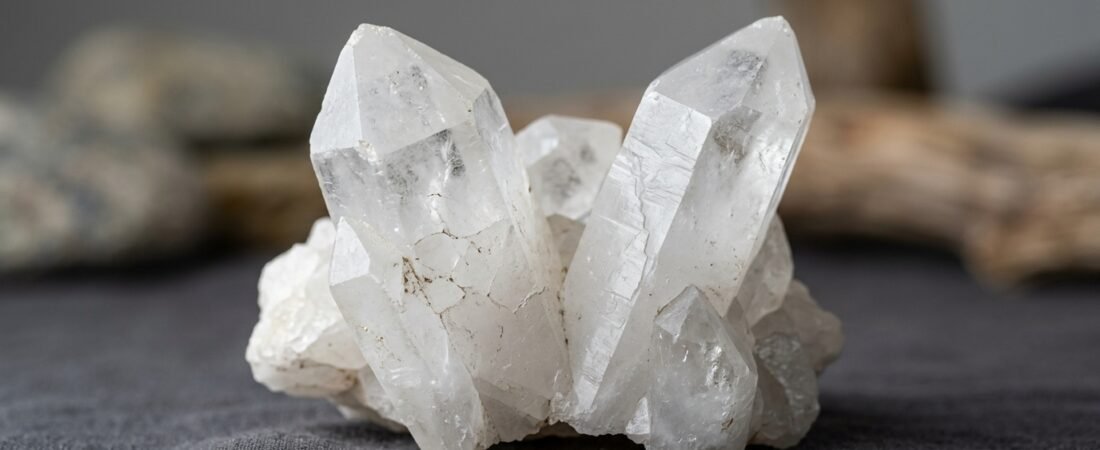
What Is Milky Quartz? Origins and Physical Characteristics
Milky Quartz is one of the most abundant and widely recognized varieties of quartz on Earth. With its soft, opaque white appearance and gentle luminosity, it has captivated human civilizations for thousands of years — appearing in ancient tools, ceremonial objects, and decorative carvings long before modern crystal culture brought it into mainstream wellness practices. Today, it remains a beloved stone for collectors, healers, and spiritual practitioners alike.
At its core, Milky Quartz shares the same fundamental composition as all quartz varieties: silicon dioxide (SiO₂). What sets it apart is not its chemistry but its visual character — a creamy, cloud-like opacity that distinguishes it immediately from its transparent counterparts. Understanding what gives this stone its distinctive look, and where it comes from, provides a meaningful foundation for appreciating everything it has to offer.
How Milky Quartz Gets Its Distinctive White Color
The characteristic white color of Milky Quartz results from the presence of microscopic fluid inclusions — tiny bubbles of gas, water, or both — trapped within the crystal lattice during its formation. As light enters the stone, these countless microscopic voids scatter it in multiple directions rather than allowing it to pass through cleanly. The result is that soft, diffused opacity that ranges from a barely-there translucency to a dense, porcelain-like white.
This process, known as light scattering or the Tyndall effect, is entirely natural and occurs when quartz crystals grow in environments where fluid circulation is abundant. The more inclusions present, the more opaque and milky the stone appears. In some specimens, the opacity is so complete that no light passes through at all, while others retain a faint glow at the edges when held to a strong light source.
It is worth noting that no two pieces of Milky Quartz are identical. The density and distribution of these fluid inclusions vary from crystal to crystal, which means each specimen has a subtly unique appearance — a characteristic that many collectors find deeply appealing.
Where Is Milky Quartz Found Around the World?
Because silicon dioxide is one of the most common minerals in the Earth’s crust, Milky Quartz is found on virtually every continent. Nevertheless, certain regions are particularly renowned for producing exceptional specimens.
Brazil remains one of the world’s foremost sources, yielding large, well-formed crystals in great abundance. The country’s rich geological diversity supports quartz formation across numerous states, and Brazilian Milky Quartz is widely available in both raw and polished forms. Madagascar is another prolific source, producing stones with a particularly bright, clean white that appeals to both collectors and lapidaries.
In Europe, the Alps have long been associated with quartz in all its forms, including the milky variety. Scotland and parts of Ireland also feature notable deposits, where the stone holds significant historical and cultural importance. In the United States, deposits are found across the Appalachian Mountains, the Rocky Mountain region, and parts of Arkansas — a state long celebrated for its exceptional quartz output.
Additional sources include parts of India, China, South Africa, and several nations across Southeast Asia. This global distribution contributes to the stone’s accessibility and relatively modest price point compared to rarer gem-quality minerals.
Milky Quartz Healing Properties and Metaphysical Meaning
Within the world of crystal healing and metaphysical tradition, Milky Quartz carries a meaning deeply connected to purity, calm, and inner stillness. Often described as the “stone of serenity,” it is believed by many practitioners to embody a gentle, nurturing energy that soothes the mind, quiets mental noise, and creates space for deeper self-awareness. While these beliefs are rooted in tradition rather than scientific evidence, they resonate strongly with those drawn to crystal work and holistic wellness practices.
The Milky Quartz metaphysical properties are often considered a softer, more introspective expression of quartz energy in general. Where clear quartz is associated with amplification and clarity, Milky Quartz is thought to turn that energy inward — encouraging reflection, patience, and a sense of profound inner peace.
Emotional and Spiritual Benefits of Milky Quartz
From an emotional standpoint, Milky Quartz is traditionally regarded as a stone of comfort and calm. Many who work with it describe a feeling of being held or supported — as though the stone gently absorbs tension and replaces it with a sense of reassurance. This quality makes it particularly valued during periods of stress, transition, or emotional uncertainty.
Spiritually, the stone is associated with accessing a deeper state of inner quiet — the kind that allows for genuine self-reflection and clarity of purpose. Some traditions hold that Milky Quartz helps dissolve mental clutter, making it easier to distinguish between genuine intuition and surface-level noise. This is one reason it is often recommended for those beginning a meditation practice or exploring inner work for the first time.
The stone is also linked to themes of forgiveness and release. Practitioners who work with it often speak of its capacity to help let go of old patterns, emotional residue, and self-imposed limitations. Rather than forcing transformation, Milky Quartz is believed to support it gently — offering a kind of energetic softening that makes change feel less threatening.
For those interested in exploring how quartz varieties interact with emotional and spiritual well-being, Rutilated Quartz offers a fascinating contrast, with its more dynamic, action-oriented energy tradition.
Milky Quartz Chakra Connections and Energy Work
In chakra-based systems, Milky Quartz is most commonly associated with the Crown Chakra, located at the top of the head. This energy center is traditionally linked to higher consciousness, spiritual connection, and the experience of unity beyond the individual self. When the Crown Chakra is balanced, practitioners often describe feelings of clarity, openness, and a sense of being aligned with something greater than oneself.
Milky Quartz is believed by many to support this alignment by gently clearing away energetic congestion at the Crown, allowing for a more unobstructed flow of spiritual insight. Its soft, white light is seen as symbolically resonant with the pure, expansive quality associated with crown-level awareness.
Some practitioners also work with Milky Quartz in relation to the Third Eye Chakra, particularly when the intention is to cultivate inner vision and quiet the analytical mind. Placed on the forehead during meditation, it is thought to encourage a receptive state — one in which insights arise naturally rather than being intellectually forced.
In energy work more broadly, Milky Quartz is often used as a grounding companion for more intense or high-vibration stones. Its calming influence is believed to help integrate energetic shifts smoothly, making it a practical addition to any crystal grid or healing layout.
How to Use Milky Quartz for Everyday Wellness and Meditation
One of the most appealing aspects of Milky Quartz is its versatility. Whether you are an experienced practitioner or simply someone who appreciates the beauty and symbolism of natural stones, there are numerous accessible ways to incorporate it into your life. The Milky Quartz crystal benefits extend from the meditative and ceremonial to the decidedly practical.
Best Ways to Incorporate Milky Quartz Into Your Daily Routine
Carrying a small tumbled piece of Milky Quartz in a pocket or bag is perhaps the simplest way to stay connected to its energy throughout the day. Many people find that having the stone within reach serves as a tactile reminder to pause, breathe, and return to a calmer internal state — particularly during demanding or stressful situations.
Placing Milky Quartz in your living or working environment is another effective approach. Positioned on a desk, windowsill, or bedside table, it is believed to contribute a softening, quieting quality to the surrounding space. Bedrooms in particular are considered an ideal setting, as the stone’s association with rest, peace, and subconscious processing aligns naturally with sleep and dream work.
For meditation, holding a piece of Milky Quartz in each hand or placing a larger specimen in front of you can help anchor the session. Many practitioners find that its presence encourages a more effortless entry into a meditative state, reducing the mental restlessness that often makes sitting still feel difficult.
Milky Quartz also works well within crystal grids. It is commonly used as a central stone in grids designed for peace, healing, or clarity — or as a supporting stone alongside more directional minerals. Its gentle energy is considered harmonious with a wide range of other crystals, making it a reliable and adaptable choice.
Worn as jewelry, Milky Quartz takes on an additional dimension. Rings, pendants, and bracelets cut from the stone allow for continuous energetic contact with the body, and its neutral, elegant appearance pairs well with both casual and formal contexts.
Cleansing and Charging Your Milky Quartz Crystal
Like all crystals used in energetic practices, Milky Quartz is traditionally cleansed and recharged on a regular basis to maintain its vitality. The methods most commonly recommended are gentle ones, in keeping with the stone’s serene character.
Moonlight cleansing is among the most popular approaches. Placing Milky Quartz on a windowsill or outdoors overnight during a full moon is believed to clear accumulated energies and restore the stone’s natural resonance. Given the stone’s lunar aesthetic — white, cool, and luminous — this method feels particularly fitting.
Smoke cleansing, using sacred herbs such as sage, cedar, or palo santo, is another widely used technique. Passing the stone through the smoke or allowing the smoke to drift over it is believed to dispel stagnant or unwanted energy without any risk of physical damage to the stone.
Sound cleansing, using singing bowls, tuning forks, or even gentle chanting, is a method favored by those who prefer not to use smoke or leave crystals unattended outside. The vibration of sound is thought to reset the stone’s energetic field quickly and effectively.
Water can also be used, though with some caution. While Milky Quartz is relatively hard (rating 7 on the Mohs scale) and generally tolerant of brief exposure to water, prolonged soaking is not recommended, as it can gradually affect the surface over time. Brief rinsing under cool, clean water followed by gentle drying is generally considered safe.
Recharging the stone after cleansing can be done by placing it in sunlight for a short period, though extended sun exposure may cause slight surface changes over time. Alternatively, placing it on a bed of selenite or within a circle of other high-vibration stones is a popular and gentle recharging method.
Milky Quartz vs. Other Quartz Varieties: Key Differences and Value
The quartz family is extraordinarily diverse, encompassing dozens of recognized varieties that differ in color, structure, inclusion type, and energetic tradition. Understanding how Milky Quartz relates to other members of this family helps clarify what makes it distinctive — and which variety might be best suited to your particular needs and intentions.
Milky Quartz vs. Clear Quartz vs. Rose Quartz: Which Is Right for You?
Milky Quartz and Clear Quartz share the same basic mineral composition but diverge significantly in appearance and traditional energy associations. Clear Quartz is transparent, formed in conditions where fewer fluid inclusions develop, and is widely considered the most versatile and powerful of all quartz varieties. It is traditionally associated with amplification, clarity, and the enhancement of other stones’ properties. Milky Quartz, by contrast, is softer and more introspective in its energetic reputation — less about magnifying external intentions and more about cultivating internal stillness. Those seeking a dynamic, active tool for manifestation or energy work often favor clear quartz, while those drawn to quiet, reflective practices may find Milky Quartz more resonant.
Rose Quartz introduces a third distinct character. Its gentle pink color comes from trace amounts of titanium, iron, or manganese, and it is one of the most beloved stones in emotional healing traditions — associated above all with love, compassion, and heart-centered work. Where Milky Quartz tends toward the mental and spiritual, Rose Quartz is oriented toward the emotional and relational. Both carry a nurturing quality, but they direct it differently: Milky Quartz inward, Rose Quartz outward toward relationships and connection.
Choosing between these three ultimately depends on your intentions. Clear Quartz suits those who want versatility and amplification. Rose Quartz is ideal for emotional healing and matters of the heart. Milky Quartz is well-suited for inner peace, meditation, and spiritual reflection.
If you are exploring the broader quartz family, it is also worth considering stones like Tourmalinated Quartz, which combines quartz’s clarifying energy with the grounding properties of black tourmaline for a very different kind of energetic experience.
How to Identify Real Milky Quartz and Determine Its Worth
Authentic Milky Quartz is not particularly difficult to identify, but it is important to know what to look for — especially as imitations and misrepresented stones do appear in the market.
Genuine Milky Quartz will feel cool to the touch initially, warming only slowly with body heat — a characteristic shared across the quartz family that helps distinguish natural stone from glass imitations, which warm much more quickly. The stone should also feel noticeably heavy for its size, reflecting its true mineral density. Glass fakes and plastic imitations will feel lighter and less substantial.
Visually, real Milky Quartz often shows natural imperfections: slight variations in opacity, visible internal cloudiness or veiling, and an organic irregularity to its form if purchased in raw or rough condition. Perfectly uniform white stones with no internal variation may warrant closer inspection, as such consistency can indicate synthetic or glass origin.
Hardness is another reliable indicator. At 7 on the Mohs scale, genuine quartz will scratch glass easily without itself being scratched. This simple test, performed carefully, can help confirm authenticity when other means are unavailable.
In terms of the Milky Quartz value, this variety is generally considered affordable compared to rarer gem-quality minerals. Small tumbled pieces typically retail for just a few dollars, while large, high-quality raw specimens or those with exceptional clarity and form can command higher prices. Polished spheres, particularly well-crafted carvings, and specimens with unusual size or formation also carry a premium. Milky Quartz is not typically considered a gemstone investment, but its wide availability makes it an excellent choice for those building a crystal collection without significant financial outlay.
It is also worth noting that Milky Quartz should not be confused with white calcite, white selenite, or howlite — all of which can appear superficially similar but differ significantly in hardness, density, and crystalline structure. When purchasing from a reputable dealer, these distinctions are typically made clear.
Conclusion
Milky Quartz is a stone of quiet depth. Its abundant presence in the natural world belies a richness of meaning and application that rewards genuine exploration. From its fascinating geological origins to the centuries-old traditions of healing and spiritual practice that surround it, this understated mineral offers far more than its modest price tag might suggest.
Whether you are drawn to it for its visual beauty, its traditional associations with calm and clarity, or simply its accessibility as an entry point into the world of crystals, Milky Quartz has something to offer. Its gentle energy is believed to support reflection, emotional ease, and spiritual openness — making it a fitting companion for meditation, daily mindfulness, or any practice oriented toward inner stillness.
For those wishing to explore the wider quartz family and its many expressions, resources on related varieties such as Rutilated Quartz and Tourmalinated Quartz offer valuable perspectives on how this remarkable mineral group continues to inspire and support people around the world.
About the Author
Didier Lancelot is an independent author and creator of the Everyday AI Series, with books on wellbeing, natural living, cooking and practical technology. Explore all his books on his Amazon Author page or visit Narmer Store.