
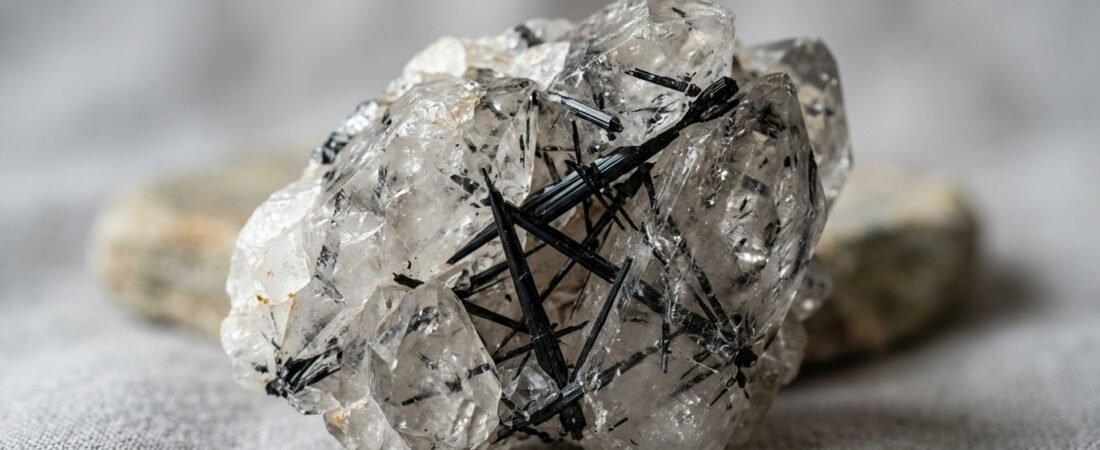
Few crystals capture attention quite like tourmalinated quartz. Its striking appearance — clear or smoky quartz threaded with needle-like inclusions of black tourmaline — makes it one of the most visually arresting stones in the mineral world. But its appeal runs far deeper than aesthetics. For centuries, crystal enthusiasts, healers, and collectors have prized this stone for its layered symbolism, its reputed protective qualities, and the unique energetic combination it represents. Whether you are new to crystals or a seasoned practitioner, this guide offers everything you need to know about this exceptional stone: its origins, metaphysical traditions, practical uses, and how to choose and care for a genuine specimen.
What Is Tourmalinated Quartz and Why Is It So Special?
Tourmalinated quartz is a naturally occurring mineral composite in which black tourmaline crystals grow within a quartz matrix. The result is a stone that embodies two distinct mineral species in a single formation. This duality is precisely what makes it so compelling — both geologically and symbolically. It is not a manufactured combination or a product of human enhancement; it is an entirely natural phenomenon, which adds to its rarity and value.
What distinguishes this stone from other inclusion crystals is the visual drama of the contrast: the transparent or translucent clarity of quartz, interrupted by dark, thread-like or rod-shaped tourmaline needles. The effect can resemble ink strokes through glass, lightning frozen in time, or an intricate network of veins. Each specimen is entirely unique, which means no two pieces are ever identical.
The Geological Formation and Physical Characteristics of Tourmalinated Quartz
The formation of tourmalinated quartz is a fascinating geological process. It occurs when black tourmaline — specifically the iron-rich variety known as schorl — begins crystallizing within a silica-rich environment before quartz solidifies around it. This process typically takes place in pegmatite rock formations, where slow cooling allows minerals to develop large, well-formed crystals over millions of years. As the quartz grows, it encapsulates the tourmaline needles, locking them permanently inside its structure.
The resulting stone exhibits a hardness of 7 on the Mohs scale, consistent with standard quartz, making it durable enough for everyday use in jewelry and handling. The tourmaline inclusions, which rate between 7 and 7.5 on the Mohs scale, are equally resistant. In terms of color, the quartz host can range from water-clear transparency to a soft gray or smoky hue, while the tourmaline inclusions appear as deep black or very dark green-black rods. The inclusions may be sparse and delicate or dense and overlapping, forming complex geometric patterns within the stone.
Major deposits are found in Brazil, which produces the majority of gem-quality specimens, as well as in Madagascar, the United States, Australia, and parts of Africa. Brazilian material is generally considered the most abundant and accessible on the international market.
How to Identify Authentic Tourmalinated Quartz vs. Imitations
Because tourmalinated quartz has grown in popularity, the market occasionally features imitations or misrepresented specimens. Learning to identify the genuine article protects your investment and ensures you are working with the real stone.
Authentic tourmalinated quartz has inclusions that appear three-dimensional within the stone. When you rotate the crystal, the needles shift in appearance based on the angle of light, and they often extend across the depth of the specimen rather than sitting flush with the surface. Natural inclusions are irregular in direction, varying in thickness and length, and they may cross each other at unpredictable angles.
Be cautious of the following signs of inauthenticity:
- Inclusions that appear flat or painted onto the surface rather than embedded within the stone
- Perfectly parallel or unnaturally uniform needle arrangements
- A glass-like feel with no natural texture or slight imperfections on the surface
- An unusually low price for a large, clear specimen with dense inclusions
- Sellers who cannot provide origin information or who market the stone under vague descriptions
When in doubt, consult a reputable gemologist or purchase from established dealers with transparent sourcing practices. Genuine specimens will often have minor surface irregularities, natural striations on the quartz, and inclusions that are visibly anchored within the stone’s interior.
Tourmalinated Quartz Meaning and Healing Properties
The significance attributed to tourmalinated quartz draws from multiple cultural and metaphysical traditions. Its dual nature — combining the light-amplifying quality of quartz with the grounding, protective reputation of black tourmaline — is believed by many practitioners to create a uniquely balanced energetic profile. Understanding both dimensions of this stone deepens appreciation for why it has remained so consistently sought-after.
Spiritual and Metaphysical Meaning of Tourmalinated Quartz
In metaphysical traditions, tourmalinated quartz is often described as a stone of integration and harmony. The clear quartz component is widely regarded as an amplifier of energy and intention, a conduit for clarity and higher awareness. Black tourmaline, by contrast, carries a longstanding reputation as one of the most powerful protective stones in the crystal world, believed to deflect negative energies and create an energetic boundary around its holder.
Together, these two minerals are thought to form a complementary system — one that simultaneously elevates spiritual awareness and keeps the practitioner grounded. This combination is particularly valued in traditions that emphasize the importance of maintaining a connection between higher consciousness and physical reality. The stone is sometimes called a “bridge builder,” believed to help individuals integrate spiritual insights into everyday life without losing their grounding.
From a chakra perspective, many practitioners associate tourmalinated quartz with both the root chakra, due to the black tourmaline element, and the crown or higher chakras, owing to the clear quartz. This multi-chakra resonance is thought to support energetic alignment throughout the entire body, rather than concentrating on a single center.
In protective traditions, the stone is considered especially effective against what practitioners describe as electromagnetic smog, psychic interference, and energetic imbalances caused by environmental stressors. It is often placed near electronic devices or carried during situations perceived as energetically draining. This protective dimension aligns closely with the broader meaning of rutilated quartz, another inclusion crystal celebrated for its energetic amplification properties, though the two stones carry distinct metaphysical signatures.
Emotional and Physical Healing Benefits of Tourmalinated Quartz
Within the crystal healing community, tourmalinated quartz is believed to offer a wide range of emotional and physical benefits, though it is essential to approach these as traditional beliefs rather than medically verified claims. No crystal should be used as a substitute for professional medical or psychological care.
On an emotional level, practitioners often work with this stone to address patterns of self-sabotage, anxiety, and negative thinking. The black tourmaline inclusions are thought to act as a kind of internal filter, helping to transform destructive thought patterns into more constructive ones. The quartz amplifies this process, intensifying the intention behind any healing work. Many individuals report feeling a greater sense of inner calm and mental clarity when working consistently with this stone.
The stone is also associated in some traditions with the relief of tension — both psychological and physical. Crystal healers sometimes place it along the spine or at the base of the skull during sessions, drawing on its reputed ability to harmonize the nervous system. Others use it during periods of major life transition, believing it supports adaptability and resilience. These are longstanding practices within the crystal healing tradition and carry deep meaning for those who engage with them, even as they remain outside the scope of conventional medicine.
For those who work with energy medicine frameworks, tourmalinated quartz is considered particularly useful for clearing blockages within the auric field and restoring energetic flow throughout the subtle body.
How to Use Tourmalinated Quartz in Your Daily Life
The versatility of tourmalinated quartz makes it accessible for a wide range of applications. Whether you prefer to wear crystals, use them in spiritual practice, or simply keep them as decorative objects in your living space, this stone adapts readily to different approaches. The key is consistency and intentionality in how you engage with it.
Wearing Tourmalinated Quartz Jewelry for Protection and Balance
Wearing tourmalinated quartz in jewelry form is one of the most popular and practical ways to benefit from its reputed properties throughout the day. Because the stone maintains direct contact with the skin, many practitioners believe that its energetic influence remains continuous, offering ongoing support rather than the intermittent benefit of occasional use.
Tourmalinated quartz jewelry appears in a wide variety of forms — pendants, rings, bracelets, and earrings — and suits both casual and formal styling due to its neutral, monochromatic palette. The black and clear tones make it a versatile choice that pairs well with most outfits.
When choosing a piece for its protective or grounding qualities, consider the following guidelines:
- Pendants worn near the heart or throat are thought to support emotional balance and communication
- Bracelets on the left wrist are traditionally associated with receiving energy, while the right wrist relates to projecting or directing it
- Rings on the dominant hand are favored by those who want to reinforce intentional action and focused will
- Earrings are sometimes chosen for their proximity to the mind and higher thought centers
Beyond metaphysical considerations, tourmalinated quartz jewelry is simply beautiful. The visual contrast within the stone creates a piece that reads as both refined and organic, appealing to those with an appreciation for natural materials.
Incorporating Tourmalinated Quartz Into Meditation and Crystal Healing Practices
For those engaged in meditation or formal crystal healing work, tourmalinated quartz offers a rich foundation for practice. Its dual nature makes it particularly well-suited to sessions focused on clearing, protection, or integration — themes that recur frequently in both personal and facilitated healing work.
During meditation, many practitioners hold a piece of tourmalinated quartz in both hands or place it on the body at a specific point of focus. Holding it during breathwork or visualization exercises is believed to deepen concentration and support the release of mental clutter. Some practitioners prefer to place a larger specimen at the base of their meditation space to establish a protective energetic perimeter before beginning their session.
In crystal grids — geometric arrangements of stones designed to amplify a shared intention — tourmalinated quartz often serves as a powerful anchor or corner stone. Its amplifying quartz nature helps radiate the grid’s intention outward, while the tourmaline component is thought to keep the energy grounded and stable.
For body layouts, a common approach involves placing the stone at the base of the spine to activate and stabilize the root chakra, then using complementary stones along the other chakra points to build an integrated session. Practitioners familiar with rutilated quartz properties and uses will recognize similarities in how both stones are used to facilitate energetic movement, though tourmalinated quartz places a stronger emphasis on protection and grounding.
How to Care for and Choose the Best Tourmalinated Quartz
Like any crystal, tourmalinated quartz benefits from thoughtful care and maintenance. Keeping your stone clean, energetically clear, and properly charged ensures that it remains in optimal condition — both as a physical object and, for those who work with its metaphysical properties, as a functional tool in their practice.
Cleansing and Charging Tourmalinated Quartz the Right Way
Cleansing tourmalinated quartz is an important step for anyone who believes in the energetic properties of crystals, particularly given its reputed role as a protector and negativity transformer. Regular cleansing is thought to clear accumulated energies and reset the stone.
Several methods are widely used and considered safe for this stone:
- Running water: Hold the stone under cool running water for 30 to 60 seconds while setting a clear intention to release any accumulated energy. Because quartz rates a 7 on the Mohs scale, it can withstand brief water exposure, though avoid prolonged soaking.
- Smoke cleansing: Pass the stone through the smoke of sacred herbs such as dried sage, palo santo, or cedar. This is a widely practiced tradition in many cultures and is considered gentle and effective.
- Sound cleansing: Place the stone near a singing bowl, tuning fork, or bell and allow the vibrations to wash over it. This method is particularly well-suited for those who prefer not to use water or smoke.
- Moonlight: Leave the stone under the light of a full moon overnight. This approach is traditional in many crystal practices and is thought to deeply restore the stone’s energetic field.
Avoid leaving tourmalinated quartz in direct sunlight for extended periods, as prolonged UV exposure can gradually fade the clarity of the quartz component. Similarly, avoid harsh chemical cleaners, ultrasonic cleaners, or steam cleaning, which can damage both the surface of the stone and the integrity of the inclusions.
Charging the stone after cleansing involves placing it in an environment that reinforces its natural qualities. Resting it on a selenite plate, burying it briefly in natural earth, or placing it alongside clear quartz clusters are common methods used to restore and amplify its energy.
Tips for Buying High-Quality Tourmalinated Quartz Crystals
The market for tourmalinated quartz spans a wide range of quality levels and price points. Knowing what to look for helps you make a purchase that aligns with your intentions — whether you are seeking a display piece, a wearable stone, or a tool for meditation practice.
First, prioritize transparency in sourcing. Reputable sellers will know the country of origin for their specimens and will be willing to discuss how the stone was sourced. Ethically mined crystals are increasingly important to buyers, and a trustworthy dealer will address this without hesitation.
Consider the density and distribution of inclusions. Some collectors prefer sparse, delicate needles that allow maximum clarity in the quartz, while others favor densely patterned specimens with dramatic visual impact. Neither is inherently superior — the choice depends on personal preference and intended use.
Evaluate the overall clarity of the quartz host. Specimens with high clarity allow the inclusions to stand out in greater relief, enhancing both the visual appeal and, according to metaphysical tradition, the amplifying capacity of the stone. Cloudy or heavily fractured quartz may indicate lower quality material or improper handling during extraction.
For jewelry, ensure that the setting complements and protects the stone. Well-made tourmalinated quartz jewelry will use settings that secure the stone without obscuring too much of its surface, allowing the inclusions to remain visible. Sterling silver and gold settings are common choices that complement the stone’s natural color contrast.
Finally, trust your instincts. Many crystal practitioners describe a felt sense of connection when handling a stone that is right for them — a subtle resonance that goes beyond visual assessment. While this is not a scientifically measurable criterion, it remains a meaningful part of the selection process for those who approach crystal work from an intuitive perspective.
Conclusion
Tourmalinated quartz occupies a singular position in the world of crystals. It is simultaneously grounding and illuminating, protective and expansive — a stone whose geological rarity is matched by the richness of meaning it carries in metaphysical traditions. Whether you are drawn to it for its stunning visual qualities, its reputed healing properties, or its symbolic resonance as a stone of integration and balance, there is much to appreciate in this remarkable mineral.
Understanding its formation, recognizing authentic specimens, working with it intentionally in daily life, and caring for it properly will allow you to develop a lasting and meaningful relationship with this stone. As with all crystals, the experience is deeply personal — shaped by your own intentions, beliefs, and willingness to engage with the natural world in a thoughtful way. Tourmalinated quartz rewards that engagement generously.
About the Author
Didier Lancelot is an independent author and creator of the Everyday AI Series, with books on wellbeing, natural living, cooking and practical technology. Explore all his books on his Amazon Author page or visit Narmer Store.