
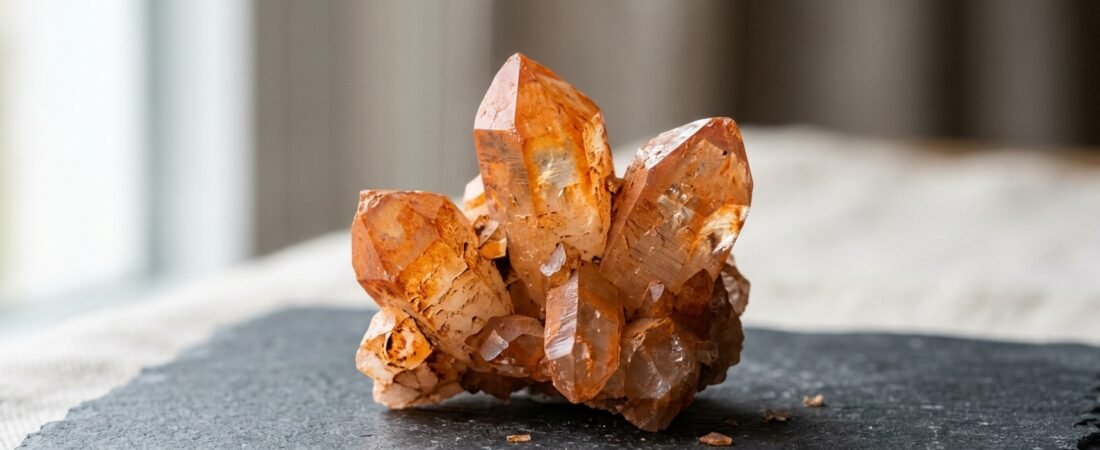
Few crystals capture the warmth of sunlight quite like Tangerine Quartz. With its vivid orange hue ranging from soft peach to deep burnt amber, this stone has drawn the attention of collectors, healers, and spiritual practitioners around the world. Beyond its striking appearance, Tangerine Quartz carries a rich history of symbolic meaning and is celebrated in crystal healing traditions for its energizing, emotionally restorative qualities. Whether you are new to working with crystals or deepening an established practice, understanding this stone from its geological roots to its metaphysical applications offers a rewarding starting point.
What Is Tangerine Quartz and Where Does It Come From?
The Geological Formation and Natural Origins of Tangerine Quartz
Tangerine Quartz is a variety of clear quartz (silicon dioxide) whose distinctive orange coloration results from a coating or inclusion of iron oxide, particularly hematite and goethite, on or just beneath the surface of the crystal. This iron-rich layer develops over long geological periods through contact with water and mineral-rich sediment. The process can occur either during the crystal’s original formation deep within the earth or afterward, as surface waters gradually deposit oxidized iron onto the existing quartz structure.
What makes Tangerine Quartz particularly fascinating from a geological standpoint is that its color is not an internal structural feature but rather an external coating — one that gives each specimen a uniquely textured, almost velvety surface. The intensity of the orange tone depends on the concentration and depth of the iron oxide layer, which is why specimens can vary so dramatically in shade from one piece to the next. Some crystals display a pale, dusty apricot, while others achieve a saturated, rust-like amber that borders on red.
In most cases, Tangerine Quartz forms in hydrothermal veins or in alluvial deposits where quartz crystals have been exposed to flowing, mineral-laden water over thousands or millions of years. The iron coating adheres naturally to the quartz surface through oxidation, creating a bond that — when authentic — is consistent and integrated rather than superficial or flaky.
Top Mining Locations and How to Identify Authentic Tangerine Quartz
The most celebrated and prolific source of Tangerine Quartz is the state of Minas Gerais in Brazil, a region long regarded as one of the world’s most important centers for quartz crystal mining. Brazilian specimens are particularly prized for their clarity and the vibrancy of their iron oxide coating. Madagascar is another significant source, producing crystals with a slightly different surface texture but equally intense coloration. Smaller deposits have also been identified in parts of Arkansas in the United States and in various regions of Africa.
Identifying authentic Tangerine Quartz requires attention to several key characteristics. Genuine specimens will have an orange coating that appears integrated into the crystal structure rather than uniformly painted on. Running a fingernail across the surface of a real stone may reveal a slightly rough or powdery texture in areas where the iron oxide is concentrated. The coating should not rub off cleanly or wash away with water under normal circumstances, though some superficial iron dust may loosen during handling.
Collectors should be cautious of artificially dyed quartz being sold as Tangerine Quartz. Dyed stones typically display an unnaturally even color, lack the subtle variation in hue that characterizes iron oxide coatings, and may bleed color when submerged in water. Purchasing from reputable dealers who provide provenance information is always advisable. When in doubt, consulting a gemologist or comparing the specimen against known authentic pieces can provide valuable reassurance.
Tangerine Quartz Meaning and Spiritual Significance
Emotional and Chakra Healing Properties of Tangerine Quartz
Within crystal healing traditions, Tangerine Quartz is most commonly associated with the Sacral Chakra, known in Sanskrit as Svadhisthana, which governs creativity, sensuality, emotional expression, and the flow of life-force energy. Practitioners believe that placing this stone on or near the lower abdomen during meditation or energy work can help dissolve energetic blockages in this center, encouraging a freer, more authentic expression of emotion and desire.
Beyond its Sacral Chakra associations, Tangerine Quartz is also believed to carry a gentle but persistent connection to the Solar Plexus Chakra, supporting personal empowerment, self-confidence, and a renewed sense of purpose. The interplay between these two energy centers is thought to make this crystal particularly effective for individuals working through creative stagnation, self-doubt, or emotional stagnation following difficult life experiences.
In healing lore, Tangerine Quartz is described as a crystal of emotional restoration. Many practitioners regard it as especially supportive for those recovering from trauma, grief, or long-standing patterns of self-criticism. It is believed to encourage the gentle release of old wounds without overwhelming the emotional body, making it a favored choice for shadow work and inner child healing practices. Its warm, solar energy is thought to replace heaviness with curiosity and openness — an invitation to rediscover joy and creative possibility.
This energetic warmth also positions Tangerine Quartz as a stone associated with motivation and enthusiasm. Those who feel creatively blocked or emotionally flat may find that working with this crystal, according to tradition, stimulates a renewed appetite for life. It is seen as a catalyst for inspiration, particularly for artists, writers, and anyone engaged in expressive or imaginative work.
Symbolism and Energy Vibrations Associated With Tangerine Quartz
The symbolism of Tangerine Quartz is deeply intertwined with its color. Orange has long been associated across cultures with vitality, warmth, celebration, and the transition between the earthly and the spiritual. In many ancient traditions, orange carried connotations of harvest, abundance, and the generative power of the sun. Tangerine Quartz, with its solar hue and crystalline clarity, embodies these associations in a form that feels both grounded and luminous.
From an energetic perspective, Tangerine Quartz is considered to carry a relatively high vibrational frequency, one that is simultaneously uplifting and stabilizing. Unlike some high-frequency crystals that practitioners find overstimulating, Tangerine Quartz is regarded as having a balanced, nurturing quality — energizing without being frenetic, clarifying without being harsh. This makes it a versatile stone suitable for daily use rather than reserved only for intensive ceremonial or therapeutic sessions.
The spiritual meaning of Tangerine Quartz is often framed around themes of renewal and authenticity. It is seen as a stone that encourages individuals to embrace their true nature, to move past fear and into creative expression, and to recognize the inherent value of their own experiences — including the difficult ones. Some traditions describe it as a bridge between the earthly self and the higher self, facilitating moments of clarity and insight without requiring the practitioner to transcend ordinary experience entirely.
For those drawn to working with Rutilated Quartz for its amplifying and energizing qualities, Tangerine Quartz offers a complementary warmth that focuses those energies more specifically toward emotional healing and creative renewal.
How to Use Tangerine Quartz for Healing and Daily Life
Meditation, Crystal Grids, and Mindfulness Practices With Tangerine Quartz
Incorporating Tangerine Quartz into a meditation practice is one of the most direct ways to explore its reputed benefits. A common approach is to hold a tumbled or raw specimen in both hands while seated in a comfortable position, allowing the warmth of the body to gradually warm the stone. Practitioners often focus their breath and intention on the Sacral Chakra area, visualizing the orange glow of the crystal expanding inward with each inhale, encouraging a sense of creative openness and emotional ease.
For those who prefer lying down during crystal work, placing a Tangerine Quartz stone directly on the lower abdomen — and optionally a second piece on the solar plexus — can deepen the experience. This configuration is believed by many practitioners to facilitate a more integrated release of emotional tension and to support the free movement of creative energy throughout the body. Sessions of fifteen to thirty minutes are commonly recommended, though there is no fixed rule.
Tangerine Quartz is also a popular choice for crystal grids, where multiple stones are arranged in geometric patterns to amplify or direct specific intentions. In a creativity or abundance grid, Tangerine Quartz is often placed as a center stone or as directional points, paired with complementary crystals such as Carnelian, Citrine, or Clear Quartz to enhance its warming, generative energy. The grid can be activated through focused intention, visualization, or the use of a crystal wand to trace the geometric pattern.
For everyday mindfulness, simply keeping a piece of Tangerine Quartz on a desk, altar, or creative workspace is considered sufficient to maintain a gentle connection to its energy. Some practitioners hold the stone briefly before beginning a creative project or difficult conversation, using it as a tactile anchor for intention-setting. This kind of informal, moment-to-moment engagement with a crystal is valued in many traditions as equally meaningful as formal meditative practice.
Wearing and Placing Tangerine Quartz for Maximum Benefit
Wearing Tangerine Quartz as jewelry allows for sustained, close contact with the stone throughout the day. Pendants worn near the heart or lower chest are particularly popular, as their placement keeps the crystal in proximity to both the heart and solar plexus areas. Rings and bracelets are also widely used, offering the additional benefit of constant tactile awareness of the stone. When selecting jewelry, it is worth ensuring that the setting does not fully encase the stone, as direct skin contact is considered beneficial in many crystal healing traditions.
Placement within the home or workspace is another practical way to work with Tangerine Quartz. Creative studios, home offices, and meditation rooms are considered ideal environments for this crystal. Placing it on a windowsill where it receives natural light is thought to keep its energy vibrant and accessible. Some practitioners choose to position it near the entrance of a room to encourage an atmosphere of warmth and openness as people enter the space.
Those who work with the principles of feng shui may find Tangerine Quartz well-suited to the south or southwest areas of a home or room, zones traditionally associated with recognition, creativity, and relationships. However, placing the stone wherever it feels most natural and intuitive is always a valid approach — particularly for those newer to working with crystals.
If you are exploring other varieties of quartz for complementary purposes, Strawberry Quartz is another warm-toned variety known for its associations with love and emotional healing, making it a natural companion to Tangerine Quartz in both aesthetic and energetic terms.
How to Care for and Cleanse Your Tangerine Quartz Crystal
Safe Cleansing Methods and Charging Techniques for Tangerine Quartz
Caring for Tangerine Quartz requires slightly more attention than caring for standard clear quartz, primarily because of its iron oxide coating. While quartz itself is relatively hardy, the surface coating that gives this stone its signature color can be sensitive to prolonged water exposure. For this reason, immersing Tangerine Quartz in water for extended periods — particularly saltwater — is generally not recommended, as it may gradually erode or discolor the coating over time.
For energetic cleansing, several effective water-free methods are widely recommended. Smoke cleansing, commonly using sage, palo santo, cedar, or other sacred herbs, is among the most traditional and accessible approaches. Simply pass the crystal slowly through the smoke while holding a clear intention for cleansing, visualizing any accumulated or stagnant energy dispersing and being replaced by clarity. This method is gentle on the surface of the stone and is suitable for regular use.
Sound cleansing is another excellent option. Placing Tangerine Quartz near a singing bowl, tuning fork, or other resonant instrument and allowing the vibrations to move through and around the crystal is believed to restore its natural energetic state without any physical intervention. This method is particularly useful for practitioners who work with multiple crystals simultaneously, as entire collections can be cleansed in a single session.
For charging — the process of restoring or amplifying a crystal’s vibrational energy — Tangerine Quartz responds particularly well to sunlight, which resonates with its solar, orange-toned nature. Brief exposure to direct morning or afternoon sun for one to two hours is generally considered sufficient and invigorating. Prolonged exposure to intense midday sun should be avoided, as it may cause some fading of the iron oxide coating over time. Moonlight charging, particularly under a full moon, is a gentler alternative that many practitioners prefer, especially for emotionally focused work with this crystal.
Burying Tangerine Quartz briefly in dry soil or surrounding it with cleansing crystals such as Selenite or Black Tourmaline are additional methods that avoid any moisture-related risk while effectively resetting the stone’s energy field.
Storing and Maintaining the Vibrancy of Your Tangerine Quartz
Proper storage is essential to preserving both the physical integrity and energetic quality of Tangerine Quartz. Because the iron oxide surface can be scratched or abraded by contact with harder minerals or rough surfaces, storing each piece separately — or wrapped in soft fabric such as velvet or silk — is strongly advisable. This is especially important for tumbled stones with a polished surface and for delicate raw specimens with pronounced terminations or edges.
A dedicated crystal box or tray lined with soft material serves as an ideal storage solution for a collection that includes Tangerine Quartz. Keeping the stone away from direct, prolonged sunlight when not in use will help maintain the richness of its color over the long term. Similarly, avoiding contact with harsh chemicals, cleaning agents, or perfumes will protect the surface coating from premature degradation.
Periodic attention to the stone’s energetic state is equally important. Many practitioners develop an intuitive sense for when a crystal feels energetically depleted or heavy, prompting a timely cleansing. For those newer to working with crystals, establishing a regular cleansing schedule — such as once a month aligned with the lunar cycle — provides a simple and reliable framework. After each significant healing session or period of intensive use, an immediate cleanse is generally recommended before storing the stone.
Maintaining the vibrancy of Tangerine Quartz is also, in a sense, about maintaining your relationship with it. Handling the stone regularly, setting intentions with it, and keeping it in meaningful, intentional spaces all contribute to a sense of energetic partnership that many practitioners find deepens the perceived benefits of working with any crystal over time. For those who also work with Milky Quartz or other quartz varieties, many of the same care principles apply, making it practical to maintain a consistent routine across an entire collection.
Conclusion
Tangerine Quartz is a stone of remarkable versatility — geologically intriguing, visually arresting, and rich with symbolic and energetic meaning as understood across various healing traditions. From its iron oxide origins in the quartz veins of Brazil and Madagascar to its associations with creativity, emotional renewal, and Sacral Chakra activation, it offers a compelling entry point for both seasoned crystal practitioners and curious newcomers. Working with it through meditation, intentional placement, jewelry, or crystal grids opens multiple pathways to engage with its reputed warmth and restorative qualities. With thoughtful care and regular cleansing, Tangerine Quartz can remain a vibrant and meaningful presence in a crystal practice for many years — a small, radiant piece of the earth’s long geological story, held in the hand.
About the Author
Didier Lancelot is an independent author and creator of the Everyday AI Series, with books on wellbeing, natural living, cooking and practical technology. Explore all his books on his Amazon Author page or visit Narmer Store.