
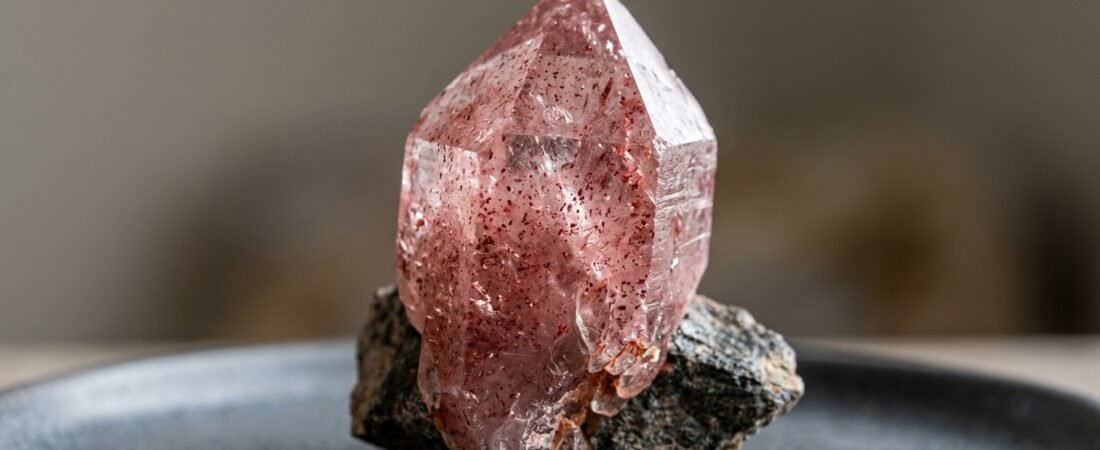
Few crystals capture the imagination quite like strawberry quartz. With its warm, rosy hue and luminous interior inclusions, this stone stands apart from the broader quartz family as something genuinely distinctive. Whether you are drawn to it for its aesthetic appeal, its reputed metaphysical properties, or simply its rarity, strawberry quartz has earned a dedicated following among crystal enthusiasts and spiritual practitioners alike. This guide explores everything you need to know about this captivating mineral — from its geological origins and physical characteristics to its symbolic meaning, healing traditions, and practical uses in everyday crystal work.
What Is Strawberry Quartz and Where Does It Come From?
The Geological Formation and Physical Characteristics of Strawberry Quartz
Strawberry quartz is a variety of silicon dioxide — the same foundational mineral compound that gives rise to the expansive quartz family. What distinguishes it from clear or common quartz is the presence of inclusions embedded within the crystal matrix. These inclusions, which typically consist of iron oxide, hematite, or goethite, create the stone’s signature reddish-pink to deep strawberry-red coloration. The effect ranges from translucent with delicate pink tones to a richer, more saturated hue depending on the concentration and type of mineral inclusions present.
On the Mohs hardness scale, strawberry quartz registers at approximately 7, making it a relatively durable stone suitable for a range of applications including jewelry, decorative carvings, and palm stones. Its luster is vitreous — glassy and reflective — which enhances its visual appeal considerably. The inclusions are often distributed unevenly, which means no two specimens are identical. Some pieces display fine, thread-like patterns of color, while others show broader, more diffuse blushes of pink and red throughout the crystal body.
It is worth noting that the term “strawberry quartz” is occasionally applied loosely in the commercial gem trade. Some stones sold under this name are actually synthetic glass or lab-created materials with added dye or inclusions. Genuine strawberry quartz — naturally formed with authentic mineral inclusions — tends to display a more nuanced, irregular color distribution, which distinguishes it from artificially enhanced imitations. Purchasing from reputable dealers and requesting provenance information when possible is always advisable.
Major Mining Locations and Natural Sources Around the World
Natural strawberry quartz deposits are relatively uncommon, which contributes to both the stone’s appeal and its occasionally elevated price point. The most significant and well-documented sources are found in Kazakhstan, particularly in the Khakassia region, where high-quality specimens with vivid coloration have been extracted for decades. Russian localities have also produced notable examples of this stone.
Beyond Central Asia, strawberry quartz has been sourced from parts of Mexico, where deposits yield stones with varied saturation levels. Brazil — a global powerhouse for quartz production in general — contributes some specimens as well, though they tend to differ in their inclusion patterns compared to Kazakhstani material. Smaller deposits exist in the United States and parts of Africa, though production from these regions is less consistent.
The geological conditions required to produce strawberry quartz — specifically, the simultaneous presence of silica-rich hydrothermal fluids and iron-bearing minerals during crystal formation — are relatively specific, which explains the stone’s limited geographic distribution. This geological selectivity means that fine-quality, naturally occurring strawberry quartz remains something of a specialty material in the mineral and gem world.
Strawberry Quartz Meaning and Spiritual Significance
Symbolic Meaning and Metaphysical Associations
Within metaphysical traditions, the strawberry quartz meaning is deeply rooted in themes of love, emotional awareness, and energetic amplification. The stone is broadly understood as a carrier of heart-centered energy — a crystal that encourages openness, self-appreciation, and a greater sense of connection to others. Many practitioners associate it with the concept of universal love, the idea that genuine compassion extends beyond personal relationships to encompass a broader empathy for the human experience.
The stone is also linked symbolically to gratitude and the recognition of abundance in daily life. In various crystal healing traditions, it is believed to help its user tune in to the subtler blessings that often go unnoticed — beauty in the ordinary, warmth in routine relationships, and meaning in seemingly small moments. This symbolic resonance with gratitude makes it a popular choice for meditation practices focused on cultivating a more appreciative and present mindset.
Historically, quartz crystals in general have held significant cultural importance across numerous civilizations, from ancient Egypt and Rome to indigenous cultures in the Americas. While strawberry quartz as a named stone is a more contemporary classification, the broader tradition of using pink and red stones to represent love, vitality, and the heart is ancient and cross-cultural. This positions strawberry quartz within a rich lineage of heart-centered gemstone symbolism.
Those interested in exploring the metaphysical dimensions of other quartz varieties may find it useful to read about rutilated quartz, another inclusion-rich crystal with its own distinct symbolic associations and energetic profile.
How Strawberry Quartz Connects to Love, Energy, and Emotional Healing
Among the spiritual properties most consistently attributed to strawberry quartz is its believed capacity to amplify feelings of love and emotional warmth. Practitioners frequently describe it as a stone that radiates a gentle, nurturing frequency — one that does not overwhelm but rather steadies and reassures. It is considered particularly helpful for individuals working through emotional wounds related to self-worth, past relationships, or difficulty giving and receiving affection.
The stone is also associated with energetic vitality. Unlike the sedating qualities attributed to some crystals, strawberry quartz is often described as subtly invigorating — capable of lifting the spirits and encouraging a more positive emotional orientation. This dual quality, nurturing and energizing, is one of the reasons it resonates with such a wide range of practitioners, from those drawn to gentle healing work to those seeking a crystal ally for motivation and joyful engagement with life.
In the context of relationships, the strawberry quartz spiritual meaning extends to fostering better communication, deeper empathy, and a willingness to be emotionally vulnerable. It is sometimes recommended for those navigating transitions in romantic or familial relationships, as it is believed to create an inner atmosphere of openness rather than defensiveness.
Healing Properties and Benefits of Strawberry Quartz
Physical and Emotional Healing Benefits
The healing benefits associated with strawberry quartz span both the physical and emotional dimensions, though it bears emphasis that these are traditional beliefs held within crystal healing communities and are not supported by clinical or scientific evidence. They should never be used as a substitute for professional medical advice or treatment.
On the emotional level, strawberry quartz healing benefits are most frequently connected to stress reduction, emotional balance, and the release of anxiety. Practitioners suggest that working with this stone — whether through meditation, carrying it as a touchstone, or placing it in a living environment — may help ease emotional tension and promote a calmer inner state. For those prone to overthinking or emotional reactivity, the stone is said to encourage a more grounded and centered response to life’s challenges.
The stone is also believed, within these traditions, to support emotional healing in cases of grief, heartbreak, or prolonged stress. It is not considered a stone of immediate, dramatic transformation but rather one of gradual, sustained support — helping its user build emotional resilience over time. This quality makes it particularly well-suited to longer-term healing intentions.
On a physical level, some crystal healing practitioners associate strawberry quartz with the circulatory system and the heart, given its color and energetic associations. It is sometimes included in healing layouts intended to promote vitality and general well-being. Again, these associations belong firmly within the realm of belief and tradition, not medical fact.
Chakra Alignment and Energy Work With Strawberry Quartz
In chakra-based energy work, strawberry quartz is most closely associated with the Heart Chakra, known in Sanskrit as Anahata. This energy center, located at the center of the chest, is considered the seat of love, compassion, forgiveness, and emotional integration in many Eastern and New Age spiritual traditions. Crystals with pink and green hues are traditionally linked to this chakra, and strawberry quartz — with its warm rose tones — is thought to gently stimulate and balance its energy.
When the Heart Chakra is considered to be blocked or imbalanced, practitioners may experience this as emotional guardedness, difficulty trusting others, or a sense of disconnection from joy and warmth. Strawberry quartz is believed to soften these blockages, creating greater energetic flow through the heart center and enabling a more open, loving engagement with oneself and with others.
Some practitioners also work with strawberry quartz in relation to the Root Chakra, given the presence of iron oxide inclusions, which carry grounding energetic associations. This dual connection — grounding through the root while opening through the heart — is considered one of the stone’s more nuanced qualities in energy work. It is said to help the practitioner feel both emotionally available and safely anchored.
For those exploring the wider world of quartz and chakra work, blue quartz offers a contrasting energetic profile, traditionally associated with the Throat Chakra and communication rather than the heart.
How to Use and Care for Strawberry Quartz
Ways to Incorporate Strawberry Quartz Into Daily Life and Crystal Practices
One of the more appealing aspects of strawberry quartz as a crystal ally is the versatility with which it can be incorporated into daily life. There is no single correct approach; rather, practitioners tend to adapt their use of the stone to suit their personal intentions and lifestyle.
Common approaches include:
- Wearing it as jewelry: Strawberry quartz is frequently fashioned into pendants, rings, earrings, and bracelets. Wearing it close to the skin — particularly near the chest as a pendant — is believed to keep its heart-centered energy in continuous contact with the body’s energetic field throughout the day.
- Meditation: Holding a polished strawberry quartz palm stone or sphere during meditation is a widely practiced technique. Many practitioners set an intention focused on love, gratitude, or emotional healing before beginning, allowing the stone to serve as a focal anchor for the practice.
- Crystal grids: Strawberry quartz can be incorporated into crystal grids designed for love, emotional healing, or relationship harmony. It pairs well with rose quartz, rhodonite, and green aventurine in heart-centered grid configurations.
- Home placement: Placing a strawberry quartz specimen in a bedroom, living room, or workspace is thought to infuse the environment with warm, loving energy. Many practitioners position it in relationship corners of the home according to feng shui principles.
- Journaling companion: Some practitioners keep a piece of strawberry quartz nearby during reflective writing or emotional processing work, using its presence as a prompt for exploring feelings of gratitude, love, and self-compassion.
Those who work with multiple quartz varieties in their practice may also find it worthwhile to explore tourmalinated quartz, which carries a very different energetic quality and is often used in complementary ways within crystal healing work.
Cleansing, Charging, and Storing Your Strawberry Quartz Properly
Caring for strawberry quartz properly ensures that it remains both physically beautiful and — for those who work with it energetically — vibrationally clear. Crystal practitioners generally recommend regular cleansing to clear accumulated energies and restore the stone’s natural resonance.
There are several effective methods for cleansing strawberry quartz. Smudging with white sage, palo santo, or other cleansing herbs is a gentle and popular option that does not risk damaging the stone. Sound cleansing — using singing bowls, bells, or tuning forks — is another safe method that requires no physical contact with water or salt.
If you choose to cleanse strawberry quartz with water, brief rinsing under cool running water is generally considered acceptable. However, prolonged submersion should be avoided, as extended water exposure can gradually affect the mineral inclusions within the stone. Saltwater in particular carries a risk of damaging or dulling the surface over time, so dry salt or a salt bed should be used with caution and only briefly if at all.
For charging — the practice of restoring or amplifying the stone’s energetic qualities — moonlight is one of the most widely recommended methods, particularly during a full moon. Placing the stone on a windowsill or outdoors overnight allows it to absorb lunar energy gently and safely. Brief sunlight exposure can also be used, though extended periods in direct sunlight may gradually fade the stone’s color due to its iron-based inclusions, so morning light for short durations is preferable.
When it comes to storage, keep strawberry quartz away from harder minerals that could scratch its surface. A soft cloth pouch or a lined compartment in a crystal storage box works well. Storing it separately from stones like topaz or diamonds — which are harder on the Mohs scale — prevents unnecessary abrasion and preserves the stone’s polish and luster over time.
Conclusion
Strawberry quartz occupies a genuinely distinctive place within both the mineral world and the broader landscape of crystal healing traditions. Its natural beauty — the result of iron-rich inclusions creating warm, rosy coloration within a vitreous quartz matrix — makes it visually compelling, while its metaphysical associations with love, emotional healing, and heart-centered energy have secured it a loyal following among practitioners of all experience levels.
Whether you are drawn to strawberry quartz for its rarity as a geological specimen, its aesthetic qualities in jewelry, or its reputed capacity to support emotional well-being and spiritual growth, it rewards attentive engagement. Understanding where it comes from, what traditions inform its meaning, and how to use and care for it responsibly allows you to develop a more intentional and informed relationship with this remarkable stone. Whatever your purpose, strawberry quartz brings warmth, depth, and a quiet vitality that few crystals can quite replicate.
About the Author
Didier Lancelot is an independent author and creator of the Everyday AI Series, with books on wellbeing, natural living, cooking and practical technology. Explore all his books on his Amazon Author page or visit Narmer Store.