
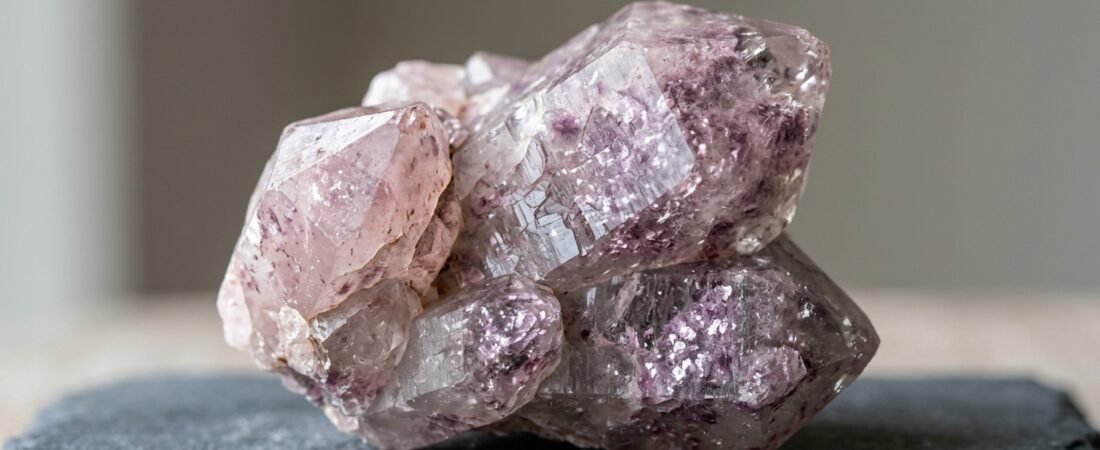
Few crystals capture the imagination quite like Lithium Quartz. With its soft lavender-pink phantom inclusions and its reputation as one of the gentlest yet most powerful stones in the crystal kingdom, it has earned a devoted following among healers, collectors, and meditators alike. Unlike many minerals that demand attention through bold color or dramatic formation, Lithium Quartz works quietly, its energy described by practitioners as deeply calming and profoundly restorative.
This guide explores everything worth knowing about Lithium Quartz — from its geological origins and distinguishing features to its metaphysical traditions, practical healing applications, and essential care instructions. Whether you are encountering this crystal for the first time or deepening an existing relationship with it, the following pages offer a thorough and grounded resource.
What Is Lithium Quartz and How to Identify It
Lithium Quartz is a variety of clear quartz that contains natural inclusions of lithium-bearing minerals, most commonly lepidolite, lilite, or other lithium-rich phyllosilicates. These inclusions give the stone its characteristic soft coloration and are responsible for the metaphysical properties attributed to it. Deposits have been found in Brazil, particularly in Minas Gerais, as well as in parts of the United States and Madagascar.
Physical Characteristics and Geological Formation
At first glance, Lithium Quartz may resemble a faintly tinted or phantomed clear quartz. Its base is typically transparent to translucent, and the lithium mineral inclusions manifest as wispy clouds, layered phantoms, or soft zones of lavender, pinkish-purple, or pale gray nestled within the crystal’s interior. The overall appearance is often ethereal — as though something was captured mid-growth inside the stone.
Geologically, these crystals form in pegmatite environments where silica-rich fluids interact with lithium-bearing mineral deposits. As the quartz grows, it periodically encapsulates surrounding minerals within its structure, creating the phantom or inclusion layers that distinguish this variety. The result is a crystal that carries the chemical signature of lithium throughout its body, not merely as a surface coating or treatment.
Hardness measures 7 on the Mohs scale, consistent with other quartz varieties. Crystals typically form in the hexagonal system and may appear as single points, clusters, or tumbled stones depending on how they were extracted and processed. The internal inclusions are the most reliable identifier; they should appear naturally embedded and distributed rather than painted on or artificially introduced.
Lithium Quartz vs. Other Quartz Varieties
Because the quartz family is remarkably diverse, distinguishing Lithium Quartz from similar varieties requires attention to detail. Several related stones share a lavender or purple palette, making comparison essential for buyers and collectors.
Amethyst, arguably the most recognized purple quartz, derives its color from iron impurities and irradiation rather than lithium inclusions. Amethyst tends to exhibit a more uniform, saturated violet hue, whereas Lithium Quartz presents a softer, more muted and often uneven distribution of color concentrated in phantom-like zones. When compared side by side, the difference in tone and internal structure becomes evident. The inclusions in Lithium Quartz give it a three-dimensional, layered appearance that polished Amethyst simply does not replicate.
Ametrine, a natural combination of Amethyst and Citrine, displays a bicolor effect with distinct yellow and purple zones — quite different from the subtle, diffuse lavender clouds within Lithium Quartz. Similarly, Rutilated Quartz contains needle-like inclusions of rutile minerals that appear as golden, silver, or copper threads, creating a visual signature entirely unlike the soft, mineral-cloud inclusions of lithium varieties.
Rose Quartz shares a gentle pink palette but is typically opaque to translucent without defined internal phantoms, and it owes its color to trace amounts of titanium, iron, or manganese rather than lithium minerals. Understanding these distinctions helps buyers make informed decisions and ensures they are acquiring an authentic natural Lithium Quartz stone rather than a substitute or mislabeled piece.
Lithium Quartz Meaning and Spiritual Significance
Within crystal healing traditions, Lithium Quartz holds a revered position as a stone of peace, emotional balance, and spiritual connection. Its meaning is closely tied to the calming nature of lithium as an element — long associated in various cultural and therapeutic contexts with mood stabilization — though it bears clarification that the metaphysical beliefs surrounding this crystal are part of a spiritual tradition and do not reflect clinical medical treatment.
Emotional Healing and Chakra Connections
Practitioners of crystal healing traditions have long associated Lithium Quartz with profound emotional support. It is said to carry a vibration that soothes anxiety, dissolves emotional tension, and creates an inner environment conducive to healing old wounds. Many who work with this stone describe a sensation of immediate calm upon holding it — a quality that has made it a preferred tool for those navigating grief, stress, or emotional turbulence.
In terms of chakra alignment, Lithium Quartz is primarily associated with the Heart Chakra and the Third Eye Chakra, with some practitioners also connecting it to the Crown Chakra. Its soft lavender-pink energy is believed to bridge the heart’s emotional intelligence with the higher mind’s spiritual awareness, creating a coherent flow between feeling and intuition. This dual chakra resonance is considered particularly valuable for individuals working through deeply held emotional patterns that have their roots in unconscious belief systems.
The Heart Chakra connection supports self-compassion, forgiveness, and the capacity to receive love without resistance. The Third Eye and Crown associations are said to enhance meditative depth, psychic sensitivity, and connection to higher guidance. Together, these energetic qualities make Lithium Quartz a versatile companion for both emotional processing and spiritual development.
Metaphysical Properties and Vibrational Energy
Among the metaphysical properties most frequently attributed to Lithium Quartz is its capacity to access and release deeply stored emotional memories. Crystal healing traditions suggest that traumas and unresolved emotions can become energetically lodged within the body and subtle energy field, and that certain stones can assist in bringing these to the surface gently and safely. Lithium Quartz is considered particularly adept at this work, partly because its energy is described as non-forceful — it is said to coax rather than push.
Its vibrational quality is often described as high but smooth, without the intensity that some practitioners associate with stones like Moldavite or high-grade Phenacite. This makes it accessible even to those who are sensitive to strong crystal energies or who are new to energy work. The quartz base amplifies and transmits the lithium mineral energy throughout the crystal’s structure, extending its influence into the surrounding energetic field of the person working with it.
Additionally, Lithium Quartz is regarded in some traditions as a stone of spiritual activation, said to stimulate dormant psychic abilities, enhance dream recall, and support communication with guides or higher aspects of the self. It is also associated with bringing light into shadow — a metaphorical quality describing its perceived ability to make unconscious material conscious in a way that feels manageable rather than overwhelming.
How to Use Lithium Quartz for Healing and Meditation
The practical applications of Lithium Quartz are as varied as the individuals who work with it. From structured meditation sessions to simple daily rituals, the crystal lends itself to integration in numerous meaningful ways.
Crystal Healing Practices and Rituals
One of the most straightforward ways to work with Lithium Quartz is through direct contact. Holding a tumbled stone or crystal point in the hand during moments of stress or emotional difficulty is a common practice. Many crystal workers recommend placing a piece over the heart center while lying down to facilitate emotional release and relaxation. This position is particularly effective during intentional relaxation sessions or breathwork practices.
Meditation with Lithium Quartz is consistently highlighted as one of its most powerful applications. Holding the stone during a seated meditation or placing it at the brow or crown is believed to deepen the meditative state and enhance receptivity to subtle inner guidance. Practitioners often report that sessions with Lithium Quartz feel notably quieter and more inward than those conducted without it — a quality attributed to its calming vibrational signature.
Sleep and dream work represent another valuable area of application. Placing a piece of Lithium Quartz beneath the pillow or on a bedside surface before sleep is a tradition associated with promoting peaceful rest, reducing anxiety-related insomnia, and improving dream recall. Those who keep dream journals may find this practice particularly rewarding.
For those drawn to affirmation or intention-setting work, Lithium Quartz serves as an excellent focal point. After cleansing the stone, holding it while speaking or silently affirming a healing intention is believed to imprint that intention within the crystal’s energetic field, which then continues to broadcast the energy throughout the day. This is one aspect of working with crystals that connects to broader traditions of sympathetic resonance and intentional focus.
Combining Lithium Quartz With Other Crystals
Lithium Quartz pairs harmoniously with a wide range of other crystals, making it a versatile addition to any collection. Its gentle, high-frequency energy integrates well with both grounding stones and high-vibration minerals without creating dissonance.
For emotional healing work, combining Lithium Quartz with Rose Quartz creates a particularly tender and heart-centered energy field. The nurturing warmth of Rose Quartz complements the depth of emotional release facilitated by Lithium Quartz, making this pairing a popular choice for grief work or self-compassion practices.
For enhanced meditation and psychic development, pairing Lithium Quartz with Amethyst or Labradorite is widely recommended. Amethyst brings focused spiritual clarity, while Labradorite enhances intuitive perception and magical awareness. Together with Lithium Quartz, these stones create a layered energetic environment suited to deep inner exploration.
Grounding stones such as Black Tourmaline or Smoky Quartz make excellent counterbalances when working with Lithium Quartz in extended sessions. Because Lithium Quartz can encourage deep introspection and emotional opening, a grounding anchor helps ensure that the experience remains centered and integrated rather than unmooring. This combination reflects a foundational principle in crystal healing: pairing stones that open and elevate with those that anchor and stabilize.
Those interested in exploring complementary quartz varieties might also consider Blue Quartz, which shares a calming quality and is associated with clear communication and emotional expression — energies that align naturally with Lithium Quartz’s heart-and-mind bridging properties.
How to Choose, Cleanse, and Care for Lithium Quartz
Owning a genuine, high-quality piece of Lithium Quartz requires both discernment in purchasing and attentiveness in ongoing care. The following guidance helps ensure that your stone is authentic and that it continues to function at its best energetically over time.
Tips for Buying Authentic Lithium Quartz
The market for crystals is vast and unfortunately not without its share of misidentified or artificially treated stones. When purchasing Lithium Quartz, several factors deserve close attention.
- Source transparency: Reputable sellers should be able to identify the origin of their stones. Brazilian Lithium Quartz from Minas Gerais is among the most commonly available and is widely regarded as high quality. Ask about provenance when possible.
- Internal inclusions: Authentic pieces display natural phantom inclusions or mineral clouds embedded within the quartz structure. These should appear three-dimensional and irregular, not painted, dyed, or applied to the surface.
- Color distribution: The lavender-pink or gray-purple coloring in genuine Lithium Quartz appears concentrated in inclusion zones rather than evenly distributed throughout a uniformly colored body. Suspiciously uniform color in a stone sold as Lithium Quartz may indicate misidentification or treatment.
- Hardness and feel: As a quartz variety, the stone should feel cool and smooth with no surface scratches, which would be inconsistent with its hardness rating. It should not feel light or plastic-like, which might suggest synthetic imitation.
- Seller reputation: Purchasing from established crystal vendors, gem shows, or specialty retailers with clear return policies and knowledgeable staff significantly reduces the risk of acquiring a misidentified stone.
Trust your instincts as well. When handling multiple pieces, many crystal enthusiasts report a distinct pull toward particular stones. While this is subjective, it speaks to the tradition of allowing personal resonance to guide selection — a practice that holds particular meaning when choosing a stone associated with emotional and intuitive development.
Cleansing and Charging Methods for Optimal Energy
Like all crystals used in healing and meditative work, Lithium Quartz benefits from regular cleansing and recharging. The intention behind this practice is to clear any accumulated energetic residue and restore the stone’s natural vibrational clarity. Several methods are well-suited to this mineral, with some important caveats.
Moonlight bathing is one of the most universally recommended methods for Lithium Quartz. Placing the stone on a windowsill or outdoors during a full moon allows it to absorb lunar energy overnight. This method is gentle, requires no special materials, and is considered highly effective for stones associated with emotional and intuitive work, given the traditional connection between the moon and these qualities.
Sound cleansing using singing bowls, tuning forks, or bells is another excellent option. Sound vibration permeates the crystal structure without any risk of damage and is considered capable of dislodging stagnant energy from within and around the stone. This method is particularly practical for large collections or delicate specimens that might be vulnerable to other cleansing approaches.
Selenite charging plates or bowls offer a convenient passive cleansing option. Placing Lithium Quartz on or beside a piece of Selenite is believed to continuously clear and recharge it, making this a popular low-maintenance practice for regular crystal users.
Smoke cleansing — using the smoke from sacred herbs such as white sage, palo santo, or cedar — is a traditional method with roots in Indigenous and shamanic practices. Passing the crystal through the smoke with clear intention is considered an effective way to reset its energy, particularly after intensive healing work.
A word of caution: water cleansing requires careful consideration. While quartz itself is relatively water-resistant, the lithium mineral inclusions within the stone may be sensitive to prolonged water exposure. Brief rinsing in clean water is generally considered low-risk, but extended soaking or salt water immersion is best avoided to preserve the integrity of the inclusions and the stone’s surface. Salt in particular can be abrasive and may damage softer mineral inclusions over time.
To charge Lithium Quartz after cleansing, placing it in gentle morning sunlight for a short period — no more than an hour — can restore its energy. Prolonged direct sunlight should be avoided, as it can gradually fade the delicate coloration of the inclusions. Alternatively, visualization practices, where the practitioner holds the stone and consciously directs positive, clear intention into it, are considered a powerful and immediate charging method that requires no external tools.
Conclusion
Lithium Quartz stands apart in the mineral kingdom not through dramatic display, but through quiet depth. Its soft, inclusion-rich interior carries a history written in geological time, and its long-standing role in crystal healing traditions speaks to the enduring human search for tools that support emotional balance and spiritual growth. Whether you are drawn to it for its visual beauty, its calming energetic reputation, or its versatility in meditation and healing work, this crystal rewards both curiosity and commitment.
Understanding its physical characteristics ensures you can identify and purchase authentic specimens with confidence. Engaging with its metaphysical traditions thoughtfully — as practices rooted in belief and personal experience rather than clinical fact — allows for a meaningful and responsible relationship with the stone. And caring for it properly ensures that whatever significance it holds for you can endure over time.
Lithium Quartz is, above all, an invitation to slow down, look inward, and approach the self with the same gentleness the stone itself is said to embody. For those ready to accept that invitation, it proves a remarkably steadfast companion.
About the Author
Didier Lancelot is an independent author and creator of the Everyday AI Series, with books on wellbeing, natural living, cooking and practical technology. Explore all his books on his Amazon Author page or visit Narmer Store.