
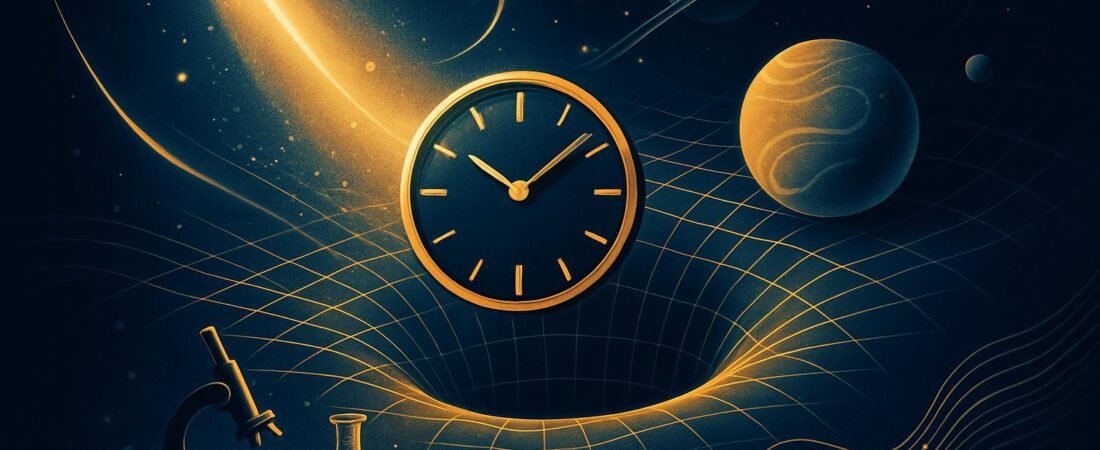
Picture placing a bowling ball on a trampoline. The fabric sags under the ball, and a rolling marble curves around it instead of moving in a straight line. General relativity says gravity works in a similar way: massive objects bend the “fabric” of the universe itself, changing not only how things move, but how time flows.
That idea, proposed by Albert Einstein in 1915, completely reshaped our understanding of space, time, and gravity. It also quietly guides the GPS in your phone, steers spacecraft across the Solar System, and helps astronomers study black holes at the center of galaxies.
From Falling Apples to Bending Spacetime
To appreciate general relativity, it helps to start with the older view of gravity. In the late 1600s, Isaac Newton described gravity as an invisible force pulling objects together. His laws worked extremely well to predict the motion of planets, falling apples, and much more. You can read a simple overview in this article on the history of Newton’s laws of motion.
In Newton’s picture, space and time are like a fixed stage. Objects move on this stage, pulled by forces, but the stage itself never changes. Time ticks the same everywhere, like a perfectly synchronized universal clock.
By the early 1900s, however, cracks began to appear in this neat picture. Einstein’s work on special relativity in 1905 showed that space and time are linked in a single fabric called “spacetime,” and that measurements of time depend on how fast you are moving. There is no single universal clock; moving clocks tick differently.
But there was a problem: special relativity worked beautifully for objects moving at constant speeds in straight lines, but it did not include gravity. Einstein spent about a decade trying to fit gravity into this new spacetime picture. The result was general relativity, announced in 1915: a theory where gravity is not a force, but the bending of spacetime itself.
Spacetime: The Fabric of the Universe
“Spacetime” sounds abstract, but the idea is simple: instead of thinking of space (three dimensions) and time (one dimension) separately, we think of them together as a four-dimensional structure. Where and when you are are tied together.
Here is the key idea of general relativity:
- Mass and energy tell spacetime how to curve.
- Curved spacetime tells matter and light how to move.
Return to the trampoline analogy. The trampoline fabric represents spacetime. The bowling ball represents a planet or star. The sag in the fabric is the curvature of spacetime. When you roll a marble nearby, it follows the curved surface and its path bends inward. It is not being pulled by a mysterious force; it is simply following the curved shape beneath it.
In the real universe, objects move along the straightest possible paths in curved spacetime, called “geodesics.” Near massive objects, these straightest paths are bent. To us, that bending shows up as gravity. This was a radical shift: gravity is geometry.
In this new view, time is also part of the fabric being warped. The presence of mass stretches not only space, but also time. Clocks near massive objects tick more slowly than clocks far away. This effect is called gravitational time dilation—“dilation” meaning stretching or slowing down.
How Gravity Slows Time: Gravitational Time Dilation
Imagine you have two identical clocks. One is placed on the ground, closer to Earth’s center, where gravity is stronger. The other is placed on top of a tall mountain or in an orbiting satellite, where gravity is slightly weaker. According to general relativity, the clock closer to the stronger gravity will tick more slowly.
In everyday life, the difference is tiny—fractions of a second over many years. But it is real and has been measured repeatedly with very precise atomic clocks. The lower clock “loses” time compared with the higher one.
Why does this happen? In simple terms, mass bends the flow of time. Near a massive object, the “time axis” of spacetime is stretched out. An observer far from the mass, where spacetime is less curved, will see processes near the mass running in slow motion. Light climbing out of a gravity well loses energy and is “redshifted” (its wavelength stretches), which is another sign that time is passing differently.
This effect becomes extreme near very dense objects like neutron stars and black holes. Near a black hole’s event horizon—the boundary beyond which not even light can escape—time for a falling astronaut, as seen by a distant observer, appears to slow to a crawl. In theory, if you watched your friend approach the horizon (from far away and safely), their clock would appear to almost stop.
Einstein’s prediction that gravity affects time was not just philosophical. It led to concrete tests, such as measuring how the frequency of light changes in strong gravity or how quickly atomic clocks tick at different altitudes. These experiments consistently support general relativity.
The First Proofs: Light, Eclipses, and a New View of the Universe
Einstein’s theory made bold predictions that differed from Newton’s. One of the most dramatic was that light itself should follow curved paths near massive objects, because spacetime is curved. That means starlight passing close to the Sun should be bent slightly, changing the apparent position of the star in the sky.
In 1919, during a total solar eclipse, British astronomer Arthur Eddington led an expedition to measure this effect. With the Sun’s light blocked by the Moon, stars near the Sun’s edge became visible. Photographs taken during the eclipse showed that the positions of these stars shifted by exactly the amount general relativity predicted. This result, widely reported at the time, turned Einstein into a global scientific celebrity.
General relativity also explained subtle discrepancies in the motion of Mercury, the planet closest to the Sun. Its orbit slowly rotates over time in a way that Newton’s laws could not fully account for. The extra shift matched Einstein’s equations.
Over the following decades, more tests accumulated: gravitational redshift (light changing frequency in a gravity field), time dilation measured by clocks in airplanes and satellites, and, more recently, the direct detection of gravitational waves—ripples in spacetime produced by colliding black holes. Each result has strengthened confidence in general relativity as our best current description of gravity.
For a broader comparison of Newton’s and Einstein’s views of gravity, you can read this guide on how gravity is explained by Newton and Einstein.
Everyday Technology that Depends on General Relativity
General relativity might sound like abstract theory, but it affects tools we use every day. The most familiar example is the Global Positioning System (GPS).
GPS satellites orbit Earth at high altitude, where gravity is slightly weaker and they are moving quickly. Two relativity effects matter:
- Special relativity: Moving clocks run a bit slow compared with clocks on Earth’s surface.
- General relativity: Clocks farther from Earth’s mass (in weaker gravity) run a bit fast compared with ground clocks.
These two effects do not cancel each other. Overall, the satellite clocks tick slightly faster than identical clocks on the ground. The difference is about tens of microseconds (millionths of a second) per day. That sounds small, but GPS needs timing accuracy better than a billionth of a second. If engineers ignored relativity, GPS position errors would grow by kilometers each day.
Instead, the system is designed with relativity built in. Satellite clock rates are adjusted so that, as seen from Earth, they keep time correctly. Your smartphone’s navigation depends on Einstein’s insights about how gravity bends time.
General relativity also shapes technologies and science in less obvious ways:
- Space travel: Mission planners use relativistic corrections when navigating spacecraft in strong gravity fields, such as near Jupiter or the Sun.
- Astronomy: Telescopes use predictions from general relativity to interpret signals from pulsars, black holes, and distant galaxies, including effects like gravitational lensing (mass bending light from objects behind it).
- Advanced communications: Precise timekeeping and synchronization for networks and scientific experiments often need small relativistic corrections.
All of this connects back to Einstein’s famous equation, E = mc², which links mass and energy. In general relativity, energy (in all its forms) contributes to the curvature of spacetime, not just ordinary mass.
What We Still Do Not Know
Despite its success, general relativity is not the final word on gravity. It works beautifully on large scales—from planets to galaxies—but it does not yet mesh smoothly with quantum mechanics, the theory that governs atoms and smaller particles.
Physicists are still searching for a deeper framework, often called “quantum gravity,” that would unify these two pillars of modern physics. There are many ideas, such as string theory and loop quantum gravity, but none are yet confirmed by experiment.
There are also open questions in cosmology, such as the nature of dark matter and dark energy—mysterious components that seem to dominate the universe’s mass and energy budget. General relativity provides the equations that describe how the universe expands and how large-scale structures form, but the true identity of these dark components remains uncertain.
Conclusion: A Universe Where Time Is Flexible
General relativity replaces the picture of gravity as an invisible force with a richer, stranger reality: mass and energy bend the fabric of spacetime, altering the paths of planets, light beams, and even the flow of time itself. Clocks run at different rates depending on where they are in a gravity field. Near massive objects, time literally slows down.
The key takeaway is that time is not absolute. It is woven together with space into a flexible fabric shaped by matter and energy. What began as a daring idea in Einstein’s notebooks now guides satellites, informs astronomy, and deepens our understanding of the cosmos. Every time your phone finds your location or astronomers map a distant black hole, they are quietly relying on the fact that gravity bends time.
About the Author
Didier Lancelot is an independent author and creator of the Everyday AI Series, with books that explain technology, science and personal growth in plain language. Explore all his books on his Amazon Author page or visit Narmer Store.