
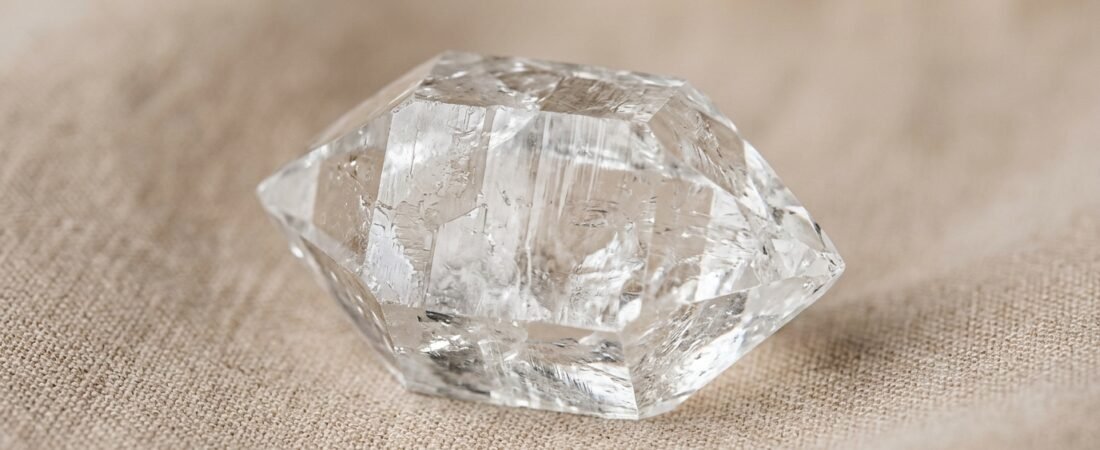
Few natural crystals capture the imagination quite like the Herkimer Diamond. With its striking clarity, naturally faceted double-terminated form, and extraordinary energetic reputation, this remarkable quartz variety has fascinated geologists, collectors, and crystal enthusiasts for centuries. Despite sharing a name with the world’s most prized gemstone, the Herkimer Diamond is entirely its own phenomenon — a geological marvel born from an ancient sea and shaped over hundreds of millions of years into something that looks almost too perfect to be the work of nature alone.
Whether you are drawn to its visual brilliance, its reputed metaphysical properties, or simply the desire to understand what makes it so distinctive, this guide covers everything you need to know. From its origins deep within New York’s dolostone formations to its place in crystal healing traditions, jewelry design, and daily spiritual practice, the Herkimer Diamond deserves a thorough and thoughtful exploration.
What Is a Herkimer Diamond and Why Is It So Special?
The Herkimer Diamond is a variety of double-terminated quartz crystal found primarily in and around Herkimer County, New York. It is renowned for its exceptional clarity, natural geometric perfection, and the distinctive eighteen-faceted, two-pointed form it develops without any human cutting or polishing. To the untrained eye, a high-quality specimen can be mistaken for a faceted gemstone — which is precisely where its evocative name originates.
What sets this crystal apart from most other quartz varieties is the rarity of its natural double termination. Most quartz crystals grow attached to a matrix and develop only one pointed end. Herkimer Diamonds form freely within pockets of host rock, allowing both ends to develop simultaneously into sharp, naturally symmetrical points. The result is a self-contained, geometrically striking crystal that requires no intervention to achieve its final form.
The Geological Origins and Formation Process
Herkimer Diamonds were formed approximately 500 million years ago during the Cambrian period, within sedimentary dolostone deposits known as the Dolostone of the Little Falls Formation. At that time, the region now known as upstate New York was covered by a shallow, mineral-rich sea. As organic matter and saline fluids became trapped within cavities in the accumulating sediment, the chemical conditions became ideal for silica crystallization.
Over vast stretches of geological time, silica-rich solutions slowly migrated into these voids and pockets, depositing layer upon layer of quartz in an environment of minimal disturbance. Because the crystals grew freely within fluid-filled cavities rather than adhering to a host surface, they developed their signature double termination. The surrounding dolostone acted as a natural mold, while the internal chemistry of the solution determined the crystal’s extraordinary transparency.
Many specimens also contain inclusions — most notably anthraxolite (a solid hydrocarbon), fluid inclusions, and occasionally enhydro bubbles containing ancient water that has been sealed within the crystal for hundreds of millions of years. These inclusions are not flaws but rather records of the environment in which the crystal formed, adding both scientific interest and visual character to individual specimens.
While Herkimer County, New York, remains the most celebrated and prolific source, similar double-terminated quartz crystals have been found in Afghanistan, China, Mexico, and other locations. However, gemologists and collectors generally reserve the term “Herkimer Diamond” for crystals originating from the New York deposits, treating other localities as distinct varieties.
How Herkimer Diamonds Differ From Real Diamonds
Despite the shared name, Herkimer Diamonds and genuine diamonds are fundamentally different minerals. True diamonds are composed of carbon atoms arranged in a cubic crystal structure and are the hardest known natural substance, rating 10 on the Mohs hardness scale. Herkimer Diamonds, by contrast, are silicon dioxide — the same mineral composition as ordinary quartz — and rate approximately 7.5 on the Mohs scale.
The resemblance that inspired the name is purely visual. A clear, high-quality Herkimer specimen has a brilliance and transparency that can rival cut gemstones, and its natural faceting gives it an appearance of having been shaped by a skilled lapidary. In reality, this form is entirely the product of geological processes. No cutting, grinding, or polishing is involved.
From a commercial standpoint, the difference is equally significant. While genuine diamonds command extraordinary prices based on the four Cs — cut, color, clarity, and carat weight — Herkimer Diamonds are priced according to size, clarity, the quality of terminations, and the presence or absence of inclusions. Fine specimens remain relatively accessible compared to gem-quality diamonds, though rare, large, and exceptionally clear examples can fetch substantial prices among serious collectors.
Understanding this distinction is important not only for accurate identification but also for appreciating the Herkimer Diamond on its own considerable merits, rather than measuring it against an entirely different mineral.
Herkimer Diamond Meaning, Properties, and Healing Benefits
Beyond its geological significance, the Herkimer Diamond holds a prominent place in crystal healing traditions and metaphysical practices. Its extraordinary clarity, natural symmetry, and double-terminated form have led many practitioners to regard it as one of the most energetically potent quartz varieties available. While these beliefs are rooted in tradition rather than scientific evidence, they form a rich and meaningful framework that continues to attract practitioners worldwide.
Spiritual and Metaphysical Properties of Herkimer Diamond
In crystal healing traditions, the Herkimer Diamond is widely regarded as a powerful amplifier of energy and intention. Its double termination is believed to allow energy to flow in both directions simultaneously — both transmitting and receiving — making it a favored tool for energy workers, healers, and meditators seeking a crystal that can both project and absorb energetic information.
It is commonly associated with the third eye and crown chakras, the energetic centers traditionally linked to intuition, higher consciousness, and spiritual connection. Practitioners believe that working with this crystal can enhance clarity of perception, sharpen intuitive abilities, and support access to elevated states of awareness. Some traditions describe it as a “stone of attunement,” capable of aligning the physical and subtle bodies and facilitating deeper resonance between an individual and their spiritual path.
The Herkimer Diamond is also associated with dream work and psychic development. Many practitioners place one near the bed or under the pillow with the intention of enhancing dream recall, supporting lucid dreaming, or receiving guidance through the dream state. Its connection to clarity extends, in this framework, beyond the physical plane into the symbolic and unconscious realms.
Within the broader landscape of quartz varieties used in spiritual practice — including Elestial Quartz, which is prized for its layered, multi-dimensional energy — the Herkimer Diamond is distinguished by its combination of purity and structural symmetry, which practitioners often describe as giving it an unusually refined and high-frequency vibration.
It is also frequently used in crystal grids, where its amplifying properties are believed to strengthen the overall energetic field created by a combination of stones. Placed at the center of a grid or at key nodal points, it is thought to intensify the intention held by the other crystals and extend the reach of the grid’s energetic influence.
Physical and Emotional Healing Properties
Within the tradition of crystal healing, the Herkimer Diamond is believed to support physical wellbeing in several ways, though it is essential to emphasize that these are experiential and traditional beliefs rather than medically substantiated claims. Crystal healing is understood as a complementary practice and should never replace professional medical care.
Practitioners have traditionally associated this crystal with the relief of tension and the promotion of energetic flow throughout the body. Some healers place Herkimer Diamonds on areas of the body that feel blocked or congested, with the intention of facilitating the release of stagnant energy. It is also associated with detoxification on an energetic level, and some traditions link it to supporting the metabolic and eliminative systems through its purported ability to stimulate energetic circulation.
On an emotional level, the Herkimer Diamond is often described as a stone of release and renewal. It is believed to assist in the process of letting go of old patterns, fears, and emotional residue that no longer serve the individual. The clarity it symbolizes physically is mirrored, in this tradition, by its reputed ability to bring emotional clarity — helping the individual to perceive their feelings with greater objectivity and to move forward with renewed purpose.
It is also frequently recommended for those navigating periods of transition or uncertainty. The stability of its crystalline structure, combined with its energetic associations with attunement and clarity, makes it a favored companion for those seeking grounding within expansion — a quality that resonates with practitioners who work with other high-vibration stones such as Spirit Quartz, which shares certain amplifying and community-resonance qualities.
How to Identify, Buy, and Care for Your Herkimer Diamond
Acquiring a genuine Herkimer Diamond requires a degree of informed discernment. The crystal market includes a range of look-alikes and mislabeled specimens, and understanding the defining characteristics of an authentic piece protects both your investment and the integrity of your collection or practice.
Key Characteristics to Spot an Authentic Herkimer Diamond
The most reliable way to identify a true Herkimer Diamond is through careful observation of its physical characteristics. The following features are hallmarks of authentic specimens:
- Double termination: Both ends of the crystal should come to a natural point. This is the defining structural feature of the Herkimer Diamond and the characteristic that most clearly distinguishes it from ordinary quartz points.
- Eighteen facets: A classic Herkimer Diamond displays six facets along the prismatic body and six facets at each termination, totaling eighteen in all. Not every specimen is textbook perfect, but this structure should be broadly evident.
- Exceptional clarity: While inclusions are common and even desirable in some specimens, high-quality Herkimers are known for their glassy, water-clear transparency. Cloudiness or excessive internal fracturing is atypical of fine examples.
- Natural surface texture: The exterior of a genuine specimen will display natural surface features — slight irregularities, growth lines, or record keeper markings — rather than the perfectly smooth surface of a cut and polished gemstone.
- Provenance: If provenance matters to you — particularly the distinction of a New York origin — purchasing from a reputable dealer who can confirm the source is advisable.
Be cautious of any crystal marketed as a Herkimer Diamond that shows signs of cutting, grinding, or artificial polishing on the terminations. Genuine specimens are sold in their natural state. Similarly, very large specimens offered at unusually low prices warrant scrutiny, as they may be misidentified crystals from other localities or synthetic quartz.
When buying in person, handle the crystal and examine it in strong natural light. When purchasing online, request multiple photographs showing all angles, including close-ups of the terminations and any inclusions. Reputable sellers will readily provide this information.
Cleaning, Storing, and Maintaining Your Crystal
Herkimer Diamonds are relatively durable, with a hardness of approximately 7.5 on the Mohs scale, but they still require mindful care to preserve their brilliance and structural integrity over time.
For routine cleaning, lukewarm water and a small amount of mild, chemical-free soap is entirely sufficient. Use a soft brush — a toothbrush with gentle bristles works well — to clean around the facets and terminations, where dust and oils tend to accumulate. Rinse thoroughly and allow the crystal to air dry, or pat it gently with a clean, lint-free cloth. Avoid ultrasonic cleaners, as the vibrations can propagate existing micro-fractures and damage specimens with fluid inclusions.
Energetic cleansing, as practiced in crystal traditions, can be performed in several ways. Placing the crystal in sunlight for brief periods, smudging with sacred herbs, or setting it on a selenite charging plate are all commonly used methods. Given that Herkimer Diamonds are associated with amplification, many practitioners cleanse them regularly, particularly after intense energy work or meditation sessions.
For storage, keep your Herkimer Diamond separate from harder minerals, particularly those that could scratch its surface, and away from materials it could itself scratch. A soft pouch or a lined compartment within a jewelry box is ideal. Avoid prolonged exposure to direct sunlight if the specimen contains fluid inclusions, as thermal expansion can, in rare cases, cause internal stress. Generally, a cool, stable environment is the safest place for long-term storage.
How to Use Herkimer Diamond in Everyday Life and Spiritual Practice
The Herkimer Diamond’s versatility is one of its most appealing qualities. It transitions naturally between the roles of aesthetic object, wearable adornment, and spiritual tool — adapting to the needs and intentions of those who work with it.
Incorporating Herkimer Diamond Into Meditation and Energy Work
Meditation is one of the most natural and effective contexts in which to work with a Herkimer Diamond. Given its traditional associations with clarity, attunement, and heightened awareness, many practitioners find that holding the crystal during seated meditation deepens their focus and accelerates the process of mental quieting.
A common approach is to hold a Herkimer Diamond in the non-dominant hand during meditation, with the intention of receiving and integrating energetic information, while using the dominant hand for any energy direction or projection work. Alternatively, placing the crystal on the forehead (at the third eye point) during a supine meditation is a widely used technique among those seeking to enhance intuition or access deeper states of inner vision.
For energy workers and healers, the Herkimer Diamond functions as both a tool and an amplifier within session work. Placing specimens at the head and feet of a client during a healing session is believed, in these traditions, to create a coherent energetic field that supports the overall effectiveness of the session. Its double-terminated form is specifically valued in this context, as it is thought to maintain a continuous circuit of energy rather than allowing it to pool or stagnate.
Those engaged in breathwork, visualization, or mantra practice may also benefit from incorporating a Herkimer Diamond into their routine. Simply having the crystal nearby — on an altar, within a crystal grid, or held loosely in the lap — is considered by many practitioners to elevate the quality and depth of any intentional practice. This quality of enhancement is shared, in different ways, with high-vibration varieties such as Lithium Quartz, which is similarly associated with deep meditative calm and emotional equilibrium.
Best Crystal Combinations and Jewelry Uses for Herkimer Diamond
The Herkimer Diamond pairs well with a wide range of other crystals, and understanding these combinations can help practitioners build more nuanced and effective crystal sets. Because of its amplifying properties, it tends to enhance the qualities of whatever stones it accompanies — making thoughtful selection particularly important.
For clarity and mental focus, combining the Herkimer Diamond with clear quartz or selenite creates a harmonious, high-clarity energetic environment. For emotional healing, pairing it with rose quartz or rhodonite softens its energy while maintaining its amplifying function. For grounding during elevated spiritual work — an important counterbalance when working with high-vibration crystals — black tourmaline or smoky quartz provides an effective anchor.
Those interested in dream work and psychic development often combine the Herkimer Diamond with amethyst or labradorite, seeking to deepen their access to intuitive states while maintaining the clarity that the Herkimer brings. In crystal grid work, placing a Herkimer at the center surrounded by stones chosen for a specific intention is considered one of the most effective ways to harness its amplifying capacity.
As a jewelry stone, the Herkimer Diamond is genuinely versatile. Its natural brilliance and geometric form make it an attractive choice for a wide range of settings, from delicate silver wirework that showcases its natural shape to bezel-set pendants and ring designs. Because it is a relatively hard stone, it holds up reasonably well in everyday jewelry, though care should be taken to avoid knocks against harder surfaces. Herkimer Diamond jewelry is prized both for its aesthetic appeal and for the energetic benefits that wearers attribute to keeping the stone in close contact with the body throughout the day.
Wire-wrapped pendants that preserve the crystal’s natural double-terminated form are among the most popular design choices, as they allow the full character of the stone — including any inclusions or natural markings — to remain visible. This transparency, both literal and figurative, is part of what makes Herkimer Diamond jewelry so enduringly appealing to those who value the connection between beauty and meaning.
Conclusion
The Herkimer Diamond is, in every sense, a crystal of extraordinary distinction. Formed over half a billion years in the sedimentary depths of ancient New York, it arrives in the hands of collectors and practitioners already perfectly shaped — a feat that no human craftsmanship could meaningfully improve upon. Its geological rarity, visual brilliance, and the rich tradition of metaphysical meaning that surrounds it make it one of the most compelling crystals in the natural world.
Whether you are drawn to it as a geological specimen, a healing tool, a meditation companion, or a wearable piece of jewelry, the Herkimer Diamond rewards attention and engagement. Understanding its origins, learning to identify authentic examples, and exploring the many ways it can be incorporated into daily life and spiritual practice allows you to appreciate it fully — not merely as an object of beauty, but as a bridge between the deep history of the earth and the living present of human experience.
About the Author
Didier Lancelot is an independent author and creator of the Everyday AI Series, with books on wellbeing, natural living, cooking and practical technology. Explore all his books on his Amazon Author page or visit Narmer Store.